
Series: Old Country Churches

Dawson County, GA
When you head out to someplace with no particular route in mind – just a bit of a plan to head up through the mountains and see if there is any chance you can catch some color with the leaves turning in the fall – you never know what you are going to find. We are always on the lookout for something new, and we usually do find something – something good.
That’s generally how we find old churches – just wandering around looking. And that’s how we found High Shoals Baptist Church a good ways up the mountain above Amicalola Falls in Dawson County, Georgia. We’d taken a detour off the main road to check out the State Park at the falls since I absolutely love waterfalls and have taken many a detour to see them. I’ve had many adventures looking for waterfalls and maybe just a few “un-adventures” too.
We’d stopped at the main part of the park, looked around, and then headed on up to check out the overlook of the falls. Very nice.
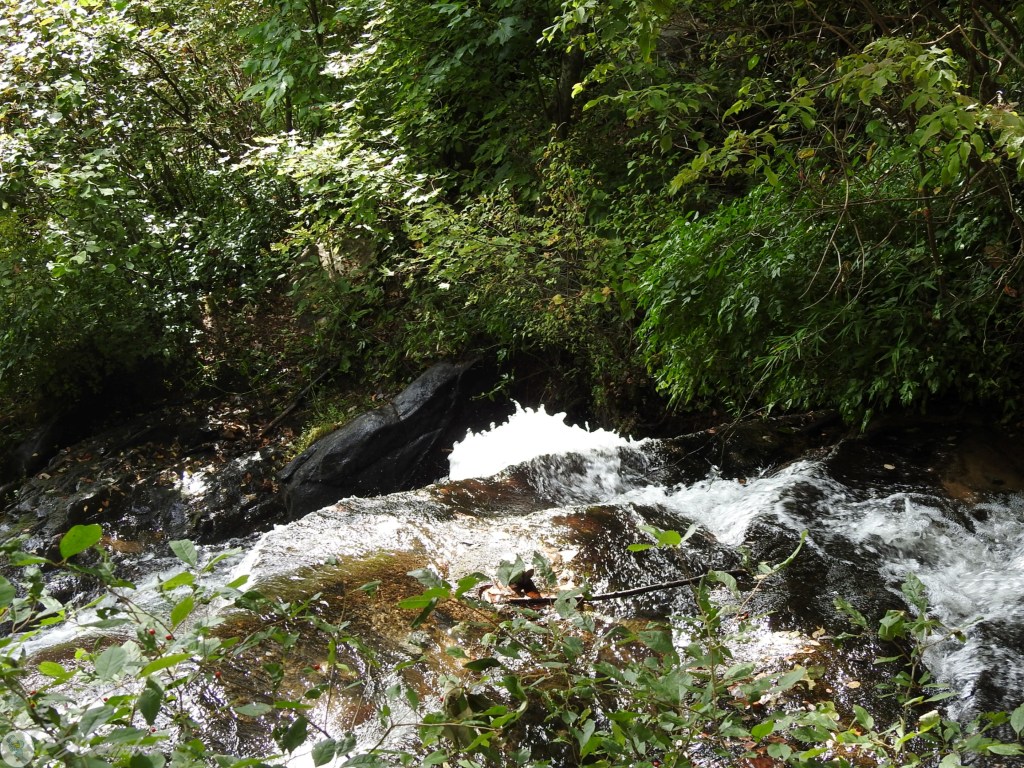
Then, we just headed on up the road a piece. We lost pavement after a bit and were thinking about maybe turning back down the mountain and back towards civilization.
That’s when we saw the sign for the church. So, that was it…decision made. Now we absolutely had to keep going up the hill to find that church.
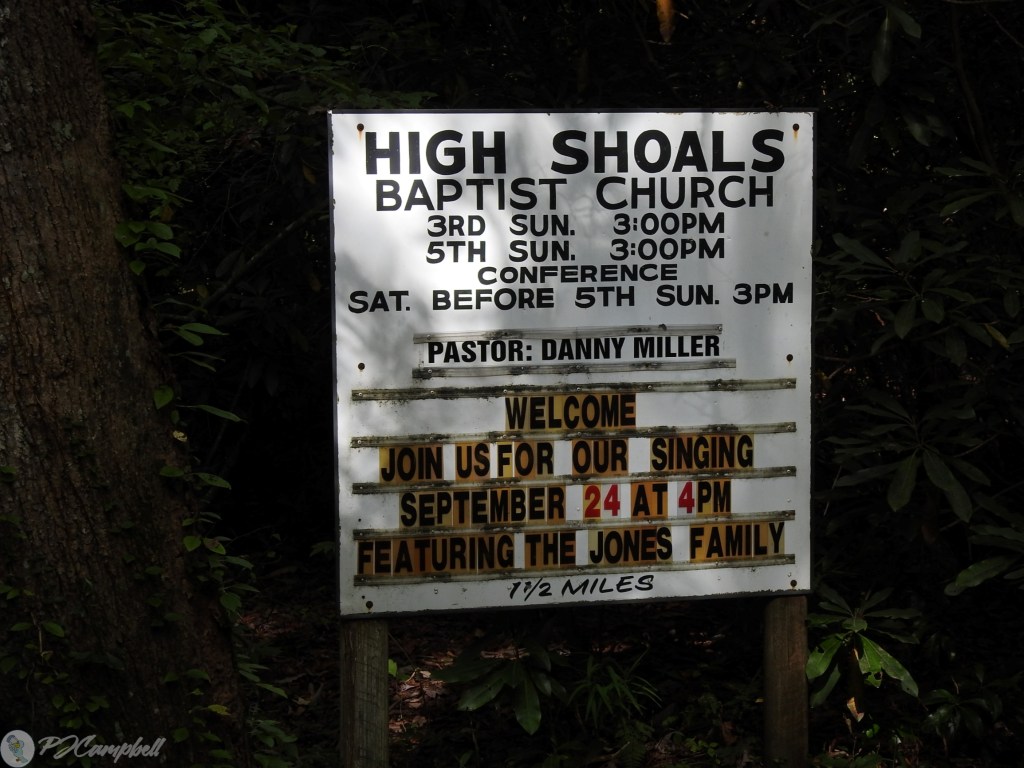
Silly me, thinking it would be just up the road from the sign. Never is. Turned out to be another mile and a half of bad pot-holed, washboard rough, used-to-be-graveled but ain’t no more, north Georgia dirt road.
We finally found the church in the middle of nowhere or, maybe from God’s perspective, in the place exactly where it is supposed to be. At first glance, it didn’t appear to be very old at all…. but it turns out that the building was new; the “church” is much older.
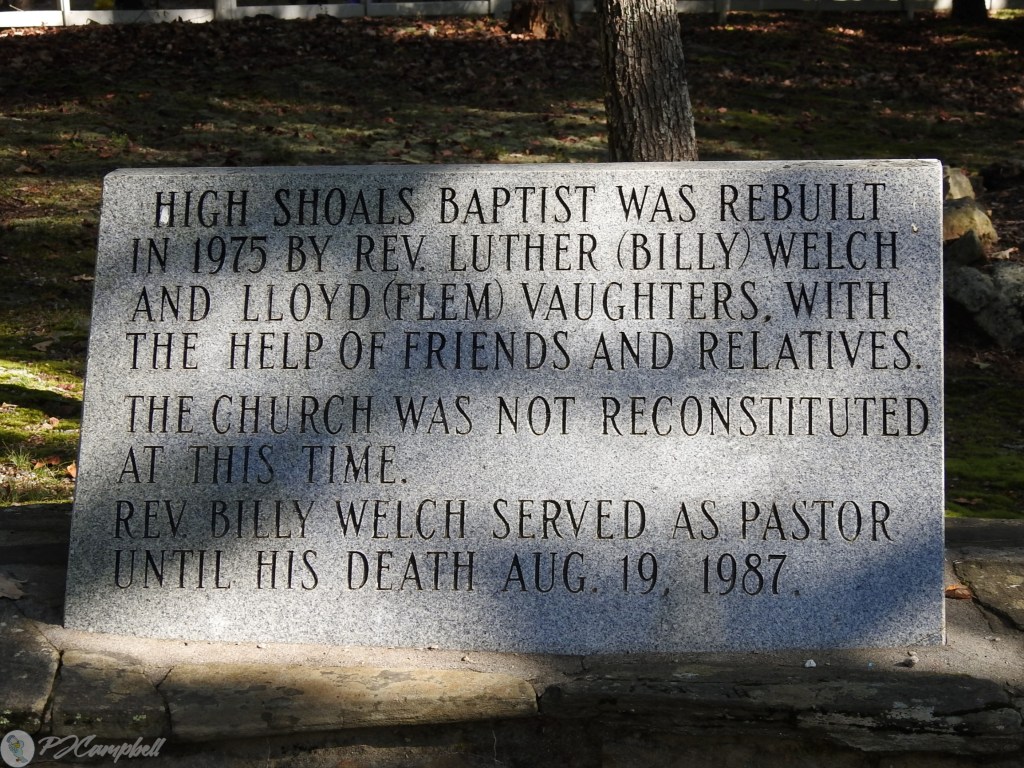
The church or congregation was established there in June 1879 by Samuel Roper and two deacons, Jonathon F.M. West and Samuel Harben.1
This area of Appalachia had been settled from about 1823 although I am sure the Cherokee were in the area long before that. Things went well at High Shoals and the settlers thrived until the 1930’s when the Government decided to create Chattahoochee National Forest. With the Government buying up (and maybe just taking) the land thereabouts, the congregation dwindled down… to few parishioners were left to support the church. The final service was held at High Shoals Baptist in 1934.1
Things went quiet at the old church for many years… no gospel singing, no scripture reading, no eloquent sermons, no altar calls… until the 1970’s when descendants of the original congregation began having “homecoming” services. The Reverend Billy Welch and Flem Vaughters got things going again and a new church building was erected in 1975. (The original building was a log cabin with dirt floors. There are no remains of this building today although the old cemetery remains from the early years.)1
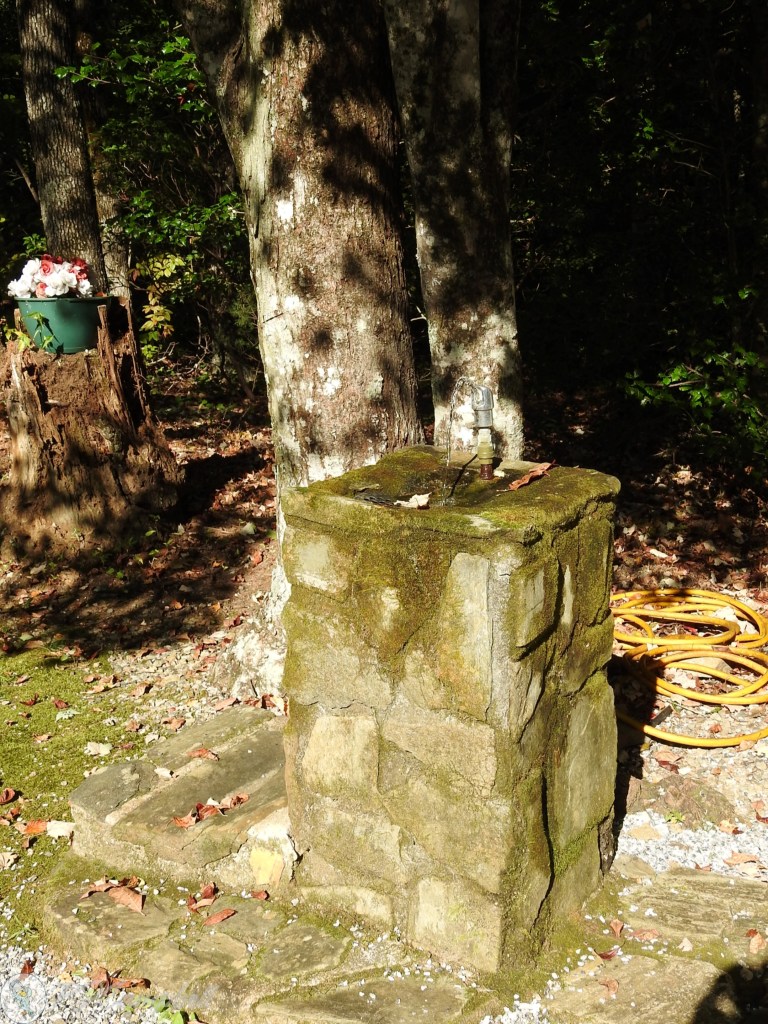
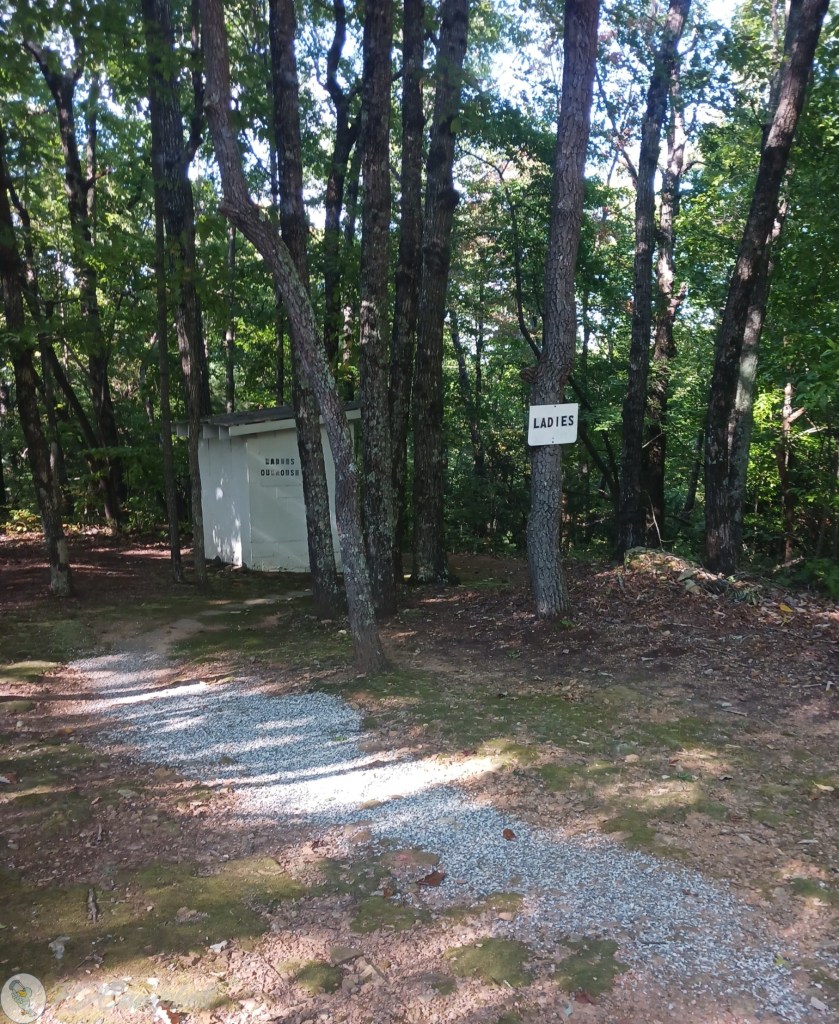
The men’s room was over on the left side.
The current church building has no electricity or running water. Propane gas lanterns are used for evening services and heaters in the winter. Water from a nearby spring is pumped in for the outhouses.2
The people came back. As of 2015, it was reported that there are about sixty members with services held on the 3rd and the 5th Sundays each month.2

Things are not so quiet at the church nowadays. The local paper, Dawson Community News, reported on a bit of an unusual occurrence at a revival service held in 2015.2 Seems a great big ole rattlesnake was there to greet the worshippers when they arrived:
“A [big] rattlesnake with 14 rattlers was right beside the front door,” said Harold Evans. “It about scared our visiting pastor to death. But he did give us all a fine sermon that night afterwards.”2
I can only imagine that particular sermon.
Pastor Evans further reported:
“We’ve seen bears, copperheads, rattlers. We’re not that concerned about them up there. We know they’re there.”2
In the country, I suppose you have to be prepared for just about everything.
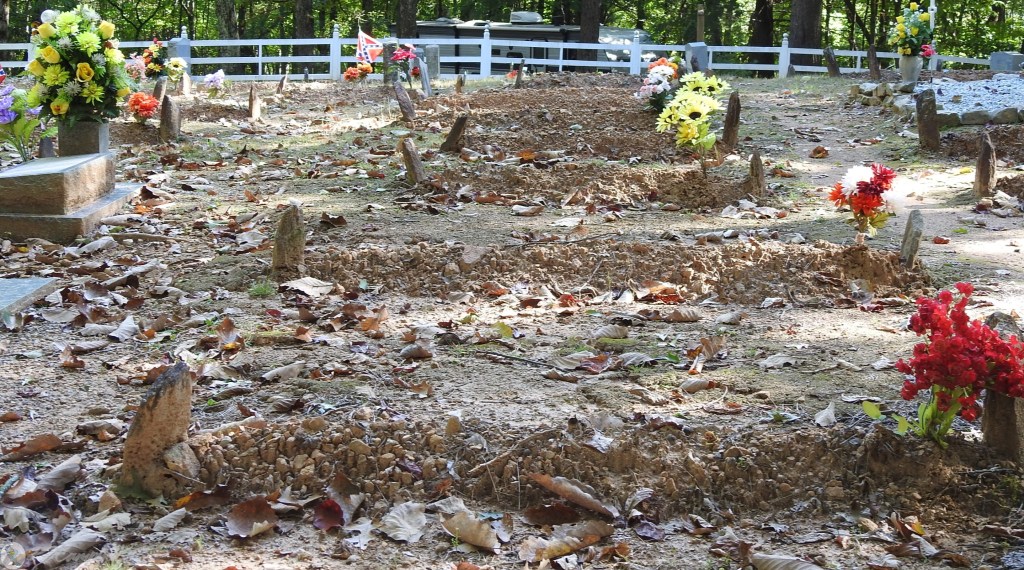
We wandered around the church and into the cemetery. (We didn’t see any snakes, thankfully!) The Georgia Genealogy Cemetery site reports there are approximately 32 unmarked graves and 11 marked graves.3

Much to our delight, the church doors were unlocked, and we were able to look around inside. There were hymnals in the pews, cushions on the seats, and plenty of those “hand-powered cardboard fans” I remember so well from my childhood days in church.


Don’t ya just love how each cushion is different as if each person just made his or her own special pillow and left it in their seat in the pew?
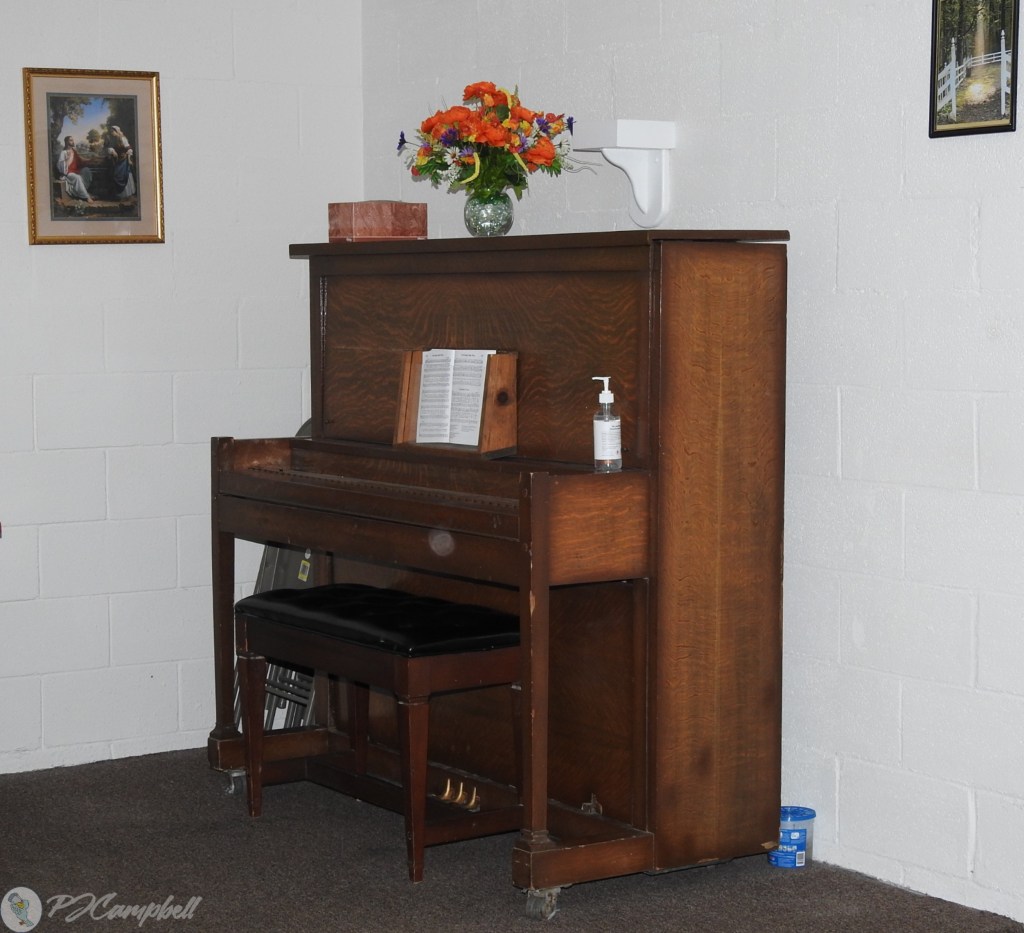
On the upright piano in the corner the hymnal was opened to page number 479, “Amazing Grace”4
and nearby an old Bible was opened to the 23rd Psalm…..
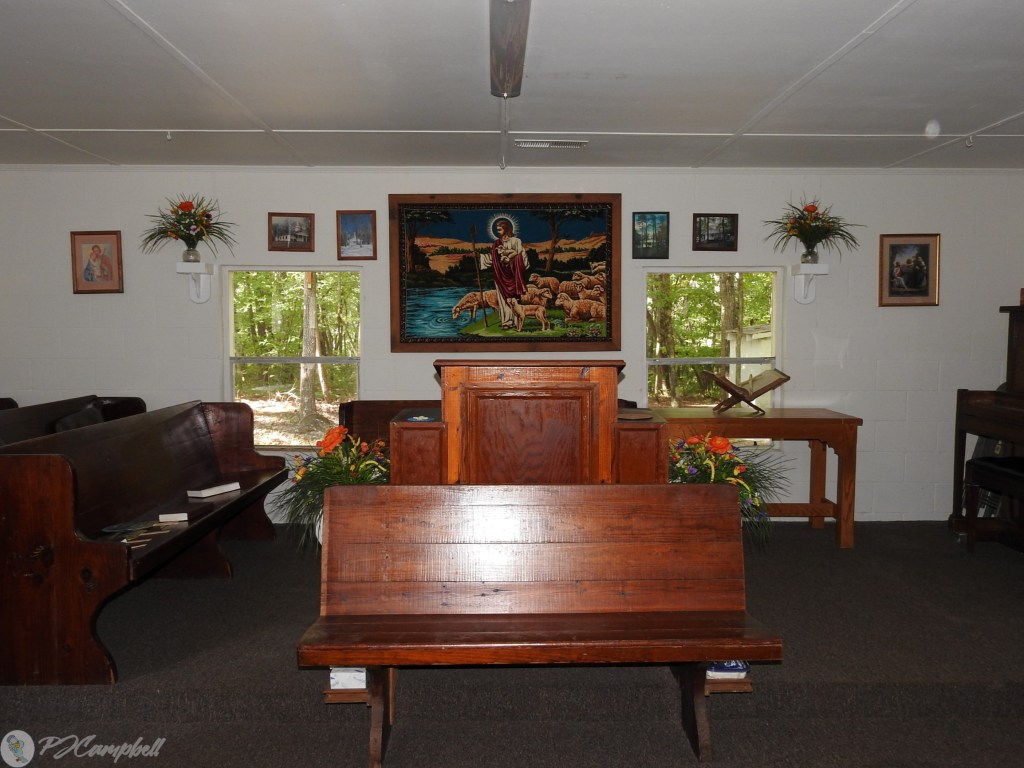
all waiting and ready for the pastor to step right in and begin the next sermon.
A Psalm of David.
1The LORD is my shepherd;
2He makes me lie down in green pastures;
He leads me beside quiet waters.
3He restores my soul;
He guides me in the paths of righteousness
4Even though I walk through
the valley of the shadow of death,
I will fear no evil,
for You are with me;
Your rod and Your staff, they comfort me.
5You prepare a table before me
in the presence of my enemies.
You anoint my head with oil;
6Surely goodness and mercy will follow me
all the days of my life,
and I will dwell
in the house of the LORD
forever.
It was all very beautiful, and we stopped together for a moment to pray before we continued on our way…a prayer of thankfulness and a hope that this church would continue to serve in God’s love and grace for many years to come.

Sources for Information:
- Primitive homeplace: High Shoals Baptist carries on long traditions – Gainesville Times; September 24, 2011
- Revival at mountain church has uninvited guest – Forsyth News, Dawson Community News; Michele Hester; August 21, 2015; Updated August 22, 2015
- High Shoals Church Cemetery, Dawson County Georgia – Georgia Genealogy
- Amazing Grace > Lyrics | John Newton (timelesstruths.org)
 It was a solemn day…..fitting for visiting an old church. We’d come up to Berryville for a funeral. I had heard of an old church that was purportedly the oldest Episcopal Church building still in use west of the Blue Ridge Mountains so it seemed like a great opportunity to drive on up to Millwood and find this church that sits at the intersection of Routes 617, 340, and 255. (I must say I was taken aback by the note that the church was “west” of the Blue Ridge Mountains….just lost my bearings for a moment and then realized where we were.)
 We found the church with very little trouble. It was right there where a church should be (I suppose) and had always been – at least for the last 223 years. Certainly this church building is young by European or Asian standards where a church probably isn’t even considered to be old at all for maybe the first thousand years. But, for this young country, a church topping 200 is pretty ancient.
 Old Chapel was listed on the National Registry of Historic Places in 1973. It was the home parish of Bishop William Meade for 25 years. Bishop Meade was born near White Post, VA. His father was Colonel Richard Kidder Meade, one of George Washington’s aides during the American Revolution. After the war, he sold his estate on the James River, bought a thousand acres in the Shenandoah Valley and moved there with his family. His son, William, became the third Bishop of Virginia.
 Old Chapel is a single story building with a “3 Bay by 3 Bay” design. It is built on a fieldstone foundation and is itself built of coursed rubble limestone. It has a single gable shingle covered roof. The application for the church to be included in the National Registry says that the building includes an interior stone chimney but I do not recall seeing a chimney when we were there.
 The arches above the doors are described as stone jack arches which (per Wikipedia) are a structural element in buildings to provide support above openings like doorways or windows. Jack arches are also called flat arches because they are not semicircular arches over the opening. They are used in the same manner as a lintel. The main doors are double-leaf paneled doors with five-light transoms above.
 The windows are wooden with twelve-over-twelve sashes and are protected on the exterior by wooden batten shutters with iron strap hinges. The east end of the building contains two additional four-light frieze windows which provide light to the altar and pulpit in the interior of the building.
 The high pulpit seemed very large for a church of this size (only about 40’ long). While it may be in the style of churches of that period, it really dominates the interior of this small church. On the other hand, you wouldn’t be able to miss that pulpit or the minister who would have a clear view of everyone in the church from the balcony on down….got to make sure no one is sleeping during the service. The carved wooden pulpit includes a plain wooden sounding board and an altar rail with turned wooden balusters. I love how the small windows on each side of the pulpit would have added a halo type effect to the minister as he performed his sermon although I think maybe the windows were there to add light to allow him to read his sermon notes and the Bible.
 The pews are wooden and straight-backed obviously for maximum comfort during the sermon.
 There is a small wooden paneled room at the rear of the church whose function we could not determine because that door was locked. (Note the double rows of nails in the wood paneling.)
 There is a wooden balcony in the back of the church which is accessible only by a steep stair from the outside. While the research sites I checked did not explain this further, I believe the outside access to the balcony was probably built to allow slaves or other servants to enter the church and worship in the balcony or gallery without using the main doors with the rest of the congregation. (I do not know anything about the dead vine on the support column for the balcony. It was not growing there as it was cut at the floor. I suppose it might have been a decoration from a past service in the church…perhaps at Christmas or Easter.)
 As I noted above, the beauty of the Old Chapel is in its simplicity and peacefulness. We found ourselves whispering while we explored inside the building. Isn’t that the way it is when one enters a sacred place? I thought of all the people who attended services here and the prayers over the last two centuries. I’m sure the ministers delivered powerful and rousing sermons that warned of the wages of sin and the absolute punishment for iniquity but, somehow, it seems to me that it is the silent whispered prayers for salvation and maybe a few soft hymns that linger in a church over the years filling the building with solitude and peace and hope for the future in an uncertain world.
 We step outside into bright sunshine and explore Burwell Cemetery that surrounds Old Chapel and is historically noteworthy in its own right. The land for the cemetery was donated by Colonel Nathaniel Burwell in 1792.
 The cemetery is known for its “ante-bellum” gravestone art and for the dignitaries buried there which include Col Burwell (of course) and Edmund Randolph who was a Virginia Governor and the first US Attorney General and John Esten Cooke (Civil War-era novelist). Bishop Meade, who ministered here for so long, had requested to be buried near his home church but died in Richmond and was buried there. His remains were later moved to the grounds of the Virginia Theological Seminary in Alexandria, VA. although other members of his family are buried here.
 The cemetery also includes a Confederate War Dead Memorial as well as many Confederate soldiers’ graves along with the graves identified as slaves from the years before emancipation. I am always struck with the irony that the good, the evil, the saints, the sinners, the soldiers, and the slaves all end up buried together in the same cemetery for all of eternity.
 Research Resources:
 Birding Boomers