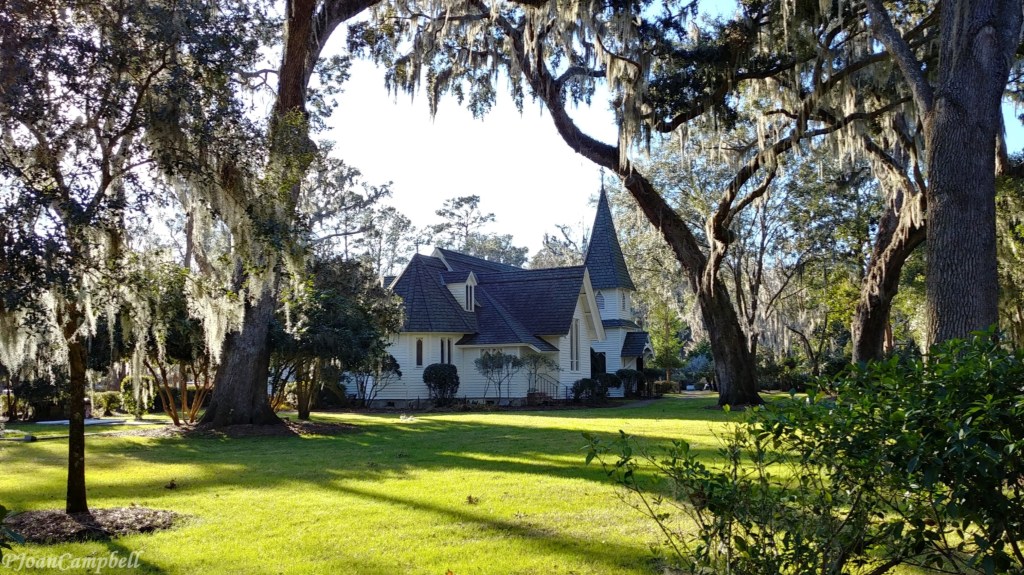
Under the Oaks – Christ Episcopal Church

Charles Wesley preached here on March 14, 1736.  It was the first service to be held at the new mission on St. Simon’s Island. There was no actual church building so Reverend Wesley preached right there under the live oak trees with limbs stretching out over an acre and with trunks so large you cannot reach your arms around them – trees that were as old as, well…. the trees.

I like to think that first sermon was in the cool of the evening after a long hot day… new settlers in from a long day’s work clearing fields, soldiers from nearby Fort Frederica, watermen brought in with the tide hauling bushels of crabs or shrimp – everyone from the small colony…. men, women, and children gathering to sing a few hymns and hear the words of the Lord.  George Whitfield, who was a deacon at the Savannah church at the time remembered:

In the evening we had publick Prayers, and expounding of the second Lesson under a large tree, and many more present than could be expected.” 1 (Aug 8, 1737)
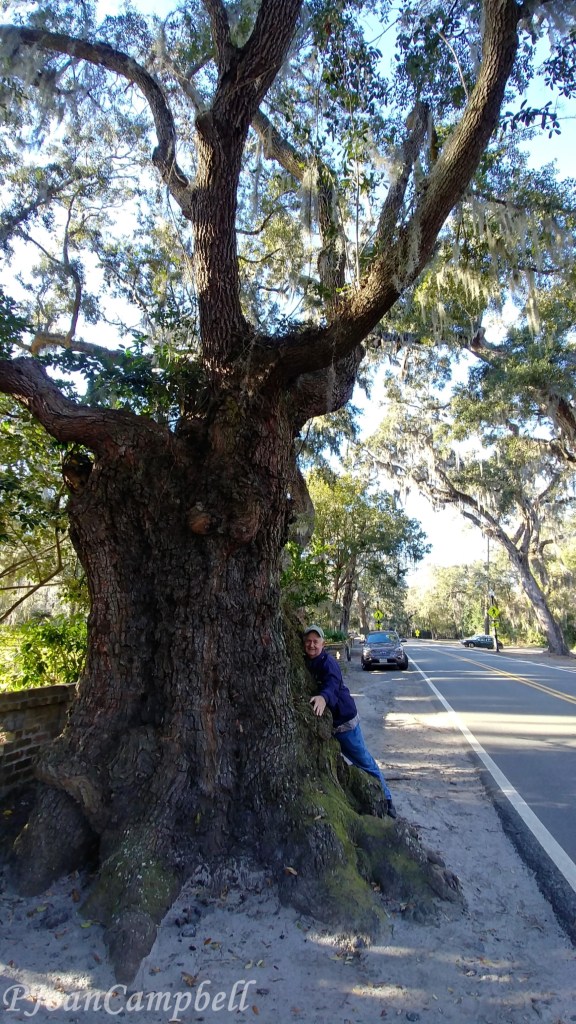
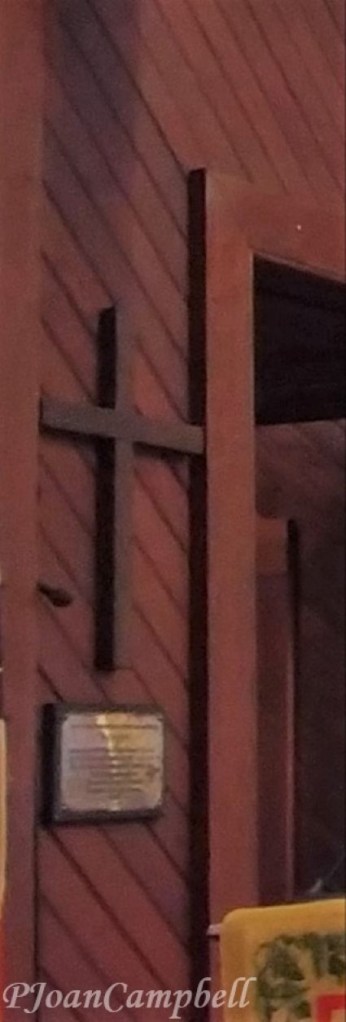
The oak no longer stands. It has long since succumbed to storms and damage and time.  There is a Georgia Historical Marker at the site that commemorates the “Wesley Oak” that stands very close to another ancient oak tree, so everyone just seems to think that is the actual oak where Wesley preached.  Yep, me too. Even took a photo with Jerry hugging the tree.  Actually taking the time to read the marker helps.  So, I have a great photo of an old oak tree that is NOT the Wesley Oak…. still a beautiful oak tree that is very picture worthy in its own right.  The original oak is gone but a cross was made from the wood and now hangs inside the church to further commemorate the man and the sermon that evening on St. Simon’s Island.

Charles was the brother of the Reverend John Wesley, the rector at the Christ Chapel in Savannah. Both brothers were sent out from the Church of England.  Brother Charles had traveled to St. Simon’s Island in the Georgia colony as a chaplain for James Oglethorpe, credited as the founder of the state. Oglethorpe had established Fort Frederica on the island on February 15, 1736 and brought in Scottish soldiers to help secure the frontier.  I do not suppose anyone thinks of the low country and barrier islands along the Georgia coast as “the frontier” these days and I daresay not too many people worry about protection when they visit, but in 1736, it was pretty much the edge of nowhere, full of all sorts of danger…. and possible Spanish colonists that couldn’t be allowed.

Charles Wesley established a mission on the island and preached that first sermon on March 14, 1736.  In the beginning, he held services in a small tabby (cement & broken up seashells) building within the walls of Fort Frederica. He served the congregation on the island at the small mission until July 1736.  The United Society Partners in the Gospel provided clergy for the mission/church during the 1700’s. After America’s Revolutionary War, the local churches broke away from the Church of England (understandably) becoming Episcopal churches in the US.

The first permanent church on the property was built in 1820. This church stood until the American Civil War when it was mostly destroyed.  Christ Episcopal Church at St. Simon’s was incorporated by state legislature in 1808 and given one hundred and eight acres on the island near Fort Frederica. Reverend William Best was the first rector of the newly incorporated Christ Episcopal Church which joined other churches to form the Episcopal Diocese in 1823.  On a sidenote, church history from Wikipedia 5 indicates that in 1840, bees built a hive in the church steeple. The congregants collected and sold honey to raise money for building repairs.  Two thoughts come quickly to mind; 1) this just has to be an early predecessor to more church bake sales than you can shake a stick at, and 2) I wonder if the bees “hummed” along with the singing during church services.

Christ Church continued to be served by lay ministers who visited the area as circuit riders at intervals in the 1800’s. It wasn’t clear where the congregation met once the church building was destroyed although under the trees seems to have worked out okay.  In 1879, Anson Greene Phelps Dodge, Jr. (Deacon and then Rector) reorganized the parish and, in 1884, had the church rebuilt in memory of his wife who was buried on the grounds. 

Reverend Dodge also established another church, St. Ignatius, nearby on Demere Road as an outreach to slaves that had been freed after the war.  Anna Alexander, a deaconess who served at St. Ignatius, is noteworthy as the first black deaconess in the Episcopal Church.  In 1998, she was named as a saint in the church by the Episcopal Diocese.  In the 1980’s, St. Ignatius was closed and merged with Christ Episcopal Church.  Christ Episcopal Church continues to be an active congregation with services still being held throughout the year.  Visitors are made welcome. (According to the church website, about 20,000 people visit the church each year.)

“Our grounds and our faith are historic, built upon the foundations laid by our ancestors on this island and the host of saints who have come before us.” 4
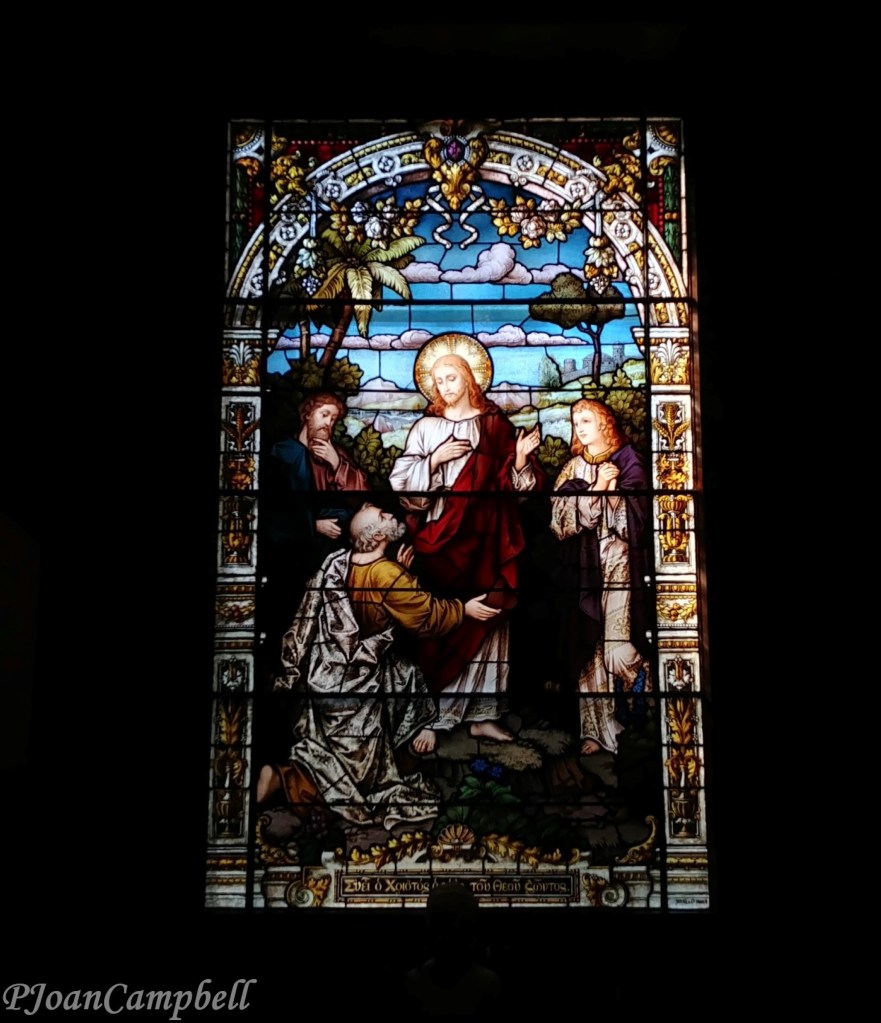
We were blessed in that the church was open on the day we visited, and we were able to go inside and enjoy the beauty of the church.  The interior of the building, which is quite simple and beautiful, was built with local heart pine which has never been stained or painted. 

We also spent quite a bit of time in the cemetery on the grounds. Many of the tombstones there are as old as the trees that surround them.  The oldest tombstone is 1803 although it is thought that there are older graves there. The cemetery includes the graves of the Rectors of the church and their families, early settlers, Officers of the British Army who served nearby, and soldiers from every war fought by the US.3

The day we visited was a quiet one with only one other couple strolling through the grounds reading the inscriptions on the gravestones, a Pastor and his wife visiting from Tennessee. 

Before we left, we asked the pastor to say a prayer with us. He obliged praying for safety in our travels and asked God to bless the church and bring souls to salvation there in the future. We prayed under the beautiful live oak trees where some 300 years ago, the Reverend Charles Wesley had preached and, no doubt, had prayed the same prayer for mercy and salvation. Amen

Notes & Sources with links:

  1. Georgia Historical Marker 063-33A, 1968, Christ Episcopal Church (I was unable to locate the link for the specific marker online so included the link for the main site.)
  2. Georgia Historical Marker 063-34A, Wesley Oak (Unable to locate the link for the specific marker.)
  3. Georgia Historical Marker 063-35, Christ Church Cemetery
  4. Christ Episcopal Church Website/About Us /(ccfssi.org)
  5. Wikipedia, Christ Church (St. Simons, Georgia)

If you’d like to visit Christ Episcopal Church:

There are two locations on St. Simons Island. The main Church and offices are located at 6329 Frederica Rd., St. Simons Island, GA 31522. St. Ignatius Chapel is located at 2609 Demere Rd., St. Simons Island, GA 31522. 4

Girdletree

Sometime around a hundred and fifty years ago, give or take a few, a farmer named Charles Bishop and his wife, Mary, broke ground on a farm in eastern Maryland about five miles south of Snow Hill. According to the old family stories, Charles girdled a beech tree while clearing the land for the farm. Now, that must have been a pretty big tree for the act to have gotten everyone’s attention and, ultimately, provided a name for the community that grew up around the farm.  Girdling is a process of cutting bark away in a circle around the tree that pretty much results in the death of the tree; it just takes a little time for nature to take its course but, eventually, the tree dies and falls. Why he didn’t just cut it down, we will never know. But he didn’t and family and friends noticed, and the new village became known by as Girdletree.

Girdletree was and is a “crossroads” village. The particular roads being crossed are Maryland Route 12 and Onley & Boxiron Road. It started out as a sleepy little village until the Worcester Railroad came through in 1876 connecting Snow Hill and Franklin City. The railroad brought prosperity and the town grew becoming a shipping point for oysters, crab, and fish from Chincoteague Island just down the road in Virginia’s eastern neck. Chincoteague has the reputation of having the sweetest and best tasting oysters on the eastern seaboard of the United States…if not the world. Ask anyone who lives year-round on the island. They will be happy to tell you about their wonderful fish and seafood. It seemed that the world wanted those oysters and the good folks of Girdletree were right there to help by shipping it all out from Taylor’s Landing. At one point there were seven canneries processing seafood out of Girdletree…oysters were not only good business for Chincoteague, they helped feed the families around Girdletree too.

George Barnes Bank of Girdletree

Things were going great economically…. good enough for George L. Barnes & Co to build a brand spanking new brick bank in 1902. Most every other building in town was “stick built” or primarily built of wood which was typical for homes in the 18th and 19th centuries. Unfortunately, prosperity didn’t last. In 1929, the Great Depression hit and the economy of Girdletree failed.  People probably weren’t gonna buy fancy seafood when they couldn’t buy bread. Barnes Bank closed in 1930. I suppose the canneries closed too soon thereafter. The old bank building is still standing as a museum and historical building on MD 12 in what’s left of the town of Girdletree.

Fast forward that hundred and fifty or so years and we (my fellow wanderer and I) found ourselves on a road we hadn’t taken before. We’d been down to Chincoteague looking for birds. We try to go at least once each year in autumn or winter after the “summer people” have gone on back home and the island once again belongs to the locals. Things quiet down in winter and the beach clears and it’s a good time to go birding at the seashore and on the refuge (Assateague Island). We’d had a good day birding and were on the way home using a new GPS which directed us to make a turn we hadn’t taken before. It was a beautiful day, and we love nothing more than to meander around so we decided to just go with it.

Girdletree Methodist Church

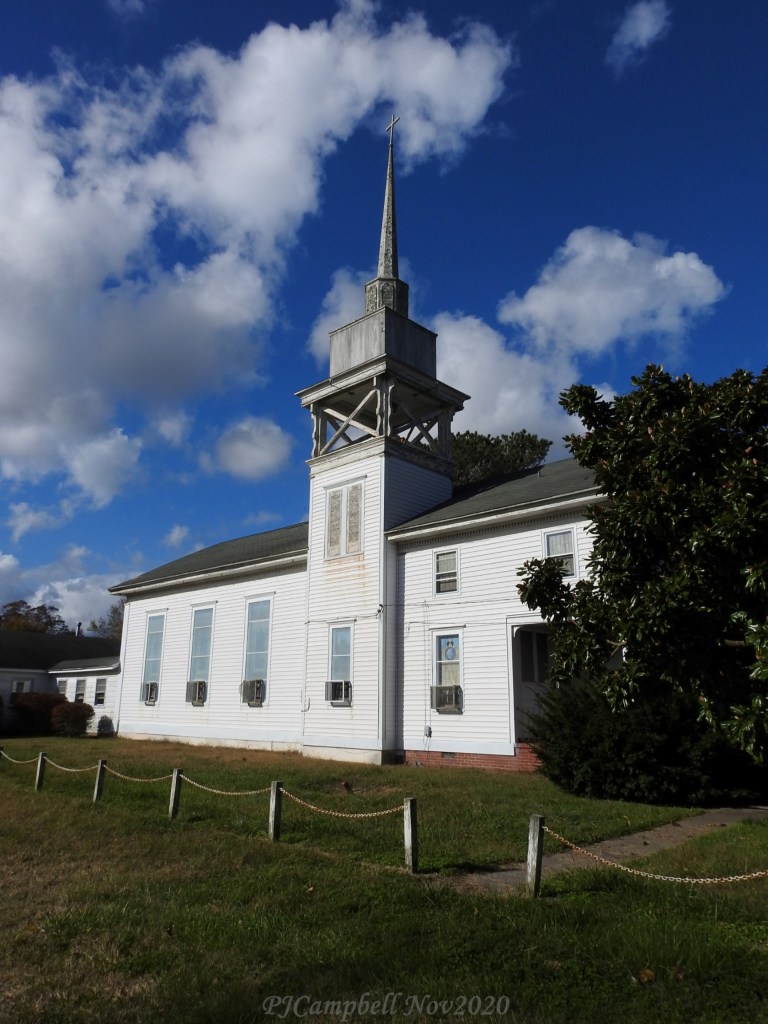
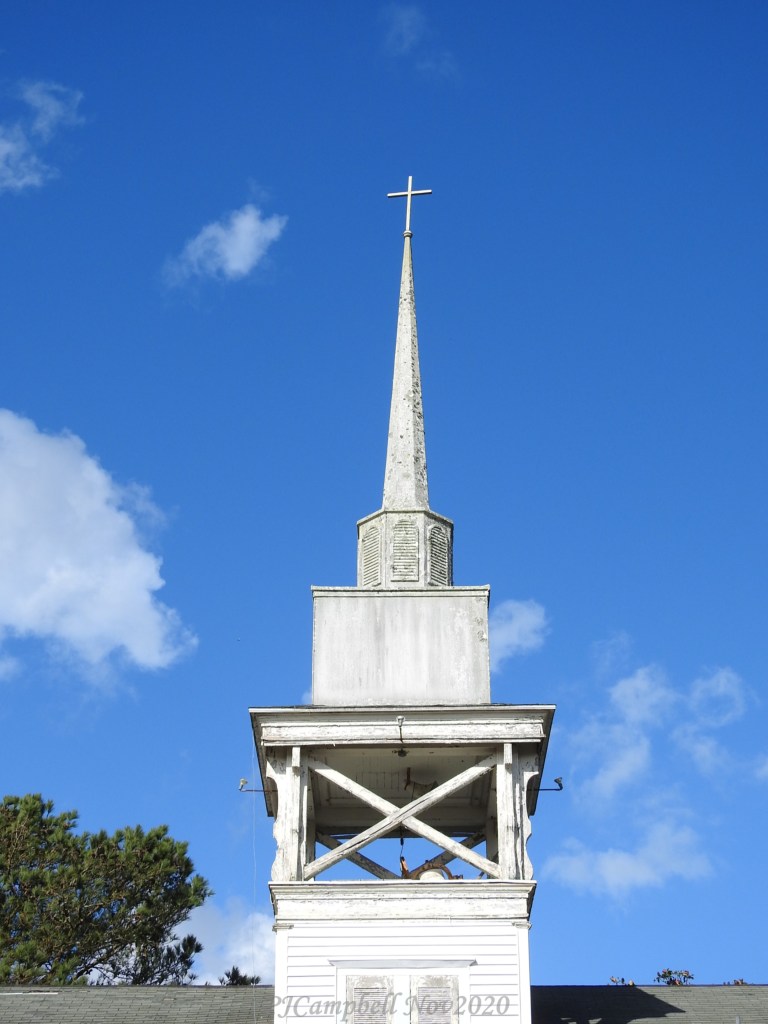
We were heading up the road towards Snow Hill when we caught sight of a lovely old church by the side of the road. We passed it but then turned around and went back to get a couple photographs. I love taking pictures of old churches and this church was a bit unusual as the steeple was just to one side of the church and not in the front center like most other churches. It definitely needed to be photographed.  Turns out we were in the once-again sleepy little community of Girdletree and the church was the Girdletree Methodist Church, one of two churches originally established in the town.

Side View of Belltower & Steeple

I got out of the car to take a few pictures of the church. I noticed the Barnes Bank across the highway and walked over to the roadside to get a photo of the bank. When I turned back, I was met by a nice older lady with a small can of paint in her hand. She wondered if I was from the paper because she had seen me taking pictures and thought maybe I was going to do an article on the fund-raising efforts to get a new roof for the church. So, across the street she came to see what exactly I was up to. I told her that I wasn’t from the local paper or anything and that I just liked old churches and this one was nice because the steeple was on the side and somewhat unusual to me.

Belltower & Steeple

“Well”, she says, “That’s not the original steeple, it burned in 1940 and it was replaced in 1960.”  

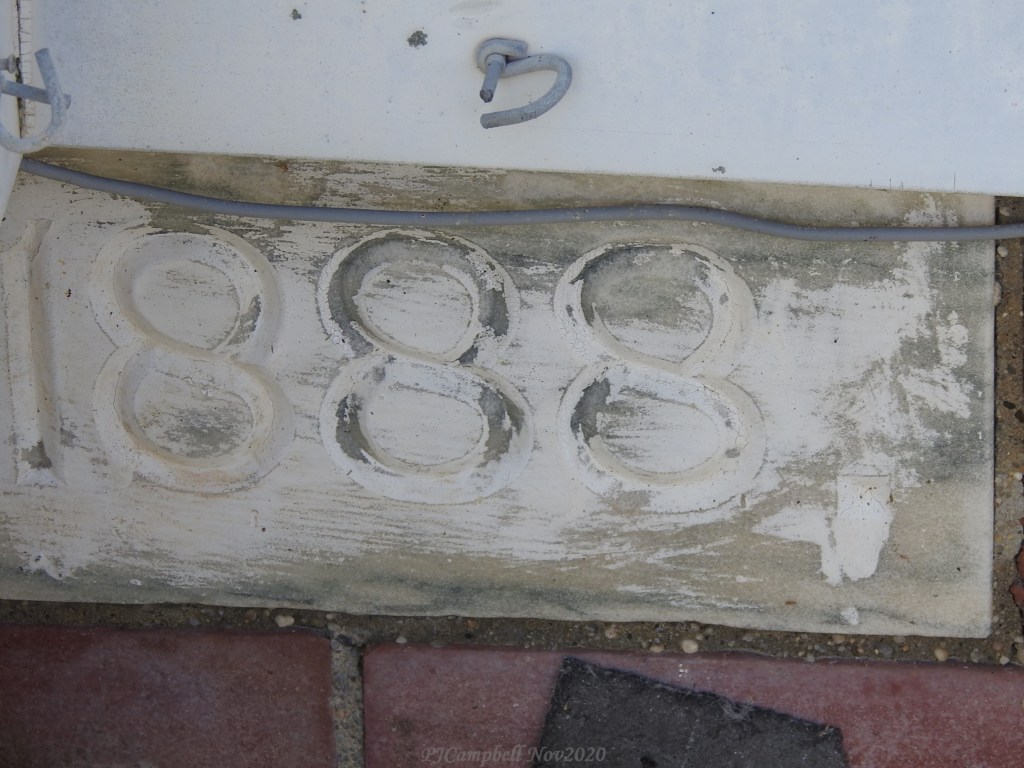
She said that the church hadn’t had a steeple when it was first built, and it was added maybe around 1929. A bad storm caused the fire in 1940 and she remembered her granddaddy and grandmama talking in later years about when the steeple burned. (The church itself was built in the late 1800’s and enlarged with the bell tower (steeple) and front addition at the later date.)

She had noticed that I had noticed the small paint can she was carrying and told me she was painting her granddaddy’s store across the street. I had not wanted to be rude and ask why she was carrying that can of paint around.  She pointed over at the old store front and said that she had painted the trim around the window a few days ago but she didn’t like the green paint she had used so was now painting over it with white. 

I asked if she lived in the house by the old store and she said she didn’t; she lived in the large old faded yellow house that was two buildings up.  She was born in 1938 and grew up around here as she circled her arm indicating right there around the old store. I asked if she had been born there but she said she hadn’t and she pointed somewhere off to the west and said she’d been born out at the family farm over there.

Front Window of the Old Store

We continued to chat, and I finally got around to asking her name which was Sandra. She told me all about the church and her childhood repeating some things like those of us who are a little older are apt to do.  The old church, while not abandoned completely, needs too many repairs and, no, they don’t have church there anymore.

Girdletree Methodist Church Cornerstone
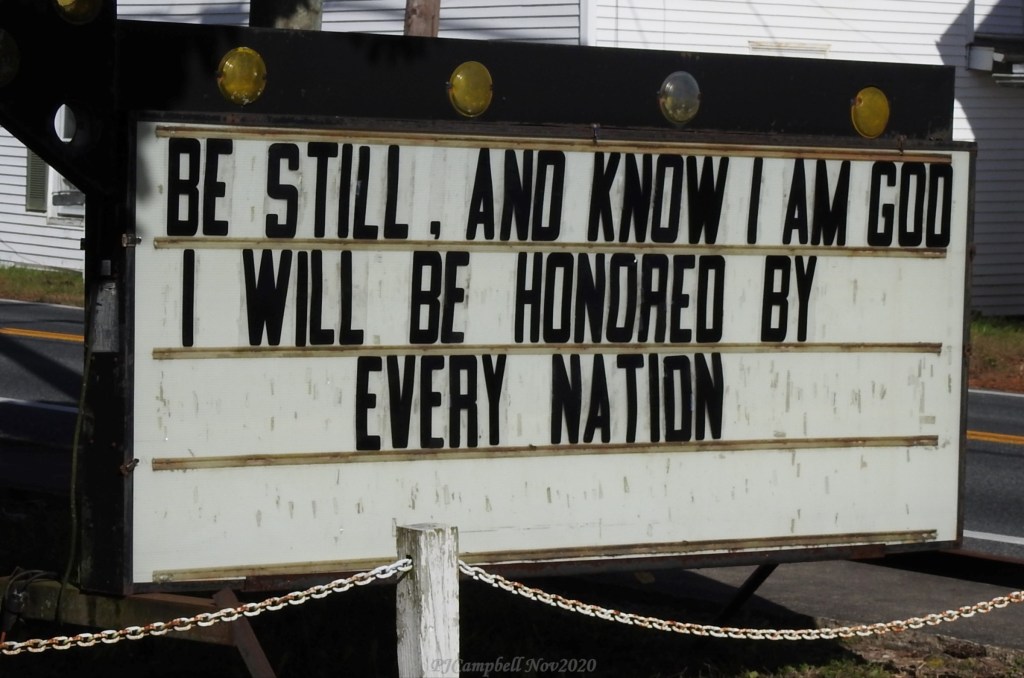
Girdletree Methodist Church Sign (unusual to have stained glass tokens on a church sign)

Ms. Sandra said the church closed in 1969 and had been deeded to the Historical Foundation who was trying to raise the funds for the new roof.  The congregation has moved on to another church in the area although the old fellowship hall out back which is newer and a bit more restored is rented out by another church for its services. The other folks from that other church had done a lots to fix it up…you just wouldn’t believe all they’d done and how nice it looked.

Ms. Sandra had to get back to her painting so she headed on back across the road and we had to get back on the road headed home but her shared memories left me with a warm feeling for the town and church and a little girl named Sandra who’d been born there and never left. I imagine her going to church with her granddaddy and grandmama way back when the steeple was newly built after the first one had burned. I see them there standing in the sanctuary singing hymns and bowing their heads to pray as the sunlight filters through the stained-glass windows painting the air with the beauty of the Lord’s love and goodness. All that remains now are the blessings and prayers that once filled the church and the memories of that young girl that have sustained her for all the days of her life.

Sources for Factual Information:

Maryland Historical Trust Inventory # WO-321: Girdletree, Maryland.