George Washington Prayed Here

Series: Old Churches & US Route 1
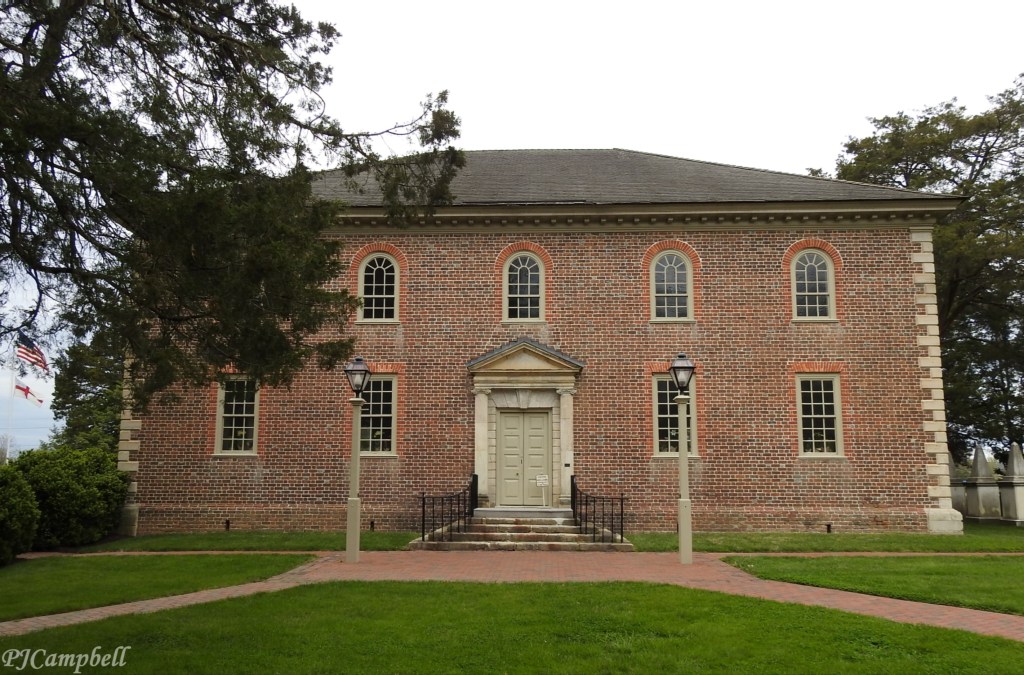
Pohick Episcopal Church

Quite a bit is known about George Washington, the stern looking man in the white powdered wig that is pictured in all the paintings in Federal buildings and schools across the nation and in every history book from about third grade on. He has been described as having long reddish-brown hair under that white wig, being maybe upwards of 6’3” tall and weighing about 220 pounds…. a big man, known for his strength. Yep, he had bad teeth and wore dentures and suffered for it using laudanum to ease the pain. And there’s that story about cutting down the cherry tree and then not lying about it when his father accosted him…. but, oh yeah, I seem to recall hearing that the cherry tree story has been discounted and moved over into the urban legend category.

But factually, he was a military officer (Commander of the Continental Army), one of the “Founding Fathers”, the first US President (“Father of the Nation”), a statesman, loving husband of Martha, a surveyor (Have you seen the Dismal Swamp Canal? Very straight), a landowner and speculator, a planter, and, yes, sadly, a slave owner. 

Wall surrounding the church property was built with the original church.

In addition to all that, George Washington was a religious man, a devout member of the Anglican Church from his baptism as a baby in April 1732 to his death in December 1799. His great-great-grandfather was, in fact, an Anglican minister. He was “raised” in the church and was a Christian though he was not a Christian in the sense that I think of Christians. Some of his biographers refer to George Washington as a “theistic rationalist” more than a “Christian”. Theistic rationalists have a hybrid belief system combining Christianity, religion, and rationalism whereby Christianity and religion “co-exist” with any conflicts being balanced out by rational thought and with rationalism being the predominant part.
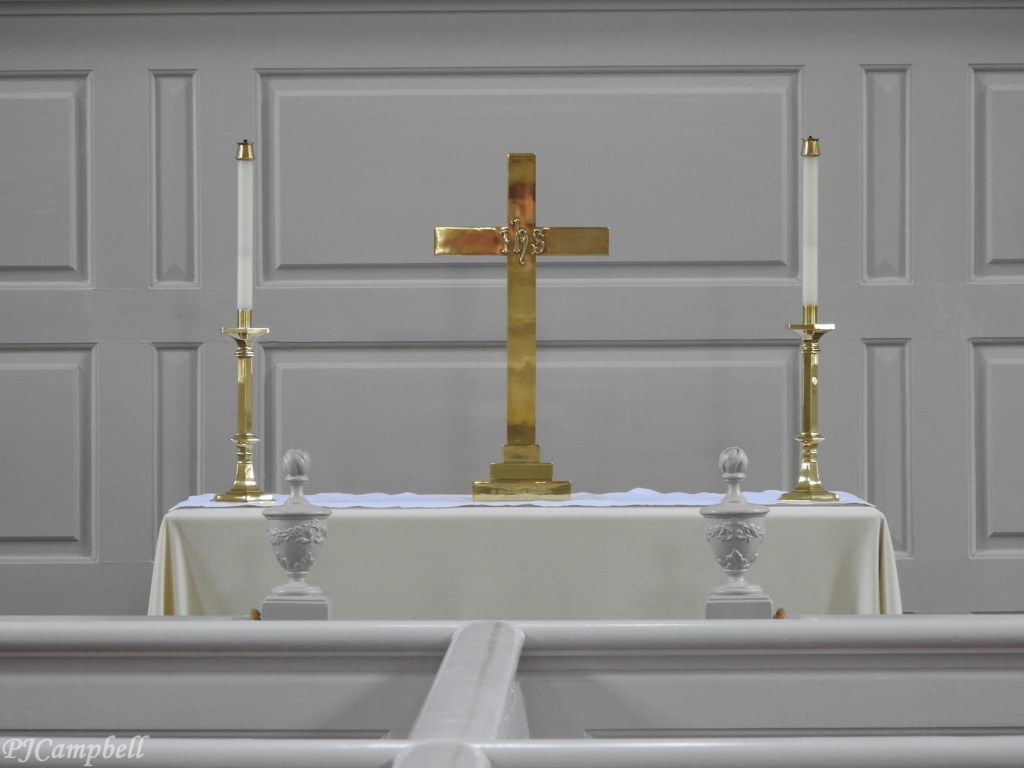
Area of the altar

But he did believe in God. In his correspondence and communications, George Washington referred to God as “Providence”, the “Creator”, the “Almighty”, the “Divine Author”, and the “Supreme Being”. Strangely, he never mentioned Jesus Christ at all (Wikipedia – George Washington1) so I can see where he is thought of as being more “theistic” than Christian.

For all his sixty-seven years on this earth, he was known to read his Bible and the Anglican Book of Common Prayer privately and to pray daily.  He also encouraged others to pray as he believed that God played a pivotal role in human life and did indeed answer prayers. And he was an upstanding member of the Pohick Episcopal Church near his home at Mount Vernon and later in his life at the Christ Church in Alexandria.
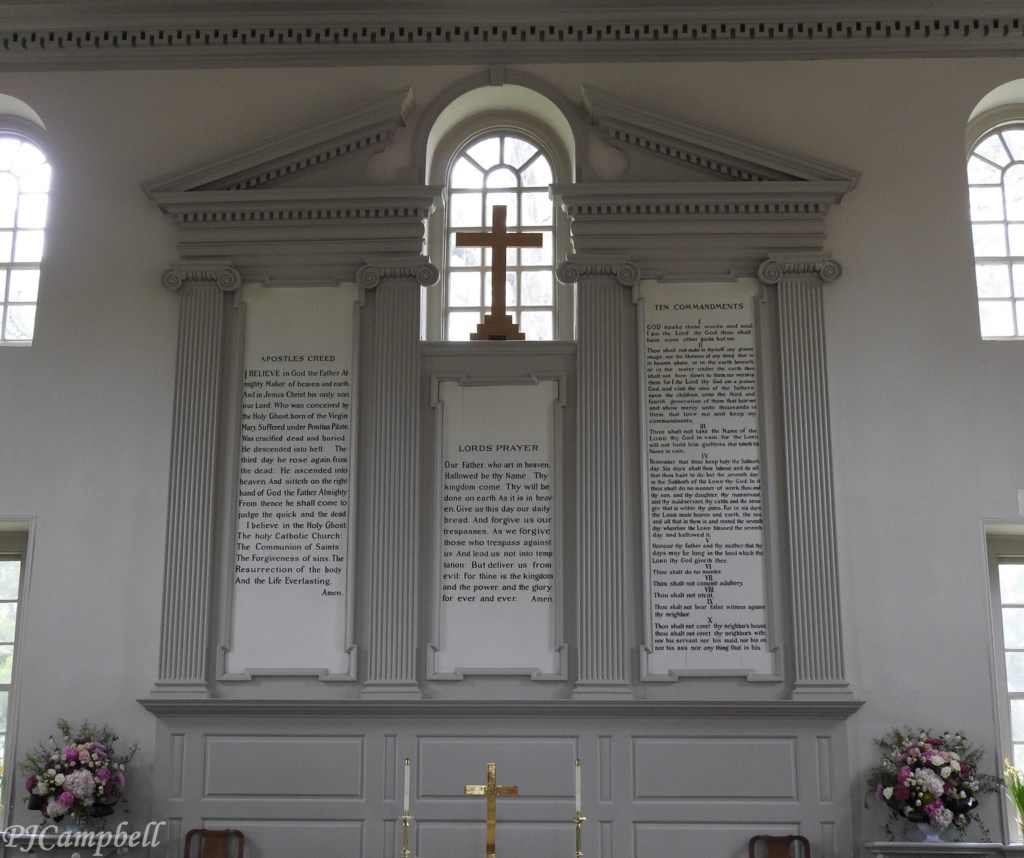
Altarpiece includes the Apostles’ Creed, Lord’s Prayer, & Ten Commandments

Recently, I visited Pohick Church where George Washington attended services, served on the church vestry, worshipped God, and, yes, where he prayed. Like our first president, I also believe God answers prayers and I really love visiting old churches.

Some years ago…. way back in the last century (it’s like I’m lost somewhere in history myself), in the late 1980’s, I worked down at an office in Newington, Virginia. The straightest commute from Maryland was straight down Interstate 95. But straight is not always the best way during rush hour so I often used a less congested way home via Telegraph Road or US Route 1 – yes, the US Route 1 that runs 2,370 miles from Fort Kent, Maine to Key West, Florida.  Of course, I only traveled those 10 miles or so that ran from Newington to the Woodrow Wilson Bridge. At any rate, every time I used that route, I passed by the old Pohick Church at the junction of what Washington would have called the Potomac Road (Route 1) and the “back road” (Telegraph Road). And every time I passed the church, I promised myself that I would stop and take a look. (Of course, I didn’t know George Washington used to be a member.) But I never did stop. Time passed, I changed jobs, didn’t think about it until recently when we were down in the area attending a seminar and had a couple free hours. What better to do than go see that old church?

View of the church interior showing the box pews.

The Pohick Church is an Episcopal church having been originally consecrated as an Anglican Church since it was established prior to the American Revolution. After the Revolution and with passage of the Religious Freedom Act in 1785, Virginia dis-established the Church of England and the Anglican churches in the “colonies” became Episcopalian churches. But things always seem to come full circle and today many of these Episcopal churches are now members of the “Anglican Communion” using the hymnals and prayer books from the “mother” church in England.

The church is comprised of several buildings including the church building itself, the Vestry house, the Parish House, a separate belfry for the church bell, and a cemetery.  The two ancillary buildings and the belfry are not considered to be historical as the vestry was built in 1931 and the Parish in 1955. But a church is not necessarily the building; it is the congregation – the people who worship there.
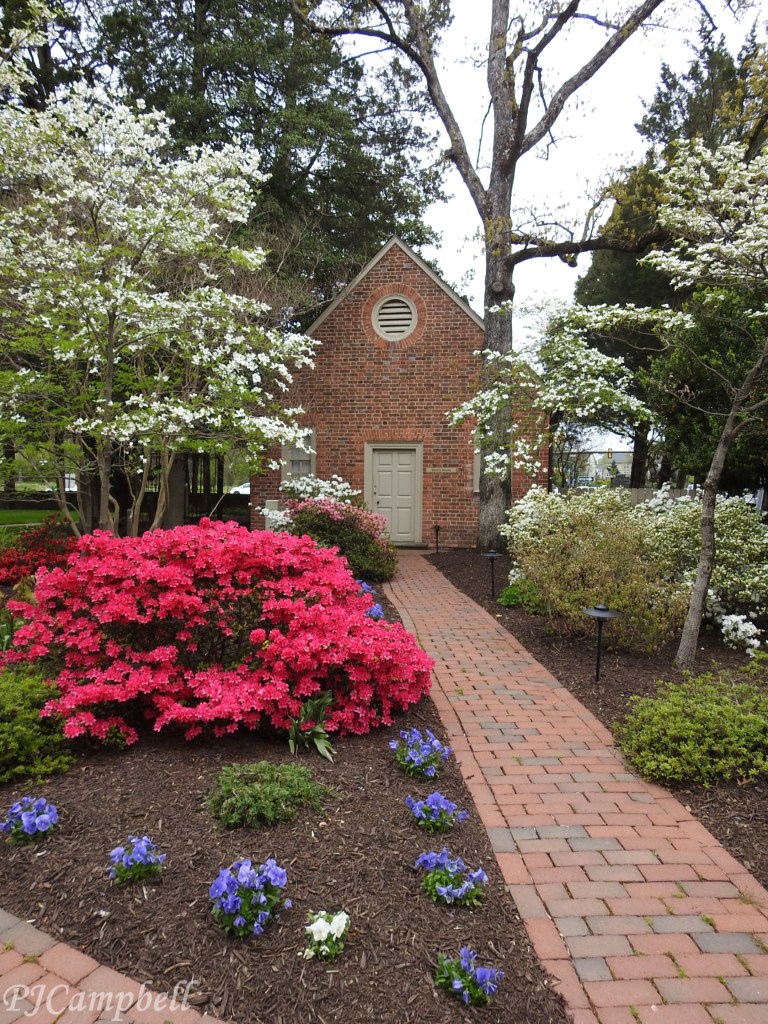
The Vestry was not part of the original church. A vestry was included in the original plans but considered to be too expensive to build at the time.

Pohick has been referred to as the “Mother Church of Northern Virginia”3.  It was first established in 1695 as a “chapel of ease”1 for Overwharton Parish in the area and occupied a building near Woodlawn & Mount Vernon (which would eventually be George Washington’s home). A chapel of ease is a building other than the parish church that is in the vicinity but is used for worship by those who cannot reach the regular parish church easily.
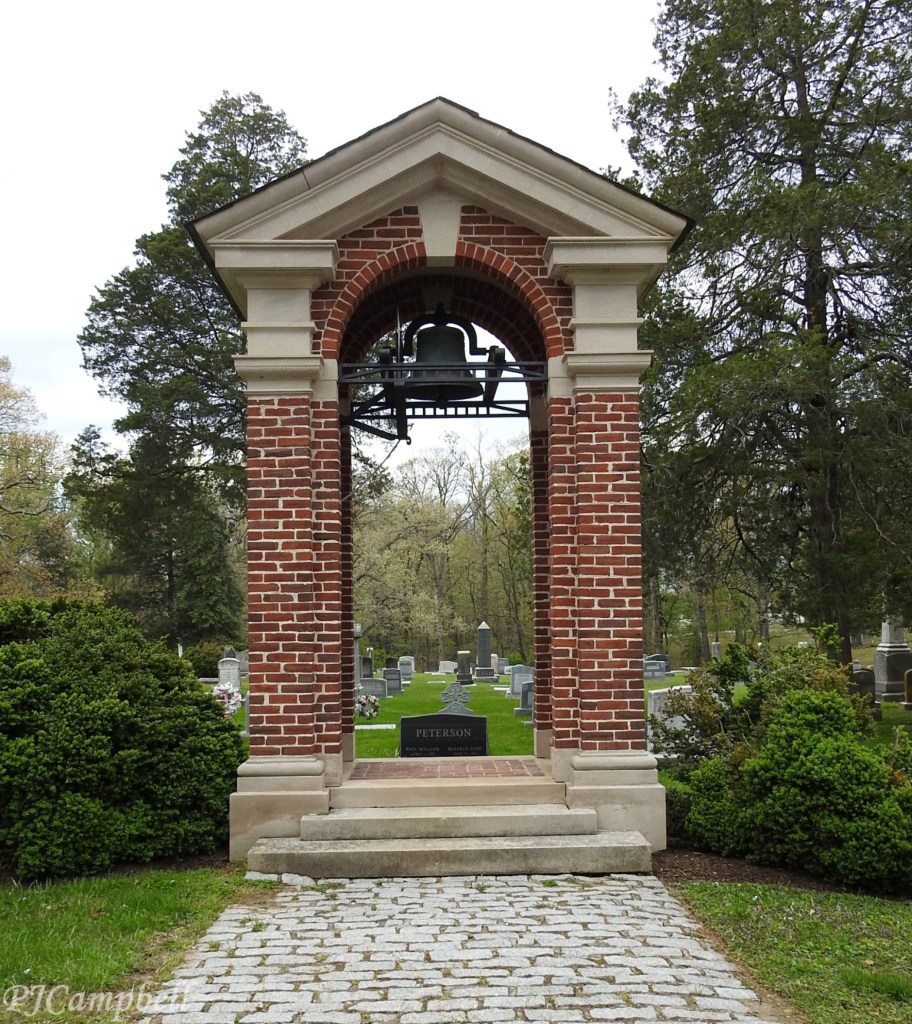
The Memorial Belfry was added at a later date in the 20th century.

In 1730, the church was moved south to Colchester and was referred to as the “church above Occoquan Ferry”. A stone marker marks the original church site which is on the grounds of another church just down the road. The name, “Pohick Church”, comes from Pohick Creek. George Washington attended the church and served as both a warden and a member of the vestry. Then, as the congregation grew, the church was moved to its current location at the intersection of Route 1 and Telegraph Road.

To be a Biblical “city on a hill” that couldn’t be hidden (Matthew 5:14), the site picked for the church was the highest point on the property consisting of 3 acres and 26 perches at that time.  (Now, that’s a great word – perches. It refers to a rod or pole which is used by surveyors and is between 3 and 8 meters long – about 16.5 feet.) The original design plan for the building by James Wren called for the church to be identical to two other churches in Virginia, The Falls Church and the Christ Church in Alexandria, but the footprint was altered sometime during the actual construction.

View of the pulpit with one of two old baptismal fonts in the church.

The church flourished for some years. George Washington attended along with other dignitaries in the area.  The first to preach there was the Reverend Lawrence DeButts who was a circuit rider hired to preach 3 times a month for 8000 pounds of tobacco a year. The first official rector was Dr. Charles Green who served for the about 20 years.  At some point, Washington started attending the Christ Church in Alexandria but kept up payments for his pew at Pohick until his death.

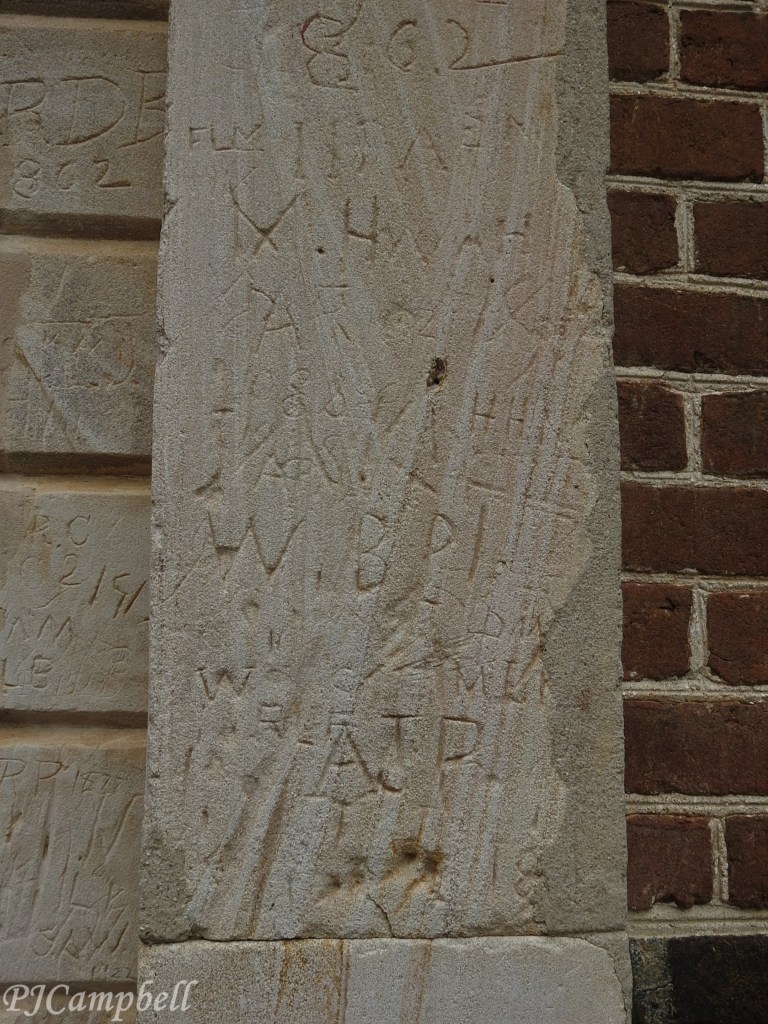
Over the years, the church at Pohick began to deteriorate. It remained relatively intact until the American Civil War when it was raided by the 2d Michigan Volunteers in November 1861. Those who thought the church “was sacred enough to be secure” were wrong. It was totally vandalized…. even the cornerstone laid by Washington in 1765 was unearthed. The pews, altar, everything was stolen or trashed. For the remainder of the war, the building was taken over by the army and used as a base of operations in the area. The graffiti carved into the walls is still visible today.
Sometime in 1874, renovations were begun, and the church was reconsecrated by the Episcopal Bishop of Virginia, John Johns, in 1875. With renovation, some items taken during the war were returned but the early renovations focused only on restoring the building for use as a church.  Later between 1890 and 1917, the Mount Vernon Ladies Association working with the Daughters of the American Revolution (DAR) began the process of restoring the building to its original design.

Pipe Organ

Today, the church – the congregation – remains active after more than 300 years. The building originally made of “good bricks well burnt” with corners (or quoins) made of Aquia Creek sandstone mined in Stafford, Virginia, stands as a testament to the faith and devotion of the people who make up the “church” and to the founding fathers of both the Pohick Church and this nation.

According to the church website, the church today is balanced on 7 pillars – worship, prayer, study, Christian fellowship, outreach/pastoral care, evangelism, and tradition/history3 citing the following Bible verse as the guide for the Pohick Church & Congregation:

“They devoted themselves to the apostles’ teaching and to the fellowship, to the breaking of bread and to prayer. Everyone was filled with awe, and many wonders and miraculous signs were done by the apostles. All the believers were together and had everything in common. Selling their possessions and goods, they gave to anyone as he had need. Every day they continued to meet in the temple courts. They broke bread in their homes and ate together with glad and sincere hearts, praising God and enjoying the favor of all the people. And the Lord added to their number daily those who were being saved.”

Acts 2:42-47

Sources for Information:

  1. Wikipedia George Washington – George Washington – Wikipedia
  2. Wikipedia Theistic Rationalism – Theistic rationalism – Wikipedia
  3. Wikipedia Pohick Church – Pohick Church – Wikipedia
  4. Pohick Church Website – Pohick Episcopal Church – LORTON, VA • EST 1732

Israel 2022: Sea of Galilee

What can I say? It was definitely another “pinch yourself” kind of day.  We had arrived late in the afternoon tired and worn out from that day’s tour but I could feel the excitement in the tour group. We had arrived at the Sea of Galilee!

Sea of Galilee

Sure, Caesarea Maritima, Mount Carmel, Megiddo…. yes, all were great places we had visited already but THIS was the Sea of Galilee. Almost everything we know about Jesus and his three- year ministry happened right there around the Sea of Galilee.  We had seen places – mainly archaeological ruins – where Jesus might’ve, could’ve, maybe did, walk or sleep or perform miracles but you could never know if he really was there in those exact places. Was he? Really?

But, not this place. Here, you could know for sure. The Sea of Galilee is right there just like it was two thousand years ago. The sun rises and sets there day after day just like it has throughout the millennia. It is right there where it has been since time began. The landscaping might have changed, the towns he knew and traveled through may be gone, but the sea itself pretty much remains the same. Timeless. We saw it as he saw it.

Our tour day – pretty much like all the tour days – started early. We were on a 6-7-8 schedule – wake up call at 6:00 AM, breakfast at 7:00 AM and be on the bus by 8:00 AM. I called it the “up, eat, go” timeline and most of the time I was still trying to get enough coffee in me at breakfast so I could at least see to get on the bus before it left the hotel. But, this morning was special.  I was ready.

Old boat along the shore

We headed out early to a dock where a boat waited to take us on a cruise on the Sea. So, I’m thinking it will be a little touristy and maybe a little kitschy to go for a ride in a boat that was sort of built in the style of ancient fishing boats…. but not really…just another tourist thing. Right?  But it was a beautiful morning as we headed out, so I put all tourist thoughts aside and planned to just enjoy myself.  The sea was calm, and the sun was up on a cloudless day, we’re in the Holy Land…and, as they say, “God’s in His heaven” …. what’s not to enjoy?

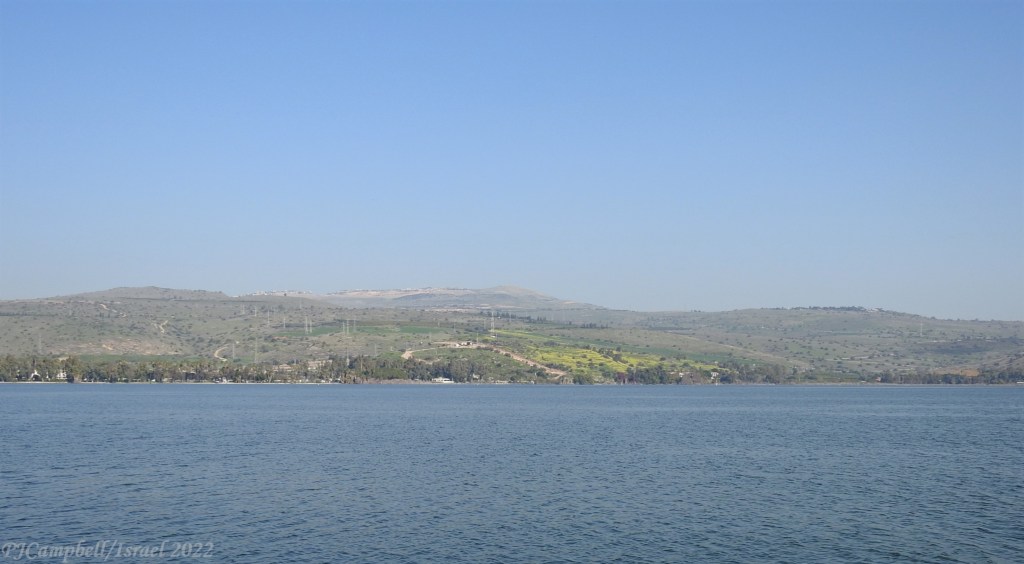
What’s not to like about a sunny day on the lake?

I say the “sea”, but Galilee is actually a fresh-water lake about 64.4 square miles (166.7 km) in area, about 32 miles (53 km) in circumference, 13 miles (21 km) long, and 8.1 miles (13 km) wide. The lake has had many names through the centuries…Lake Kinneret or Kinnereth, Lake Tiberias, and the Sea of Minya, to name a few.

The name Kinneret comes from the name of a Bronze/Iron Age city of Kinneret, the remains of which lie on the northwest shore at Tell el’Oreineh. There is also a school of thought that the name is derived from the Hebrew word “Kinnor” which means a harp or lyre because the sea/lake has the shape of a lute. I think maybe the ancient city from the Bronze Age might trump the harp/lute theory although a lute-shaped sea is very appealing and easier to remember.  Oh, here’s something to think about – the “Kinnor” or lute is the first musical instrument to be mentioned in the Bible. (Do not ask me where.) One last theory. According to the Talmud, the lake is named for Kinnar trees which grow there1….which may refer to reeds or the jujube, neither of which sound much like a tree at all to me.

Heading down to the boat.

Christians generally refer to it as the Sea of Galilee which is derived from the Hebrew “Haggalil” which means “the district”. Gelil Haggoyim means “the district of nations”1.  Since the lake and the Jordon River have been denoted as the borders for Israel, Syria, and Jordan over the years, then Galilee being a district of nations makes sense.  But, enough on the names and enough history for now…..back to the tour.

The buses took us to the park and museum area where we would catch the boat. As we walked down to the pier, I wondered if a fishing boat could be large enough to hold our entire tour group….or would we have to split up into groups. I needn’t have worried about that at all. There was plenty of room. As we gathered on the boat and found a seat, the praise team, having set up at the front, began to sing. Others in the group soon joined in and the day that was already beautiful, became even more so.

I wish I could tell you what songs they were singing and that I sang along but I can’t. I was raised in the south right there in the Bible belt and I remember the old hymns which I dearly love…..so I tend to go to churches where they still sing the old songs….the ones that stir my heart.  I do know a few of the more contemporary songs but not too many….so that morning on the Sea of Galilee, I was listening to the music and not doing too much singing. 

And, of course, I was busy trying to get photos of everything…and I mean everything.  Branch sticking up out of the water, I got it.  Reeds growing on the shore, got that too.  And I won’t mention how many blurry pictures of boats and birds that I took.  I know that many of my memories will hinge on what I can capture with my camera. I’m getting to that age when, sadly, my memories are fading. If I see the photo, it helps me to remember (for now, at least) the place and the experience.

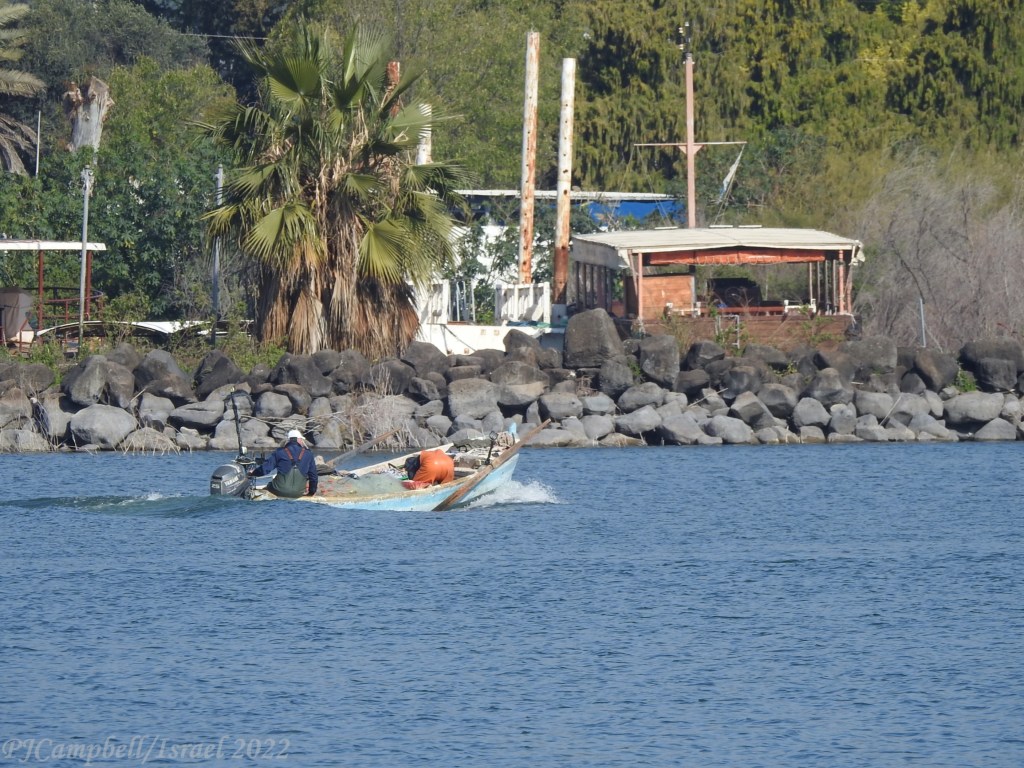
There are still fishermen on the sea.

And, the experience was wonderful. When our DTS guide, Dr. Yarbrough2, started to read from Mark chapter 4, I was hooked knowing that the events in the story he was reading took place right here in the middle of the Sea of Galilee in a boat not too different from the one we were in.  And it is a story I love (doesn’t everyone?) I know that you know the story – everyone who’s ever been to Sunday School knows it. 

The Primacy of St. Peter (Franciscan)

Jesus and the apostles were all in the boat crossing over the sea when a terrible storm arose. The twelve apostles were fighting to steer the boat and stay afloat. Meanwhile, Jesus slept peacefully in the stern on a cushion. (For some reason, I have always liked that Jesus had a cushion. I’m thinking most fishing boats at that time did not come equipped with cushions for sleeping. It reminds me that “the son of man” had no place to rest his head.)

When things got pretty rough, Peter woke Jesus up letting him know how perilous things were and asking how he (Jesus) could just sleep peacefully while the storm was raging and they were all in danger.  Jesus chided Peter a bit for not having faith and then He rebuked the storm commanding “Silence! – be still!” (Mark 4:35-41).  

And, it did. The storm just stopped…… just like that.

Now, when we set out in our boat that day, the sea was by no means stormy, but it was a bit choppy…nothing out of the ordinary for a lake…. pretty calm, in fact.  But when Dr. Yarbrough got to the point in the passage when Jesus rebuked the storm, I swear the water went dead calm…. not a ripple. The water was still.  I felt it right down to my toes. Everyone on the boat got quiet and I was sure that they felt it too. We were all having a “pinch yourself” moment.

Now, maybe it was just my heart that slowed for a minute or two; maybe it was just me hearing that old story and feeling it down deep knowing where I was at that moment and maybe it was not really the sea that calmed. I don’t know…. but one minute, I could feel the boat was rocking gently on the water, and the next minute it wasn’t. I felt it… I was not just hearing the words being read from scripture, I was feeling them…. and maybe I was really hearing those words for the first time.

No matter, in that moment, I was there. There. On the sea where Jesus walked.

Sunrise on the Sea of Galilee

Scriptural Cites Related to the Sea of Galilee:

  1. Numbers 34:11 – Shows Galilee as the boundary for the promised land/referred to as the Sea of Kinneret or Chinnereth (depending on the translation being used).
  2. Joshua 12:3 and Joshua 13:27 – Territories and cities listed in the kingdom of Sihon of Heshbon with the boundary running along the Jordan River as far north as the Sea of Galilee.
  3. Joshua 19:35 – The allotment for Naphtali included the fortified town of Kinnereth.
  4. Deuteronomy 3:17 – Land given to the Gadites & Reubenites from Kinnereth to the Dead Sea.
  5. Deuteronomy 33:23 – Naphtali reaches to the south from Lake Galilee.
  6. Isaiah 9:1 – God will honor Galilee of the nations by the Way of the Sea, beyond the Jordan.
  7. Matthew 4:13 – Jesus left Nazareth and went to live at Capernaum.
  8. Matthew 4:18-22, Mark 1:16-20,  Peter, Andrew, James, & John become followers of Jesus
  9. Matthew 5 and Luke 6:20-23 – Sermon on the Mount overlooking the Sea of Galilee.
  10. Luke 5:1-11 – Jesus tells Peter to put out into deep water and the fishermen catch enough fish to fill their boat and another boat to the point of beginning to sink. Luke refers to the sea as Lake Gennesaret
  11. John 1:43 – Jesus decides to go to Galilee and finds Philip who is called to follow Jesus.
  12. Mark 3:7-12, Matthew 4:23-25, & Luke 6:17-19  – A large crowd from Galilee, Judea, Idumea, Tyre & Sidon follows Jesus to the sea area. Jesus went throughout Galilee teaching, preaching, and healing.
  13. Matthew 8:23-27, Mark 4:35-42, and Luke 8:22 – Jesus calms the storm.
  14. Mark 5:1-20, Matthew 8:28-34, and Luke 8:26-39  – On the sea in the region of the Gerasenes, Jesus removes the demons from a possessed man and allows them to go into a herd of pigs which threw themselves into the sea.
  15. Matthew 13:1 – Jesus went out and sat beside Lake Galilee.
  16. Matthew 14:22-33, Mark 6:45-52, and John 6:16-21 – Jesus walked on the waters of the sea.
  17. John 6:1-16Matthew 14:13-21, Luke 9:10-17 and Mark 6:30-42  – Jesus went to mountain and feeds 5000 with five loaves and two small fish. Sea of Galilee is referred to as the Sea of Tiberias. Luke refers to the town of Bethsaida.
  18. Matthew 15:29-38 and Mark 8:1-10 – Jesus feeds 4000 on a mountain near the Sea of Galilee
  19. Mark 7:31-36 and Matthew 9:27-34 – Jesus left Tyre and went to the Sea of Galilee to Decapolis where he healed a deaf and mute man.
  20. John 21:1-24 – Jesus meets with the disciples at the Sea of Tiberias after his death & resurrection  It is at this appearance that Jesus asks Peter, “Do you love me?”.

Sources for Additional Information About the Sea of Galilee:

(Other than the Biblical cites listed above, my research comes from Wikipedia as shown below.)

  1. Sea of Galilee – Wikipedia
  2. Dr. Mark Yarbrough – Dallas Theological Seminary
  3. Kinneret (archaeological site) – Wikipedia – Bronze Age/Iron Age city on northwestern shore of the Sea of Galilee.
  4. Ginosar – Wikipedia
  5. Nahal Ein Gev II | The Institute of Archaeology (huji.ac.il) – Prehistoric Natufian site (hunter gatherer – pre-agricultural)
  6. Sea of Galilee Boat – Wikipedia
  7. Jesus Trail – Wikipedia – 40 Mile hiking trail “where Jesus walked”.
  8. Miracles of Jesus – Wikipedia
  9. Book of Signs – Wikipedia

ICYMI (In case you missed it) – Previous blogs in the Israel 2022 series:

Israel 2022: Pinch Yourself – April 4, 2022

Israel 2022: Caesarea Maritima – Birding Boomers – April 11, 2022

Israel 2022: Contested on Mount Carmel – Birding Boomers – April 20, 2022

Israel 2022: In This Valley – Birding Boomers – April 30, 2022