
If you missed Day 1 of this series, you can catch up here (Nebraska Trifecta & More – Day 1).
The plan for the day was to find our way to Route 30 also known as the Lincoln Highway and travel across Nebraska westward and then south towards Grand Island. The Lincoln Highway was first transcontinental roads and runs from Times Square in NYC passing through fourteen states on its way to Lincoln Park in San Francisco, CA.
 The map shows Route 30 running right along the Platte River and, knowing that the Platte River was where the Sandhill Cranes were supposed to be, it made sense to take a road that tracked with the river across the eastern part of Nebraska. And, according to Google Maps, the distance between Omaha and Grand Island along Route 30 would be 160 miles with “no traffic” which would take approximately three and a half hours. Now, that “no traffic” was music to my ears. It seemed to be just the kind of road that we loved – a back road along a river. Much has changed since the Lincoln Highway was the only highway across the state headed east & west.

I had determined that, all things considering, the best way to get to Route 30 was to go right through the middle of Omaha via Route 6 also known in town as Dodge Street. I came up with an address in Omaha on the GPS and plugged it into and we were ready to go. I just wanted to get to Dodge Street which seemed to run straight through Omaha…it was only a few miles, maybe ten, and Omaha was not too large and we were well past rush hour when we headed out so it shouldn’t be too difficult or take too long. We turned right out of the hotel and then about a mile later, we turned left just before the bridge at the Missouri and there we were, right in the middle of a riverfront park. What better place to bird than a park right on a river!
We were less than a mile from the hotel and were at our first stop. You can see why it takes us so long to get anywhere on our road trips. We do quite a bit of meandering. Our current record for most time taken to get someplace is a 2005 trip to the Outer Banks of North Carolina. Most people can do that trip from Annapolis, Maryland in a good six hours but we took just about four and a half days to get from our house to Kitty Hawk, NC. On this trip exploring eastern Nebraska, we only had three hard stops. We had to be in Gibbon at the Rowe Sanctuary at 6:00 PM on Wednesday, April 5th to see the Sandhill Cranes; we had to be at Calamus Outfitters in Burwell by 3:00 PM on Friday, April 7th for the Prairie Chicken festival; and we had to be back at Eppley Airfield in Omaha by 9:00 AM on April 11th for our flight home. Otherwise, we had time to explore. Like all vacations, it seemed like we’d have plenty of time for meandering but, by the time we headed home, we realized we didn’t have nearly enough time to do everything…… but it was enough altogether.
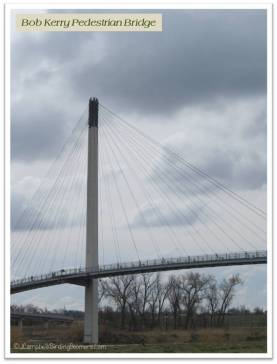 But, back to the birding at Miller’s Landing at the Park along Riverfront Road in Omaha. The park was very birdy this morning and a lovely spot on the river. We did not see any new birds; most were the common birds we see in the eastern part of the US.
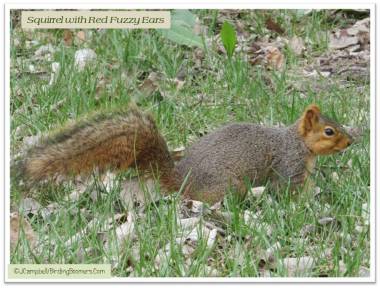 We did see a lovely red squirrel with fuzzy ears that we had never seen before back east. We also saw the first of what would be hundreds of American Robins – Nebraska seems to be crawling with Robins in the spring. On the other hand, we started to notice that there was a bird species that is so ubiquitous back east that we were not seeing – the Vulture – neither Black nor Turkey Vultures were to be seen.
 The park also included the first of several interpretive monuments we would see on our trip that identified the stops on the Lewis and Clark Expedition. You can take a “self-guided” tour of the whole expedition by following the stops on the Lewis & Clark Trail. This first monument commemorated the expedition landing on the Missouri River here between Council Bluffs, IA and Omaha, NE. There is also a beautiful suspension bridge – pedestrians only – here crossing the Missouri and seemingly connecting the two cities (we did not cross).
 Then it was time to push on through Omaha and find our way to Route 30 (via Route 6/Dodge Street and Route 275 to Fremont). Getting through Omaha was not bad – we didn’t travel through the city as quickly as I had hoped but, then again, it is the largest city in Nebraska so getting to the other side took a little time. We stopped along the way to get photos of a couple churches (one of my other photo vices which also include wildflowers and animals of any kind) and old buildings. We spotted the Mutual of Omaha building standing proudly above the others and, although we ate at a Perkins Restaurant one morning, we never spotted Marlin Perkins although I suppose it would have been creepy if we had since he died in 1986.
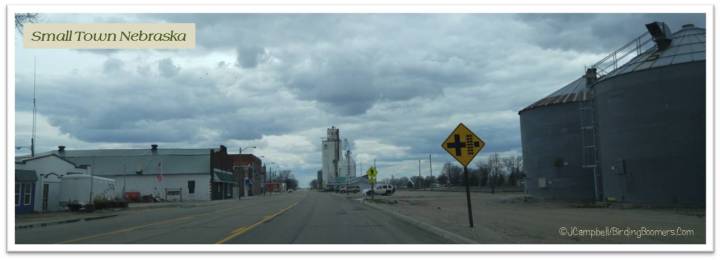 Before you knew it we were at Fremont and heading west on Route 30. We immediately got a feel for the prairie and for long flat lonely roads. We pondered how desolate it would have been to the pioneers traveling across this country with nothing in sight but more prairies – flat grasslands as far as the eye could see. And there were no roads back then – they just ran their wagons along a trail through the grasslands and, if the trail could not be determined by the wheel ruts of wagons that passed before, then the only alternative was to cross new ground. On our last night at Calamus up near Burwell, a storyteller spoke at the festival. One of the things she spoke about in her “story” related to the endless days with no change in the scenery – day after day of pressing forward into the unknown – and the need to stay north of the river so that you never had to take the wagons across the river where they were most likely to get stuck in the wet sand and wetlands around the river. Alas, for the pioneers there were no roads and no bridges either.
And we’re back to the river – well, the road did follow right along the river but was about 2 miles away so we rarely saw the river at all. I scoured the maps to see if there were roads closer to the river that we could take – even for a few miles – but there really weren’t. While there were side roads that appeared on the map to go down near the river, almost all were perpendicular to the river (i.e., they go down and then you turn around and come back) and very few ran parallel to the river.
I have to pause a moment and talk about roads in Nebraska. If you’re in the city or on a highway or on a state road, you’re traveling on pavement but pretty much everything else is dirt. In the east we are used to dirt roads out in the boonies that are “rocked” with granite chips about once a year or so but, in Nebraska the side roads – and pretty much all of them are side roads – seem to be flat hard sand. If there are rocks mixed in with the sand, they must be very small pebbles which make sense in creating a hard surface on packed sand for automobiles and tractors. So, we learned quickly that getting off the main road meant getting onto a dirt road.
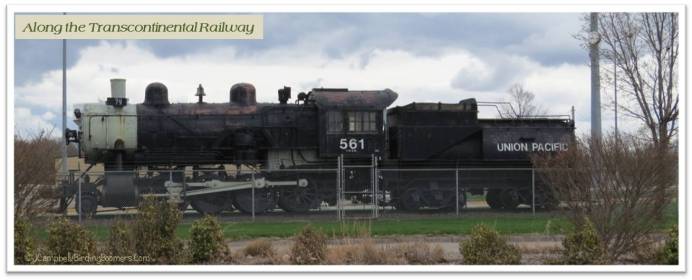 We also noticed right off that the railroad track does run parallel to the highway both running almost straight as an arrow towards the horizon. (Okay, that’s an old steam engine we found in Columbus…..no longer working, of course. On the other hand, we did see quite a few trains as we traveled west not to mention getting stopped at a crossing at least twice on the way.)
 About every five miles (Jerry started tracking it), we would come to a set of large grain silos and a small community which seemed to be built on one side or another of the road and railroad track rather than all around the silos and on both sides of the road. And that was all. There might be a gas station or a convenience store but little else of note.
 And we discovered that there are no WaWa’s in Nebraska and we only saw 7-11’s in the larger cities but there were plenty of Casey’s General Stores. Since WaWa is an east coast thing, I didn’t expect to see them but was surprised that there were few 7-11’s. For the most part, there were large farms and lots of tractors. I really do not recall seeing lots of McMansions along the way. There were some big old houses in some communities and some rather large ranch houses way out in the fields…..this was farm country, pure and simple.
 We noticed a very large granary between Fremont and Columbus that I wanted to photograph. It was more of a grain processing plant I think by the size of it. The drive up to the granary turned out to be a pretty good birding spot since there were wetlands (unexpected) along the drive that added American Coots and Ruddy Ducks to our trip list.
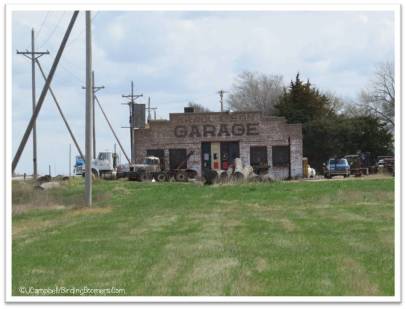 Then we were back on the road again. We made a snack stop in Schuyler at a Casey’s (our first) and discovered they did not have ginger ale. How could that be? No ginger ale? So, we stopped at a Walmart (aren’t they everywhere?) in Columbus and finally found one two liter bottle of Seagram’s (I swear it was the only one). We asked a store clerk about Canada Dry Ginger Ale and got a bit of a blank stare before she directed us back to the soda section “if we have any” which they didn’t. It wasn’t until we got back to Omaha, well, actually Carter Lake, Iowa that we found a store that carried Canada Dry Ginger Ale.
Since we were at the Walmart, we grabbed a sandwich from Subway and headed to a memorial I had on my list of possible places to see on the trip. Route 30 hadn’t offered much by way of parks or preserves to see along the way. We did a quick drive-through at the Fremont State Recreational Area (SRA) but there wasn’t much there to see. It was more of a fishing and camping park that wasn’t very busy or birdy this time of year although the small lakes were nice. So, although I hadn’t planned on stopping at the Higgins Memorial Park since it was more historical than parks related to birds, etc., we decided it might be a great place to take a break, look around, and have lunch. So, I plugged the address into the GPS and we headed to the park.
And, this is the spot that gave us our first GPS glitch. When you travel, there are always locations or addresses that can cause a little problem with the GPS and you end up either lost or just maybe taking a longer route than you had anticipated. So, we followed the GPS and ended up in a very nice park – with some of those little red squirrels with the fuzzy ears – with a dead end street that the GPS insisted we should follow. At GPS moments like this, I resort to Google Maps on my trusty smart phone – my unfailing back-up. I routed us through a neighborhood and over to the main road which we crossed and entered the park that included the memorial. It turns out that the underpass from one side of the park to the other was closed for repair so I really cannot blame the GPS – stuff like this happens. It is always good to have a back-up plan and a couple of paper maps.
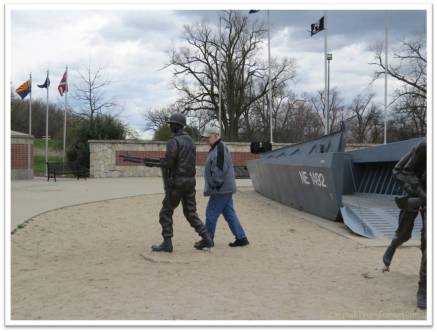
 The Higgins Memorial turned out to be quite interesting and the surrounding park was lovely on a beautiful spring day. It wasn’t too birdy this day so we contented ourselves eating lunch and checking out the Memorial. Andrew Higgins is credited with designing and building landing crafts that were used in World War II. You know these boats – they look like metal boxes with flat bottoms that are used to transports troops from ships to beaches that push up close to a beach and drop a ramp so that the troops can come pouring out onto the beach ready for combat. The boats were especially useful in storming the beaches at Normandy on D-Day (June 6, 1944). According to the memorial and the website, Dwight D. Eisenhower (famous US General in WWII and the 34th US President from 1953 – 1961) called Andrew Higgins “the man who won the war for us”. Since Higgins was born in Columbus and raised around the Platte and Loup Rivers where flat bottomed boats were typically used on the shallow rivers, the memorial is here at Columbus.
 After Columbus, the road turned south and we headed on towards Grand Island our destination for the day. There weren’t a whole lot of parks along Route 30 but we did get a great feel for the land and the towns along the rivers.
 There was one last site I wanted to visit before we called it a day and headed to a hotel – Townsley-Murdock Trail site. This is supposed to be the only place in Nebraska where you can actually still see the imprint of pioneer wagon wheel ruts in the grasslands. It is not a big site and not easy to find. But the guidebooks I had read had given me the crossroads and GPS coordinates and enough information to get us there. And still we passed it and had to go back since it is really not much more than a sign on the side of the road. But we found it and….well….I have to say, there isn’t much there except for that sign. It is supposed to be the one spot on the Mormon Trail near the Wood River Crossing that had not been disturbed since the pioneers used that route.
 The wagon ruts are said to be visible in the swales of grass growing there but we had to really use our imagination to see what we might call wagon wheel ruts on the trail. There did appear to be something but it appeared that people had walked through the area so it was difficult to tell if the “rut” was from a pioneer wagon a hundred or so years ago or from a day-hiker last week. I thought about rummaging through the grass to see if I could find a rut underneath but that seemed like way too much trouble at the time and the authorities probably wouldn’t appreciate me digging at a monument site.
Finally, we headed on over to a hotel, checked in, and called it a day. Tomorrow we would explore some parks around Grand Island in hopes of finally seeing some Sandhill Cranes and maybe some more of those fuzzy eared squirrels.
Itinerary:
April 3 – Baltimore, MD to Omaha, NE (via Minneapolis, MN): 1153 Miles
April 4 – Omaha to Grand Island (via Route 30): 160 Miles
Sites Visited Thus Far:
ADM Grain Company Driveway
Freemont State Recreation Area (SRA)
Higgins Memorial
Townsley-Murdock Trail Site
Birds Spotted On The Trip Thus Far:
American Coot
American Robin
Canada Goose
Common Grackle
Double-Crested Cormorant
European Starling
House Sparrow
Killdeer
Mallard
Mourning Dove
Northern Cardinal
Red-Tailed Hawk
Ring-Billed Gull
Ruddy Duck




 Birding Boomers