What can I say? It was definitely another “pinch yourself” kind of day. We had arrived late in the afternoon tired and worn out from that day’s tour but I could feel the excitement in the tour group. We had arrived at the Sea of Galilee!

Sure, Caesarea Maritima, Mount Carmel, Megiddo…. yes, all were great places we had visited already but THIS was the Sea of Galilee. Almost everything we know about Jesus and his three- year ministry happened right there around the Sea of Galilee. We had seen places – mainly archaeological ruins – where Jesus might’ve, could’ve, maybe did, walk or sleep or perform miracles but you could never know if he really was there in those exact places. Was he? Really?
But, not this place. Here, you could know for sure. The Sea of Galilee is right there just like it was two thousand years ago. The sun rises and sets there day after day just like it has throughout the millennia. It is right there where it has been since time began. The landscaping might have changed, the towns he knew and traveled through may be gone, but the sea itself pretty much remains the same. Timeless. We saw it as he saw it.
Our tour day – pretty much like all the tour days – started early. We were on a 6-7-8 schedule – wake up call at 6:00 AM, breakfast at 7:00 AM and be on the bus by 8:00 AM. I called it the “up, eat, go” timeline and most of the time I was still trying to get enough coffee in me at breakfast so I could at least see to get on the bus before it left the hotel. But, this morning was special. I was ready.

We headed out early to a dock where a boat waited to take us on a cruise on the Sea. So, I’m thinking it will be a little touristy and maybe a little kitschy to go for a ride in a boat that was sort of built in the style of ancient fishing boats…. but not really…just another tourist thing. Right? But it was a beautiful morning as we headed out, so I put all tourist thoughts aside and planned to just enjoy myself. The sea was calm, and the sun was up on a cloudless day, we’re in the Holy Land…and, as they say, “God’s in His heaven” …. what’s not to enjoy?

I say the “sea”, but Galilee is actually a fresh-water lake about 64.4 square miles (166.7 km) in area, about 32 miles (53 km) in circumference, 13 miles (21 km) long, and 8.1 miles (13 km) wide. The lake has had many names through the centuries…Lake Kinneret or Kinnereth, Lake Tiberias, and the Sea of Minya, to name a few.
The name Kinneret comes from the name of a Bronze/Iron Age city of Kinneret, the remains of which lie on the northwest shore at Tell el’Oreineh. There is also a school of thought that the name is derived from the Hebrew word “Kinnor” which means a harp or lyre because the sea/lake has the shape of a lute. I think maybe the ancient city from the Bronze Age might trump the harp/lute theory although a lute-shaped sea is very appealing and easier to remember. Oh, here’s something to think about – the “Kinnor” or lute is the first musical instrument to be mentioned in the Bible. (Do not ask me where.) One last theory. According to the Talmud, the lake is named for Kinnar trees which grow there1….which may refer to reeds or the jujube, neither of which sound much like a tree at all to me.

Christians generally refer to it as the Sea of Galilee which is derived from the Hebrew “Haggalil” which means “the district”. Gelil Haggoyim means “the district of nations”1. Since the lake and the Jordon River have been denoted as the borders for Israel, Syria, and Jordan over the years, then Galilee being a district of nations makes sense. But, enough on the names and enough history for now…..back to the tour.
The buses took us to the park and museum area where we would catch the boat. As we walked down to the pier, I wondered if a fishing boat could be large enough to hold our entire tour group….or would we have to split up into groups. I needn’t have worried about that at all. There was plenty of room. As we gathered on the boat and found a seat, the praise team, having set up at the front, began to sing. Others in the group soon joined in and the day that was already beautiful, became even more so.
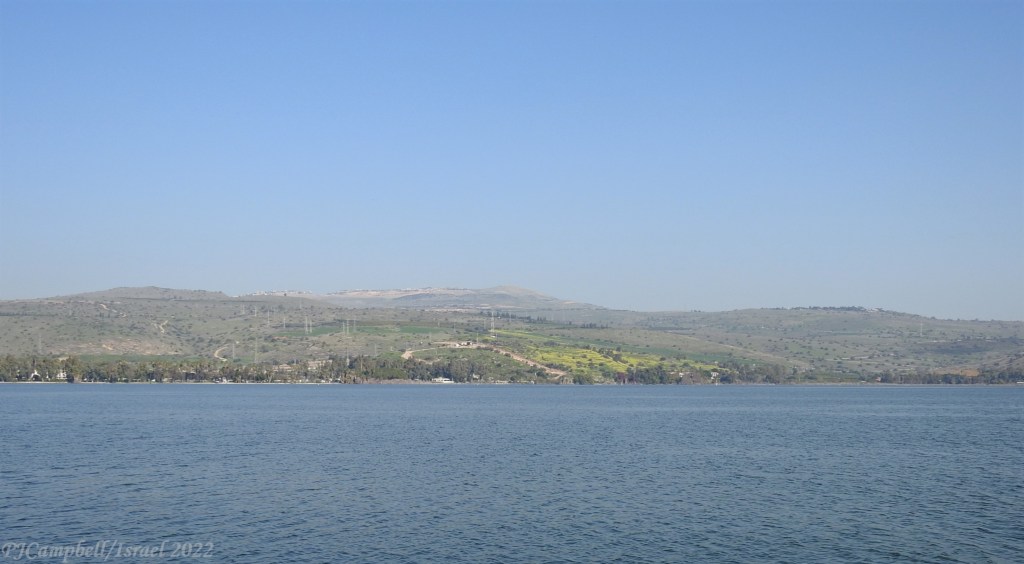
I wish I could tell you what songs they were singing and that I sang along but I can’t. I was raised in the south right there in the Bible belt and I remember the old hymns which I dearly love…..so I tend to go to churches where they still sing the old songs….the ones that stir my heart. I do know a few of the more contemporary songs but not too many….so that morning on the Sea of Galilee, I was listening to the music and not doing too much singing.
And, of course, I was busy trying to get photos of everything…and I mean everything. Branch sticking up out of the water, I got it. Reeds growing on the shore, got that too. And I won’t mention how many blurry pictures of boats and birds that I took. I know that many of my memories will hinge on what I can capture with my camera. I’m getting to that age when, sadly, my memories are fading. If I see the photo, it helps me to remember (for now, at least) the place and the experience.
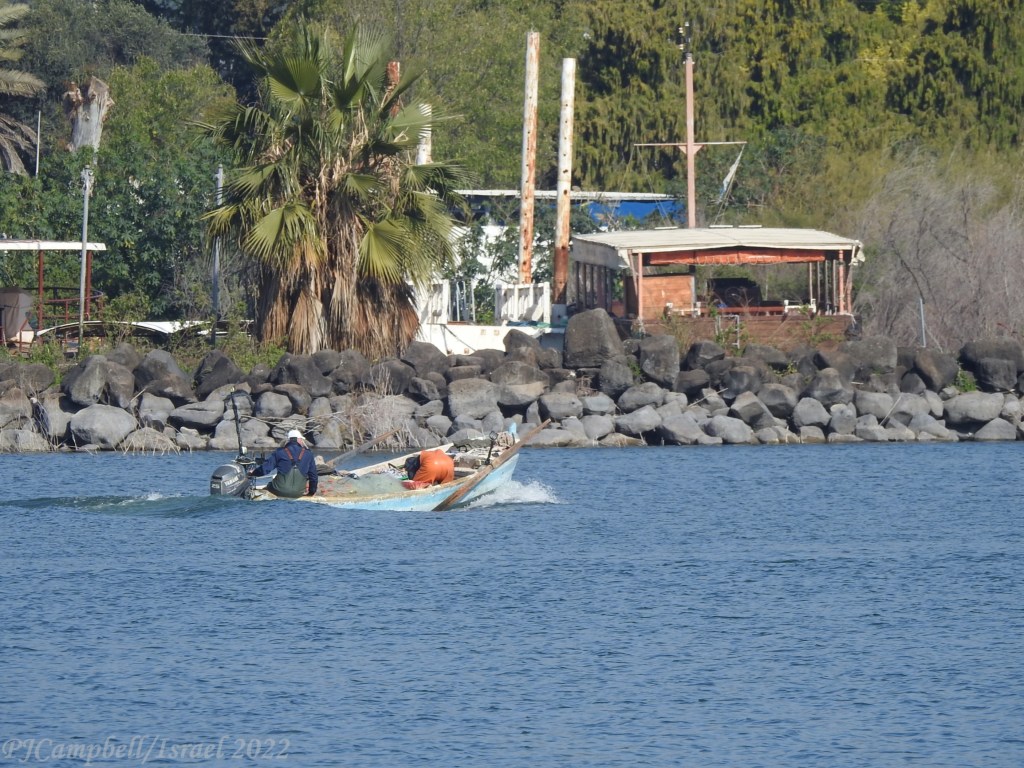
And, the experience was wonderful. When our DTS guide, Dr. Yarbrough2, started to read from Mark chapter 4, I was hooked knowing that the events in the story he was reading took place right here in the middle of the Sea of Galilee in a boat not too different from the one we were in. And it is a story I love (doesn’t everyone?) I know that you know the story – everyone who’s ever been to Sunday School knows it.

Jesus and the apostles were all in the boat crossing over the sea when a terrible storm arose. The twelve apostles were fighting to steer the boat and stay afloat. Meanwhile, Jesus slept peacefully in the stern on a cushion. (For some reason, I have always liked that Jesus had a cushion. I’m thinking most fishing boats at that time did not come equipped with cushions for sleeping. It reminds me that “the son of man” had no place to rest his head.)
When things got pretty rough, Peter woke Jesus up letting him know how perilous things were and asking how he (Jesus) could just sleep peacefully while the storm was raging and they were all in danger. Jesus chided Peter a bit for not having faith and then He rebuked the storm commanding “Silence! – be still!” (Mark 4:35-41).
And, it did. The storm just stopped…… just like that.
Now, when we set out in our boat that day, the sea was by no means stormy, but it was a bit choppy…nothing out of the ordinary for a lake…. pretty calm, in fact. But when Dr. Yarbrough got to the point in the passage when Jesus rebuked the storm, I swear the water went dead calm…. not a ripple. The water was still. I felt it right down to my toes. Everyone on the boat got quiet and I was sure that they felt it too. We were all having a “pinch yourself” moment.
Now, maybe it was just my heart that slowed for a minute or two; maybe it was just me hearing that old story and feeling it down deep knowing where I was at that moment and maybe it was not really the sea that calmed. I don’t know…. but one minute, I could feel the boat was rocking gently on the water, and the next minute it wasn’t. I felt it… I was not just hearing the words being read from scripture, I was feeling them…. and maybe I was really hearing those words for the first time.
No matter, in that moment, I was there. There. On the sea where Jesus walked.

Scriptural Cites Related to the Sea of Galilee:
- Numbers 34:11 – Shows Galilee as the boundary for the promised land/referred to as the Sea of Kinneret or Chinnereth (depending on the translation being used).
- Joshua 12:3 and Joshua 13:27 – Territories and cities listed in the kingdom of Sihon of Heshbon with the boundary running along the Jordan River as far north as the Sea of Galilee.
- Joshua 19:35 – The allotment for Naphtali included the fortified town of Kinnereth.
- Deuteronomy 3:17 – Land given to the Gadites & Reubenites from Kinnereth to the Dead Sea.
- Deuteronomy 33:23 – Naphtali reaches to the south from Lake Galilee.
- Isaiah 9:1 – God will honor Galilee of the nations by the Way of the Sea, beyond the Jordan.
- Matthew 4:13 – Jesus left Nazareth and went to live at Capernaum.
- Matthew 4:18-22, Mark 1:16-20, Peter, Andrew, James, & John become followers of Jesus
- Matthew 5 and Luke 6:20-23 – Sermon on the Mount overlooking the Sea of Galilee.
- Luke 5:1-11 – Jesus tells Peter to put out into deep water and the fishermen catch enough fish to fill their boat and another boat to the point of beginning to sink. Luke refers to the sea as Lake Gennesaret
- John 1:43 – Jesus decides to go to Galilee and finds Philip who is called to follow Jesus.
- Mark 3:7-12, Matthew 4:23-25, & Luke 6:17-19 – A large crowd from Galilee, Judea, Idumea, Tyre & Sidon follows Jesus to the sea area. Jesus went throughout Galilee teaching, preaching, and healing.
- Matthew 8:23-27, Mark 4:35-42, and Luke 8:22 – Jesus calms the storm.
- Mark 5:1-20, Matthew 8:28-34, and Luke 8:26-39 – On the sea in the region of the Gerasenes, Jesus removes the demons from a possessed man and allows them to go into a herd of pigs which threw themselves into the sea.
- Matthew 13:1 – Jesus went out and sat beside Lake Galilee.
- Matthew 14:22-33, Mark 6:45-52, and John 6:16-21 – Jesus walked on the waters of the sea.
- John 6:1-16, Matthew 14:13-21, Luke 9:10-17 and Mark 6:30-42 – Jesus went to mountain and feeds 5000 with five loaves and two small fish. Sea of Galilee is referred to as the Sea of Tiberias. Luke refers to the town of Bethsaida.
- Matthew 15:29-38 and Mark 8:1-10 – Jesus feeds 4000 on a mountain near the Sea of Galilee
- Mark 7:31-36 and Matthew 9:27-34 – Jesus left Tyre and went to the Sea of Galilee to Decapolis where he healed a deaf and mute man.
- John 21:1-24 – Jesus meets with the disciples at the Sea of Tiberias after his death & resurrection It is at this appearance that Jesus asks Peter, “Do you love me?”.
Sources for Additional Information About the Sea of Galilee:
(Other than the Biblical cites listed above, my research comes from Wikipedia as shown below.)
- Sea of Galilee – Wikipedia
- Dr. Mark Yarbrough – Dallas Theological Seminary
- Kinneret (archaeological site) – Wikipedia – Bronze Age/Iron Age city on northwestern shore of the Sea of Galilee.
- Ginosar – Wikipedia
- Nahal Ein Gev II | The Institute of Archaeology (huji.ac.il) – Prehistoric Natufian site (hunter gatherer – pre-agricultural)
- Sea of Galilee Boat – Wikipedia
- Jesus Trail – Wikipedia – 40 Mile hiking trail “where Jesus walked”.
- Miracles of Jesus – Wikipedia
- Book of Signs – Wikipedia
ICYMI (In case you missed it) – Previous blogs in the Israel 2022 series:
Israel 2022: Pinch Yourself – April 4, 2022
Israel 2022: Caesarea Maritima – Birding Boomers – April 11, 2022
Israel 2022: Contested on Mount Carmel – Birding Boomers – April 20, 2022
Israel 2022: In This Valley – Birding Boomers – April 30, 2022