
It never fails to amaze me that I can get on a plane in a bit of a snowstorm in Baltimore, Maryland and, within a couple of hours, get off that plane in Miami, Florida – just about 972 miles away – to find blue skies and warm breezes. But let’s not stop there. We traveled on to San Jose, Costa Rica – a total of roughly 2098 miles – and we are slap dab in the tropics. All in the space of a single day – Bazinga! There you are, in another country almost in another hemisphere and you’re stripping off layers of jackets and sweaters and long-sleeved shirts trying to get down to something more fitting for summertime weather.
 We landed in San Jose in the afternoon ….just in time for their version of rush hour. A driver picked us up at the airport and transported us to our hotel for the first couple of days in country. The driver had a very young and very nice assistant who spoke enough English to make the journey a little less hectic. It sounded like he told me that the locals call rush hour, “dunde pickle”. I know very little Spanish – you know, the basics – “hello”, “goodbye”, “thank you”, “where the heck is the bathroom” – so I cannot tell you what the young man was really saying to me or whether or not I was even hearing the phrase correctly but it does have a ring of truth in it no matter what the language. I can tell you, having experienced more traffic jams in my life than I care to, you are usually in some kind of a pickle or another when you’re stuck in traffic so “dunde pickle” sounds like a pretty good interpretation to me.
 We arrived at a beautiful hotel that seemed to arise out of nowhere. We were riding along down a crowded street where all the houses looked the same and included forbidding wrought iron fences and gates, some with razor wire strung across the tops of the fences, when we came to a imposing stone fence and ornate gateway hiding beautifully landscaped gardens and an old world style lodge. The Hotel Bougainvillea was as charming and lovely as the name implies…and there were tons of bougainvillea growing and blooming everywhere. I am not really sure if we could ever have found the hotel by ourselves. In the case of Costa Rica, I have learned that it is probably best to leave the driving to someone else. But I will leave traffic and the hotels in Costa Rica for another day; today, it is all about the birds.
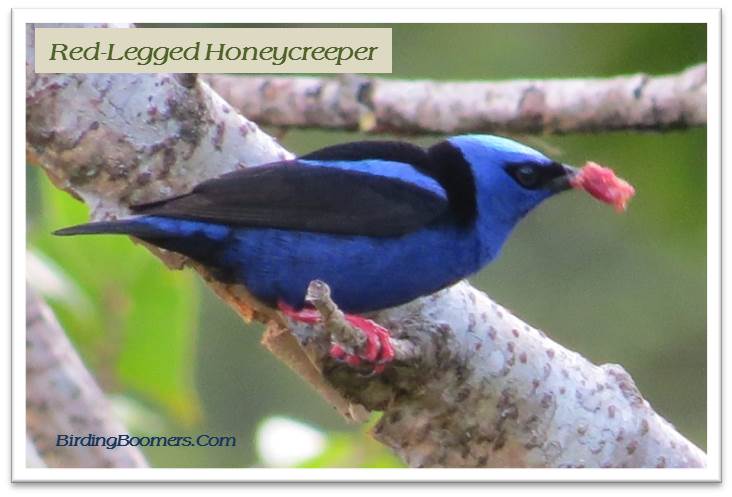 We went to Costa Rica to see birds. And birds we saw. In the twelve (12) days we stayed in Costa Rica, we recorded 188 species of birds. All but a handful of these were birds we had never seen before…..all life birds for us. One of the very first species we saw was a gorgeous Baltimore Oriole and do not think that the irony of traveling two thousand miles to see a Baltimore Oriole was lost on us. But the pair of Orioles were beautiful and started us out right. For the next eleven days we traveled to three different locations in the country looking for and enjoying birds in a variety of different environments.
I won’t try to include a list of the birds here but I have recorded the birds at eBird.org. I have annotated the lists at eBird.org to be “shared” so, if you are so inclined you can review the list there or you can view the list here. In all, we took more than 1000 photos and then when we got home and looked at all of them on the computer screen, I think I may have deleted roughly about half of them. My standing joke is that when I show photos of the birds I have seen, all of their names begin with “blurry” as in, “Here is another blurry eagle photo”. I like birding and I like taking pictures but I hate carrying around a large camera so I make compromises about the camera size and capabilities so I get some basic photographs that work for me but certainly will not win any awards. I am sharing some of the bird photographs that came out best and not necessarily sharing photos of the birds that impressed me most.
 The bird that was probably the most photographed bird by everyone we encountered on the trip was the Resplendent Quetzal. Even our guide stopped pointing out all other birds when a Quetzal came into view. We were staying at the Sevegre Mountain Lodge in the cloud forest where the Quetzals live and everyone there was fascinated with the birds. The driver that delivered us to the lodge and two days later returned to pick us up was totally besotted with the Quetzal. He told us that the bird was the national bird of Honduras and seemed miffed that Costa Rica had chosen the lowly but common Clay Colored Thrush (also called a Robin) as its national bird. He (German – that’s pronounced Herman as he told us right from the start) told us that he had not seen a Quetzal in more than 4 years and that most Costa Ricans lived their whole lives without ever seeing a Quetzal. It reminded me of our own Bald Eagle and how exciting it is for most Americans to see a Bald Eagle for the first time.
I have to pause a moment to remind everyone as I was reminded while in Central America that we from the United States refer to ourselves as “Americans” but we are not the only “Americans”. In point of fact, anyone living in the western hemisphere (North, South, and Central America) can correctly be called “Americans”. But, although this was pointed out to me, I suspect most citizens of Canada, Central and South America do not always want to be bunched in with the United States. Sometimes it is good to be “American” and sometimes I think the non-USA folks do not necessarily want to be included in the mix with us North-but-not-Canada Americans.
Okay, enough politics and back to Quetzals and our driver, German. To finish up the thought, as we were driving out of the valley on this rough, washed out, gravel (washboard all the way) road with an incline of about 80 degrees, German saw a man with a scope on the side of the road and promptly stopped the van, jumped out and rushed over to see the Quetzal that we had just spotted in the tree. As he stopped, I told him that we had seen several Quetzals while at the lodge and that “it was okay by us” if he didn’t stop to view this one. He jumped out of the van and called over his shoulder as he ran that “it is not okay by me”. So I got out and grabbed my binoculars for one last look at one of the birds. What else could I do? Interestingly enough, the nice young man at the side of the road with a scope with a digiscope/camera attachment graciously offered to let us take a look at the bird through his scope. German, in excitement at seeing a Quetzal, just started taking pictures with the nice guy’s camera. The nice guy, amazingly enough, seemed to understand and didn’t say a word…..at least that I heard.
 I mentioned the Clay Colored Thrush which is Costa Rica’s national bird. And I must say that German, for one, wasn’t very happy about that but “What can you do? The Government says it must be this way.” The Clay Colored Thrush, also called a robin by most people we met there, is very common and can be seen pretty much throughout Costa Rica. Perhaps it is the fact that Clay Colored Thrushes are so prevalent throughout the country that made it the ideal candidate for national bird. After all, it would be difficult to find anyone who lives in or visits Costa Rica who hasn’t seen or heard the Clay Colored Thrush. It was one of the first new birds we encountered and one of the last we saw before departing for the airport on our way out. It is a beautiful cinnamon color, looks very much like a robin in shape and form, and seems to sing from dawn to dusk every day. Of course, I was advised by one of our birding guides that American Robins are not really robins, they are also thrushes. It seems that English colonists settling the US saw the birds and, thinking they looked quite a bit like the robins in Europe, promptly named them American Robins. I haven’t researched this but it makes sense. I’ll put it in my notes as something I should check on another day.
 The most unusual bird we saw had to have been the Great Potoo. And this was like a “bonus” bird in that I’m betting most birders who go to the country for the first time might not have the opportunity to see this bird. Our guide, Eric, knew another guide who knew someone who had spotted the bird in a tree in front of a private residence. They painted a big sign on the side of the road that says, “Potoo” so the guides in the area would know which house. I tried to imagine someone painting a sign like that near a house in our neighborhood back home….wouldn’t the homeowner’s associations just love that? Not to worry, Eric had contacted the homeowners and gotten permission to bring his birding groups to see the bird. It was pretty awesome. Of course, I say we saw the bird but I have to tell you that this bird has to be the most well-camouflaged bird known to man. It is definitely the hardest to see that I have ever seen. The bird is nocturnal and spends its days sitting motionless on a limb of a tree. It looks exactly like just another dead branch jutting out of the tree. Even when Eric set the scope up to view the bird, it was amazing to think that there was a bird there at all. The photo here is the best I could get considering the lighting was not great (late afternoon) and the bird was so well concealed – in plain sight. The homeowners did not speak any English but they offered us fresh fruit and told us (through our guide) stories about the Potoo and its habits. And they advised that the Potoo was a parent and there was a baby. Now, I was having enough trouble differentiating the bird itself from the tree and now they tell me there is a baby somewhere up there on that limb too. And there was! You had to view it through the scope and wait patiently. Every 5 minutes or so, the little guy would peek out from the adult bird’s feathers and gave us a quick view. It was nothing more than a little ball of fur that made me wish I could see more but it was not to be – he was safe in mom’s (or dad’s) feathers. What an experience that was.
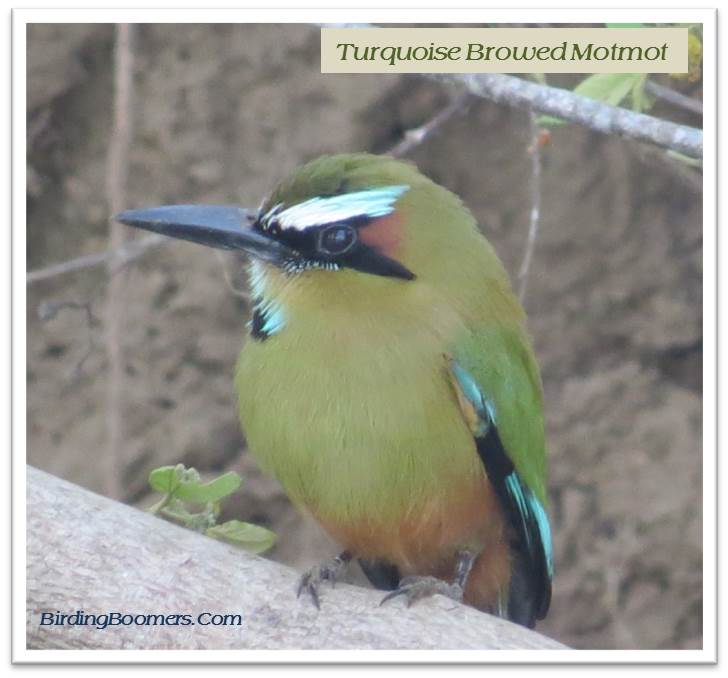 Now my favorite bird was the Motmot. I don’t know whether it was the name or the funny call it made or the beauty of the bird itself but I really liked the Motmot. We saw two different ones, the Blue-Diademed (or Crowned) Motmot in the rainforest and the Turquoise-Browed Motmot down near the Pacific coast. Both were very beautiful and, after seeing the first one earlier in the week, I was thrilled to see a second type on our very last day of birding before we headed home.
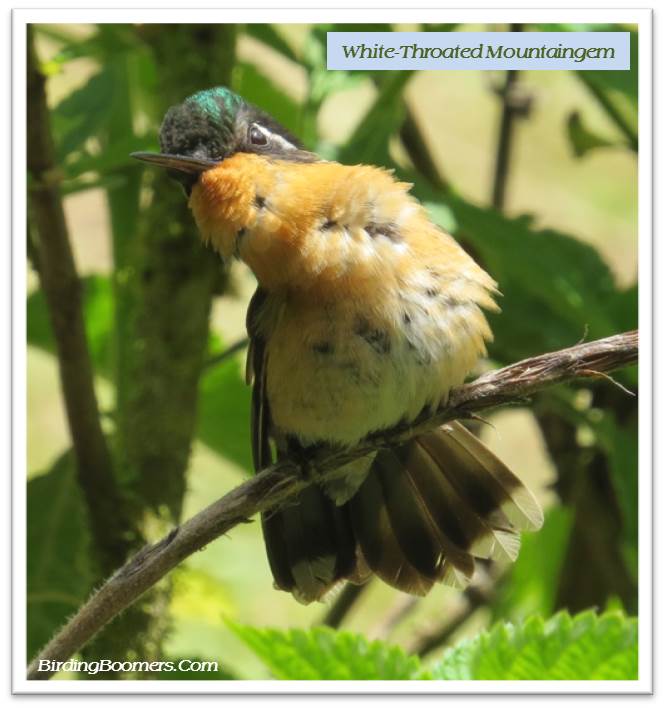
 Jerry’s favorite bird was one of the hummingbirds. And there were hummingbirds everywhere. If you hang out a feeder in Costa Rica, you will get hummingbirds absolutely (apparently). We saw 17 different species on our trip. Now that is like sensory overload when you consider that we only really have the 1 species in Maryland, the Ruby-Throated Hummingbird (although there are a couple migrants that pass through now and then). We visited a privately owned preserve called Bosque De Paz and spent several hours just sitting outside at a pavilion watching and photographing hummingbirds. Now, you might tell yourself that I should be a hummingbird expert at this point. Nope, not a chance. I have to go through all the photographs and try to figure out which is which. I have the names written down but the birds all run together in my mind. I’m thinking that there must be a more organized way to identify the birds associated with the photos but, if there is, I didn’t do a very good job of it. But, I do know that Jerry’s favorite was the White-Throated Mountaingem. We had seen the Purple-Throated Mountaingem near Basque de Paz; the White-Throated Mountaingem was spotted at Sevegre Mountain Lodge. Now, the males of the two species are quite gorgeous but it is the females that captured Jerry’s heart. He was smitten from first sight.
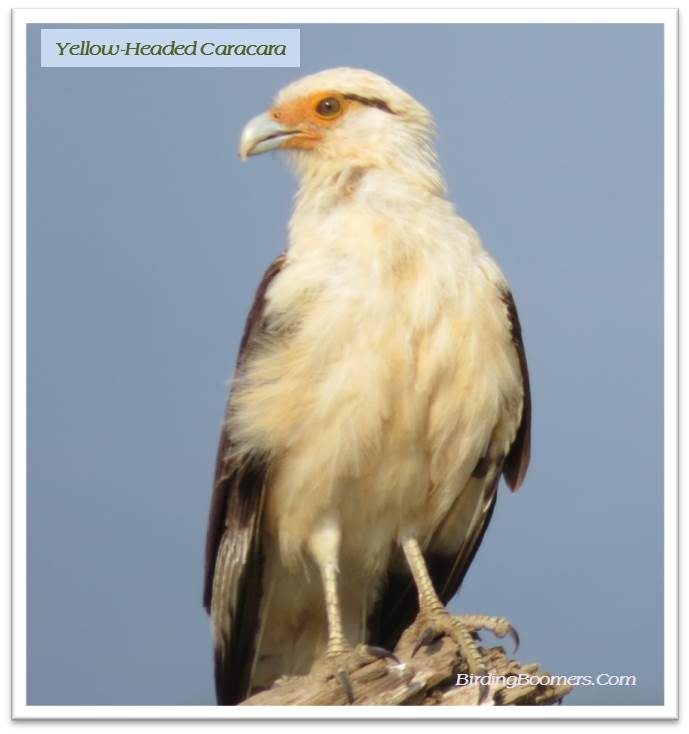 I would be remiss if I didn’t mention the bigger birds. The two Tiger Herons, Bare-Throated and Fasciated, were both beautiful birds. Of the raptors, the Laughing Falcon, the Swallow-Tailed Kite, the White-Tailed Kite, the Yellow-Headed Caracara, and the Black Hawk and its cousin, the Mangrove Black Hawk, were all spectacular. The Black and Crested Guans were also pretty amazing. I quickly ran out of adjectives to use and started to attempt to use a little Spanish here and there saying the birds were “mucho bueno”. Eric (our ever patient guide) suggested I might try British phrases like
  “splendid” or “fascinating” instead when I ran out of colorful words to describe the beautiful birds. Guess I was doing a pretty good job of butchering his language and he figured getting me back to English would be a good idea.
Now, of course, we saw Macaws, Parrots, Parakeets, and Toucans. Some we saw flying over the hills and valleys near the house where we saw the Potoo. Others we saw at the rainforest at La Selva Biological Station. La Selva is a part of the Organization for Tropical Studies which is an institution owned jointly by a consortium of universities and is pretty much a “must see” for anyone visiting Costa Rica. We spent several very hot and humid days at an eco-lodge called Selva Verde near La Selva. I would like to say I got some wonderful photos of the Toucans and Parrots and, especially, the Scarlet Macaws but, alas, those dratted birds liked to stay high up in the trees hiding in the branches and leaves. We got good views of them but not so good photographs. Those were some of the first photos I deleted when I got home. Oh well, gives me good reason to go back to Central America in the future and try again.
I know I could go on for hours remembering the birds and I could make you all totally crazy with my stories but I think I will save some stories for the next blog or for when I see you in person. Please do not run away when you see me coming wearing my brand new Costa Rica t-shirt and toting my big book of blurry bird photographs. I promise I won’t make you look at all of them….at least not in one sitting.

 And there would be birds in a climate that allows orange trees to grow wild in the parks. Now I have picked a few red raspberries at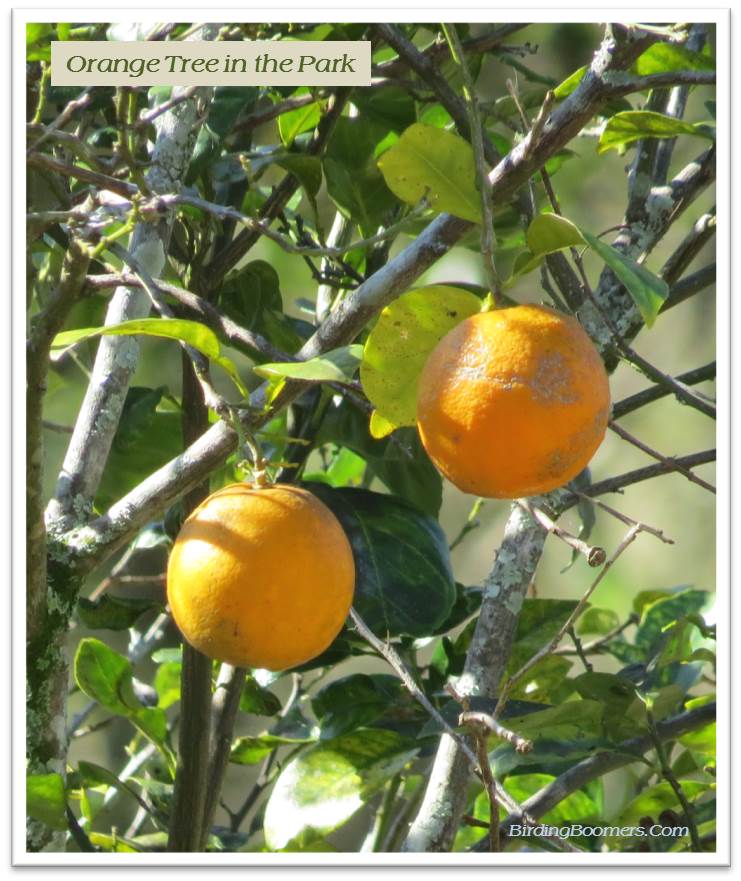

 But, while we were searching for parks and preserves along the road, we didn’t really have to search very hard for the birds. It is Florida, after all. I think I might have said that already.

 Birding Boomers