
 So how does it go – “One if by land, and two if by sea”? Wait, my apologies to Henry Wadsworth Longfellow and “Paul Revere’s Ride”, but I think I have the wrong war. Scroll forward a handful of years to the War of 1812 – that would be the one. It is 1814 and the British (yep, them again) are anchored off the sleepy little community of North Point in the mouth of the Patapsco River – you know, right about the point where the Francis Scott Key Bridge crosses the river today. The British are here fresh off an adventure where they cruised up the Patuxent River to Pig Point (which might be somewhere near Wooton’s Landing), then marched up through Bladensburg where they battled their way into Washington.
Okay, this is a blatant call out to Hugh Vandervoort of My Birding Photos who absolutely loves to go birding and “bugging” at Wooton’s Landing (or Wooten’s – whichever works for you). Today, there is little to find at the county park that would suggest there was ever a bustling boat landing or trading post and there seems to be absolutely no trace of the Wooten family who might have owned the land in colonial times. But you will find birds and bugs there and you will find Hugh there taking photos of the bugs and birds on any given day of the year.
But back to the war, the British have sailed up the river, marched overland, battled and won at The Battle of Bladensburg, and on August 24, 1814, have burned Washington, DC (which was then called Washington City). They were probably feeling pretty darned sure of themselves at this point and were ready to take their burning and ransacking on up to Baltimore. Now anyone who knows even one Baltimore Ravens fan knows that the good folks of Baltimore (“Bal-da-mer” or “Bought-More” depending on the neighborhood you live in) do not take lightly to being ransacked and pillaged. It is just a Baltimore thing, hon. At the mouth of the harbor there is a little outpost called Fort McHenry (lovely park today but a strategically placed fort that was armed to the hilt with cannons back in 1814). This fort had to be conquered before the British could enter the Baltimore Harbor and move forward with their plans to burn the place down. And you will recall from elementary school history lessons that a gentleman named Francis Scott Key was a “guest” on one of those British ships that would attack Fort McHenry in the Battle of Baltimore which lasted for 24 hours (13 & 14 September). Mr. Key will be held by the British and will be witness to the dastardly bombardment of Fort McHenry all through the night and he will write about his joy at seeing the flag of the United States raised over Fort McHenry in the early morning light in a poem called “The Defence of Fort McHenry” which was published on September 20, 1814 making him quite famous locally and, ultimately, resulting in the aforementioned bridge being named after him (among a whole plethora of schools and other things) when it was built in March 1977.
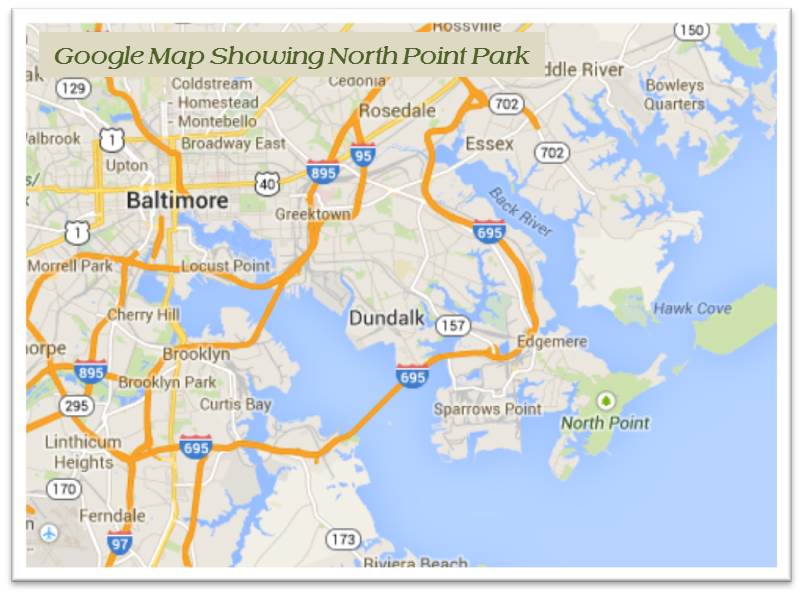 But let’s not get ahead of ourselves. Meanwhile, there were other British ships anchored off the shore of a little peninsula called North Point. The British had a two part plan which gets me back to the by land or by sea aspect of it. While those big ole ships would be bombing the fort, the British would land troops who would sneak up through the little farming community of North Point and head on up the road to Baltimore proper and do some serious ransacking and burning. But they had not accounted for those aggravating citizens of Baltimore (ancestors of future Ravens fans no doubt) who got word of the planned attack and had built ramifications to protect the city from just such an attack by land. When the British landed, the landowners and farmers at North Point (about five miles south of Baltimore) sent word on up to Baltimore that the British were on the way and it was time to call out the locals to protect the city…which they did. The Battle of North Point on September 12, 1814 was not a resounding victory for the Americans but it did what it was supposed to do – delay the attack on Baltimore. On the other hand, a couple of days later, the Battle of Baltimore was a victory for the Americans. The British were defeated and retreated back down along North Point Road burning the farms along the way – I guess burning the farms was some sort of a consolation prize for missing out on burning Baltimore and a punishment for the farmers who had not been very cooperative after all. At any rate, the British got back to their ships and sailed away leaving the good folks of Baltimore to do what they do best – drink beer (Natty Bo) and eat crabs.
So the war ended, the words of Frances Scott Key were set to music and later became our national anthem, “The Star Spangled Banner” which is sung (sometimes very badly) at the start of every Baltimore Ravens game. In the meantime, North Point went back to being a sleepy little farming community.
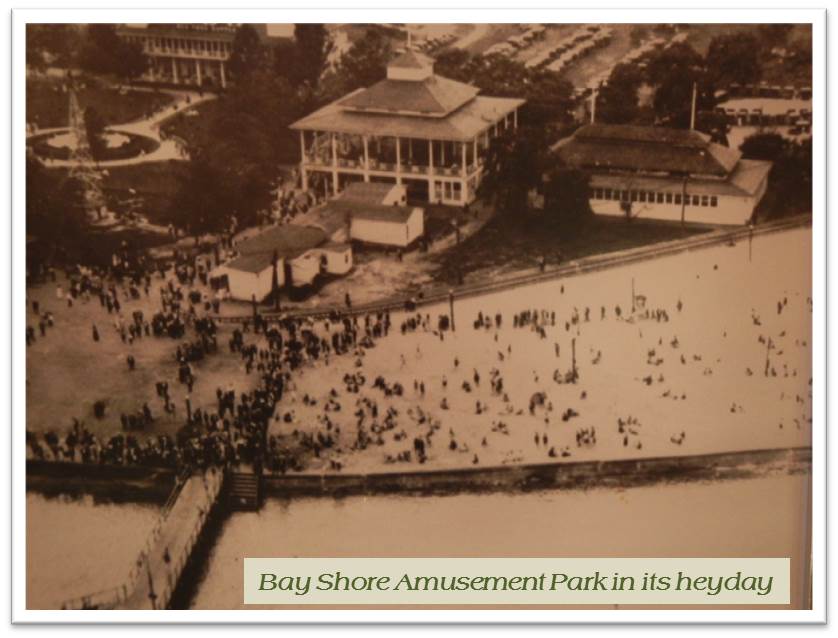 So we scroll forward another hundred years or so to the early 1900’s. Baltimore is a thriving city and seaport but it gets so hot in the summer – hot and humid and sticky. The bricks and mortar of the buildings just soak up the summer sun and the heat is unbearable to the good citizens of Baltimore. So where do you go when it gets hot in the city? You go to the shore. There is just one little thing in your way – the Chesapeake Bay. In 1914, there was no Chesapeake Bay Bridge (or more properly – the William Preston Lane Jr. Memorial Bridge) so you had to take a ferry get to the eastern shore of the Bay and to the beautiful beaches beyond or you had to drive up over the top of the Bay and around through Delaware. It was quite an undertaking. But, if you lived in Baltimore in the early part of the 20th century and if you didn’t have the time or the money to go all the way to the shore, you could take the trolley to North Point for 30 cents and spend the day at the Bay Shore Amusement Park. How convenient is that?
Bay Shore Park was the place to be. There were gardens, walking paths, a dance hall, a bowling alley, a restaurant, and a pier for fishing or crabbing. There were also just about 6 miles of beautiful shoreline for swimming and even more fishing on the Chesapeake Bay. After a long day of resting, relaxing, swimming, fishing, bowling and dancing, you could head on back to Baltimore totally refreshed or maybe totally exhausted. The Bay Shore Amusement Park was built in 1906 and operated at North Point until 1947 when the land was acquired by Bethlehem Steel and the park was demolished. It was fun while it lasted, I suppose. Once again, North Point went back to being a sleepy little farming community…..and it pretty much stayed that way for the next seventy or so years.
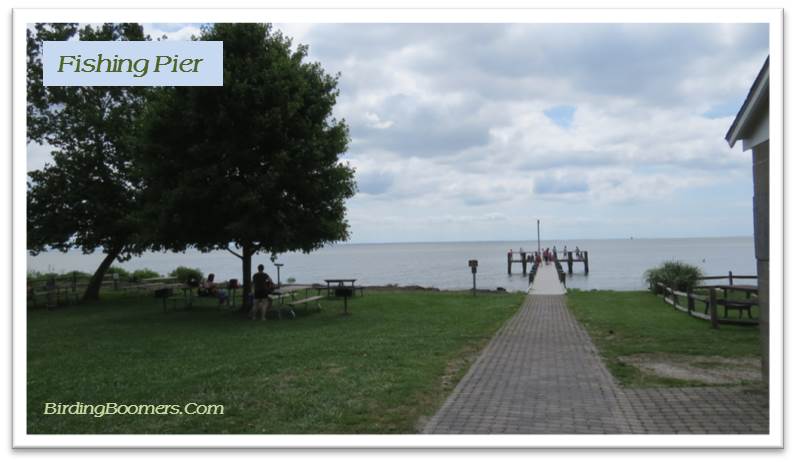
 Today, two hundred years (minus 30 days) after the British attack on Baltimore, North Point has become a Maryland State Park with plenty of hiking trails, a lovely visitor center, a swimming/wading beach and, of course, a 1000 foot long pier for fishing and crabbing. The “Defenders Trail” runs through the park and is part of the Star Spangled Banner Trail (map and guide). Little remains of the war but you can track the path the British used with a little imagination and a bit of persistence…there are a few markers but you have to look for them (try this blog for a little help on that part).

 The old fountain and the trolley stop from the Bay Shore Amusement Park remain. Both have been restored and the old trolley stop is now a picnic pavilion you can rent for an additional fee. Otherwise, almost all traces of the war or the amusement park have vanished leaving a beautiful park to be enjoyed by everyone.
 And, (yes, you knew I would finally get to the birding part) the park is a well-known birding hotspot where more than 225 species of birds have been spotted (eBird hotspot data). The park has more than 1300 acres with several miles of trails through a variety of habitats to include marshlands and meadows. About 667 acres of the park have received protection as “State Wildlands” – The Black Marsh Wildlands. The best part about the Black Marsh trail is that, being designated a wildlands means that no bikes or pets are allowed. This is very good for birding and solitude (but I do wish they would put a few benches along the trail for more quiet contemplation).
 It is relatively easy to find North Point State Park with a GPS but it is a bit (a very little bit) off the beaten path – in this case, maybe 5 miles south of Interstate 695 (exit 42/43) south of Baltimore. There is a small fee to enter the park ($4/summer, $3/winter) but it is well worth it to be able to access such a peaceful park.
 We visited on a weekday and the park was relatively quiet and not crowded but information at the park website indicates that the park can become very crowded in summer months. Trolley or not, the people still come. If you want to bird, I would advise you to pick a weekday and go early. Don’t expect to find much by way of restaurants in town. We found a pizza/subs place for lunch — the sandwiches were okay but nothing to write home about. Since there are picnic tables and pavilions on the water in the park, pack a lunch – you’ll be happy that you did.
 Finally – my apologies to any historian, teacher, citizen of Baltimore, or War of 1812 expert for my quick and dirty overview of the War and the Battles of Baltimore and North Point.
Otherwise, GO RAVENS!
BirdingBoomers Hotspot Review for North Point State Park. (Remember that my reviews are not about how many birds you’ll see or what activities you can enjoy…there are other websites that provide that. I am more focused on the accessibility of the park and how easy it is for older people who are not necessarily in great physical shape to enjoy.)








 Birding Boomers