
 Visiting another country gives one perspective. When we are born, our whole world lies within the tiny room where we are kept safe from harm by our parents. With each passing day, our world expands – to the house, then to the yard, then to the neighborhood, then to our town and so on and so on until our safe little world is pretty good sized but still limited to a small corner of the world. Some people live their whole lives within one city or one state and are quite content with doing so. But some of us yearn to see the world and see what’s over the hill, so to speak, and so at some point leave the proverbial nest and start exploring anywhere and everywhere. And so it was with me. I couldn’t wait to leave home and get out of that hick town where I grew up and see the world. And I did….for a while. But somewhere along the line, life caught up with me and I settled down again. There just wasn’t time for a great deal of travel what with getting married and working and focusing on the family. Travel was limited to vacations here and there when there was enough time and money to do so. And travel was limited to dreaming about the places we would go when we “retired”. And, now, we are here and we are getting back into travel mode and putting some of those dreams in focus. Funny how my dreams have changed. When I was younger, I wanted to see big cities and historical sites….and now I find that I prefer natural areas and wildlife preserves. So most of our outings in the past couple years have been focused on the great outdoors. But our recent trip to the Netherlands gave me a little bit more history than nature and has given me much to think about in terms of my small world in relation to the bigger world out there beyond the hedgerow, as it were.
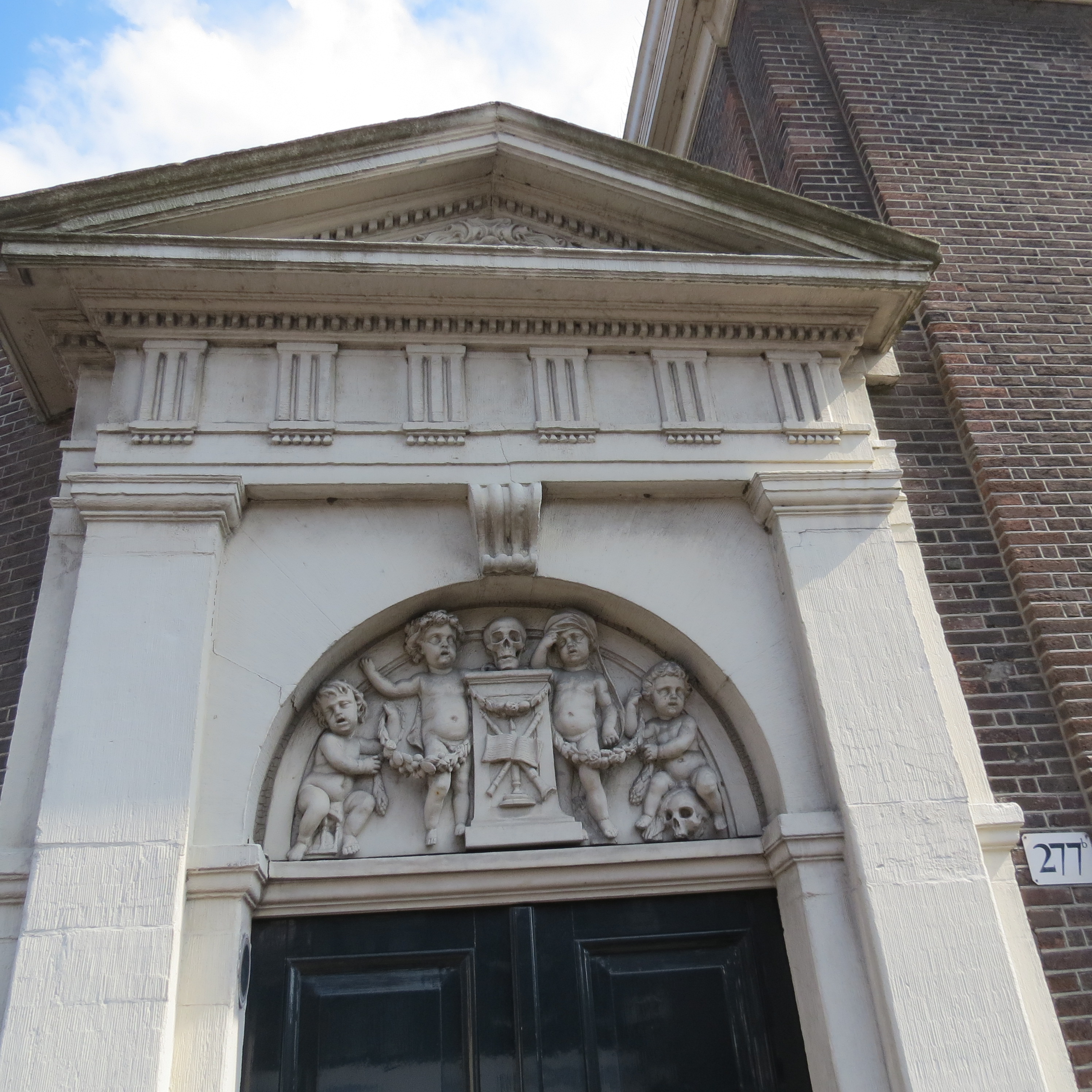
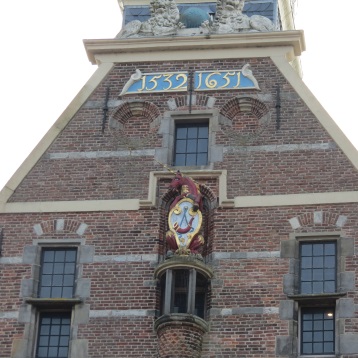 One of the things that struck me from the first day in Amsterdam is that everything there is so old. Of course, there are newer and very modern areas in and around Amsterdam but the “old town” is, to quote someone much younger than me, like really old – ancient, in fact. I think of “old town” Alexandria, VA or Annapolis, MD, — areas I am familiar with and “old” in the United States is not nearly so old as old is in Amsterdam. Or, at least, the “old” that is preserved in old buildings that can be dated back to the founding of this country in the 1700’s. But the buildings in Amsterdam can be dated back to the 1500’s – I know this because they put stone carvings over their doors of the buildings with the date clearly shown. These stones can also show the occupation of
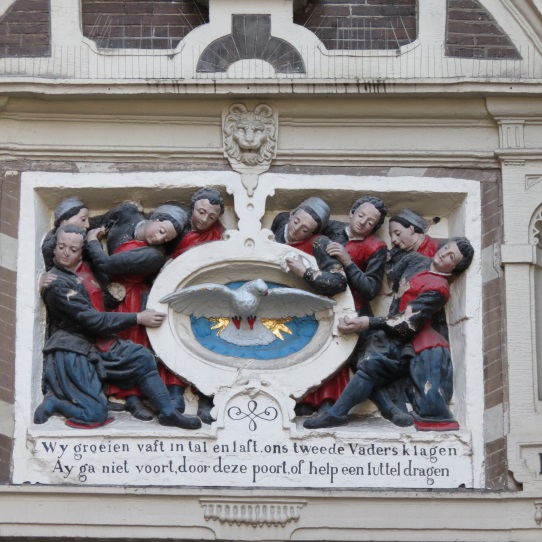
  the owner when the home was built. These stones fascinated me and I found, when I got home that most of the photos I had taken on the trip were of these door stones. Homes built in 1532 are not only still standing but still inhabited. These homes were built before the United States was colonized. Of course, there were native Americans living on the east coast but there were no three level row houses with cap stones dated from that period so America appears to be quite young where western civilization is concerned. And, not only did the Dutch have homes in the 16th century, they have records of zoning laws.
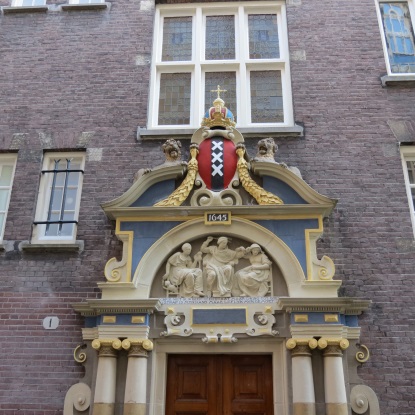 Or, at least, it is what we would refer to as zoning regulations. According to the guides who led us through the city, Amsterdam had rules about how their homes would be built in the middle of the 15th century. Only one or two wooden houses still exist from that century. Wood would be very flammable and fire would be very dangerous for houses built very close together so laws had to be passed that would require houses to be built of brick. The “logo” for Amsterdam is XXX and you see it on signposts and carvings all over the city. It is not clear exactly what this means as there doesn’t seem to be any historical documents to explain but the guides say that the traditional story is that it refers to the three main threats to the city – fire, flood, and pestilence. I think they might also add the government and bureaucracy because from the earliest times, in additional to numerous laws and building codes and regulations, they also had taxes.
 According to Wikipedia, the ultimate “go to” source for everything and anything, there are records of people living in the Netherlands on man-made “terps” or hills as early as the 1st century AD. No row houses then, but certainly ancient “swamp people” living along the coast and in the lowlands and raising ground on which to build shelters. These terps were later connected to each other by dikes, or dams, to form communities all working together to keep the water in the canals and rivers and provide some bit of dry land. The old town of Amsterdam is built on the dam on the Amstel River and started as a fishing village in the 12th century. Yep, it is the river that gave name to the beer. And, the main square in Amsterdam is the “Dam Square” – which after walking around on the uneven cobblestones all day and getting lost and trying to find your way back to the main areas where you could possibly catch the tram and get off your tired aching feet, became “that DAMNED Square”.
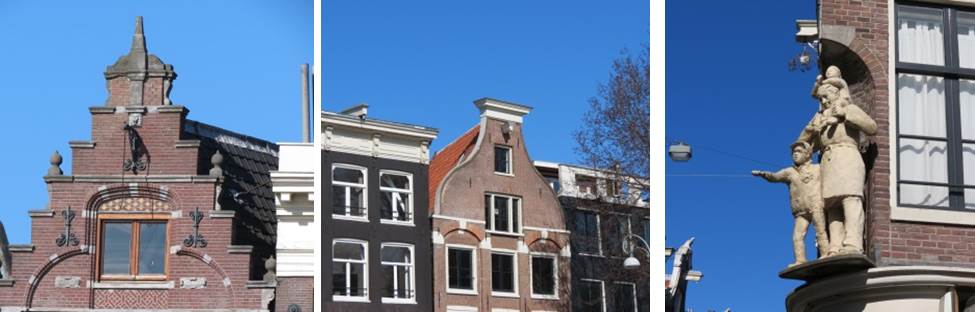
To provide stability, the homes in the old town were built on pilings sunk deep into the ground (or the soil of the dam). I do not recall the exact number but remember the guide mentioning the number of pilings in the city as being in the thousands.  The guide also mentioned that in the olden days, prisoners were issued a pump when they were put into the old prison because their cells would be below sea level and a prisoner either pumped or died. That treatment probably wouldn’t be allowed in today’s society but it does seem….well, never mind. Another prison fact I gathered while in the Netherlands was that they didn’t really feed the prisoners in the earlier times – well, not the civil authorities anyway. The rich folks provided bread for prisoners via the church….sort of in hopes of getting into heaven by feeding the poor. Guess you didn’t get a break on your taxes for your charitable donations but the priest and church did see some benefit to it and as people got older, they were apt to make donations to the church. Of course, some of the money went for bread but most of it went to the churches which are the biggest buildings with the most elaborate ornamentation of all.
Now back to taxes. Taxes were calculated by the width of the building frontage and, even in the 1400’s, people didn’t like to pay taxes. So the people built their homes narrow in the front and long and tall. These homes had steep narrow stairs to the upper floors and the furniture could not be carried up the stairs so homes were built with hooks on the front of the top floor of the building so that 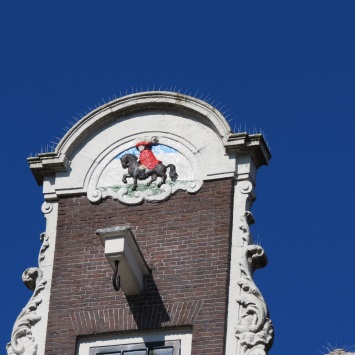 the furniture could be hoisted up to each floor. This is the practice even today. I watched a recent HGTV® show about expats living overseas and the furniture was brought into the house using the hook. The moving man leaned precariously out of the attic window and hung a pulley onto the hook. Then, he and his colleague used the pulley to hoist the furniture up and into the house. The moving man indicated that afterwards they always had a beer and it was the home-owner’s responsibility to provide the beer. Some things never change.
So the houses are tall and narrow and  relatively uniform and standard – tall, long rectangular boxes. Not much architectural interest in that; so, over the years – okay, over the centuries, the Dutch began the practice of putting elaborate facades on the buildings. And so you have what everyone in the world would recognize as a Dutch home – tall row houses with tall ornate gables and lots of carving and decorative embellishments making each a unique creation and essentially works of art. This was pretty much true for several of the towns we visited – tall narrow houses on narrow streets sandwiched between canals and lakes and rivers.
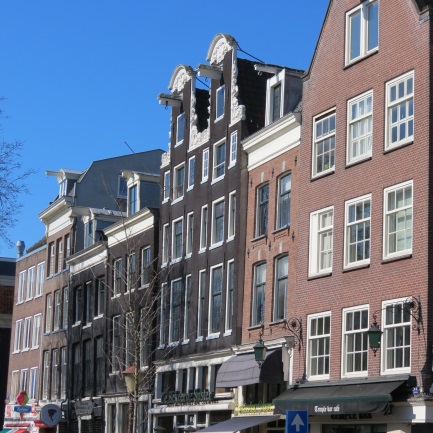 And the houses all lean one way or the other but mostly forward. Going back to the need to hoist the furniture up to the upper levels of the house…..heavy furniture on a rope would tend to swing and break the windows. Glass was a prized commodity and very expensive. So the houses were built so that the façade leaned out just a bit so that the heavy furniture would hang level (like a plum bob, I suppose) and away from those expensive windows. But then someone noticed that his house might be more noticeable if it stuck out just a little bit further than his neighbor’s house so it became all the rage to build one’s house so that it leaned just a little bit more forward than
  all of the neighbors. And, of course, when things get out of control, the government has to step in and try to fix things. So we come full circle to the taxes and the zoning laws and history. Before there was even a glimmer of a United States, the Dutch were busy building houses and writing regulations and passing laws that dictated how far forward a house could lean and how high the facades could be and ultimately collecting fees and taxes on anything that could possibly be taxed and fined.
Walking the streets of a city that was a full-blown city, center of commerce and government some two to three hundred years before our country was even a colony certainly puts things into a more global perspective. Someone on the tour mentioned this perspective to one of our tour guides at one point and the guide pointed out that Europe’s history is also America’s history — that many of our ancestors came from that part of the world not so many years ago. Again, more perspective of our greatly expanding life-lines going back to the Netherlands and Europe and beyond is gained. It seems that we like to travel to learn about other places and people in the world but, in the end, we mainly learn about ourselves most of all.
P.S. A little touch of American history perhaps?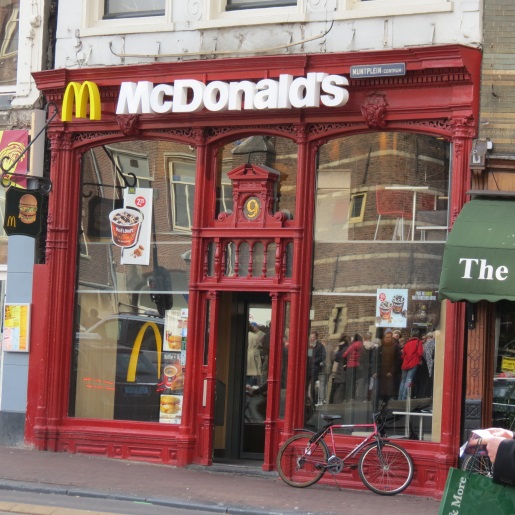











 Birding Boomers