
 In late January, it was cold in Maryland – really cold and there was snow and freezing rain and all sorts of winter weather events that were starting to get just a little bit old, in my humble opinion. So, like any all-American retired person, we started thinking about Florida and warm sunshine and maybe a little misting rain here and there to cool things off towards evening. What else could we do but head south on the auto train? We arrived to sunshine and blue skies – 80 degrees – and we were set to do some serious birding in warm weather…..or so we thought. We had exactly one day of warm weather before a coldfront (were they calling it a “Polar Vortex” this year?) hit the southeast and most of Florida. Rats! The temperature dropped to the 30’s and turned rainy – not really freezing rain but darn near close to it. Well, we were there so might as well try to enjoy it. Thank goodness we had packed jackets and gloves and hats and sweaters and a few long sleeve t-shirts for the trip. I had learned a great deal about “layering” while living in Alaska in the late 70’s – layers on when the temperature drops and layers off when it rises – so was prepared for cooler weather but had hoped I wouldn’t have to wear those extra layers down in paradise. I mean, it is Florida after all.
And my layering involved all sorts of clothing – undershirts, shirt, sweater, windbreaker – in all sorts of colors. Back in the fall last year, I had attended a photography workshop put on by the local bird club – Anne Arundel Bird Club – and taught by a birder and photographer named Emily. You can find some of her beautiful photos of birds at her blog – Hoof Beats and Foot Prints. Emily had advised us to wear earthy colors when out birding so we blended in a little more with the environment. She noted that the purple shirt I wore to the workshop wasn’t exactly in keeping with eath-tones. Hey, it was a Baltimore Ravens shirt – so what’s not natural about that?
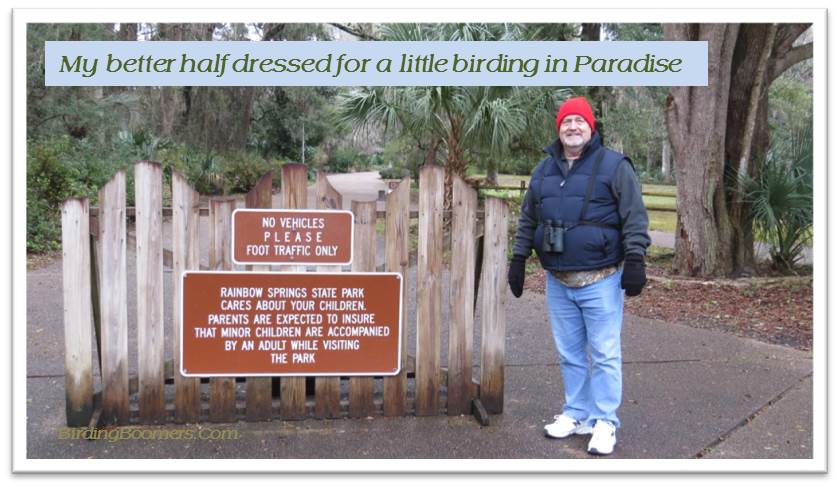 But all in all, I have had a couple of thoughts about getting all camouflaged up to go birding. First – I have found that no matter how far away I am or how quietly I approach, the birds always know I am there long before I know where they are, especially the hawks and eagles. The birds do not seem to care whether I am wearing brown or green or purple – they tag me right from the start. As such, many of the photos I take show the bird giving me a look that says, “I know you are there and you had best behave, little lady”. Secondly, I love to go birding in botanical gardens and arboretums and such – great places to see all the “B’s” right in one spot – birds, butterflies, bees, blooms and bugs. I find myself wondering if, perhaps, I should blend in there too. Should I wear riotous pinks, magentas, or orange (okay, maybe even purple) in hopes that the birds will not notice me standing amongst the flowers in the garden? It is a good question, I think. Wouldn’t I stick out if I wore camo in a flower garden?
But I do like to fit in and I can follow good advice so I had headed on up to the local Bass Pro Shops and picked up a nice long-sleeved camo shirt (just like the boys wear on Duck Dynasty) and I was all prepared to be almost invisible the next time I went out birding. If it works for the Robertsons, then it should work for me. I brought that camo shirt with me to Florida thinking I wouldn’t wear it much because it was long-sleeved and it would be way too hot, but it turned out to be exactly the shirt I needed during those first four days of nasty weather. Yeah, all those folks in the restaurants wearing tropical Hawaiian shirts and such did kind of look at me kind of funny but, hey, I was warm and when I stood near the potted plants, you could hardly see me at all.
In spite of the weather, the birding was pretty good. It was, after all, Florida. There were birds all over the place.
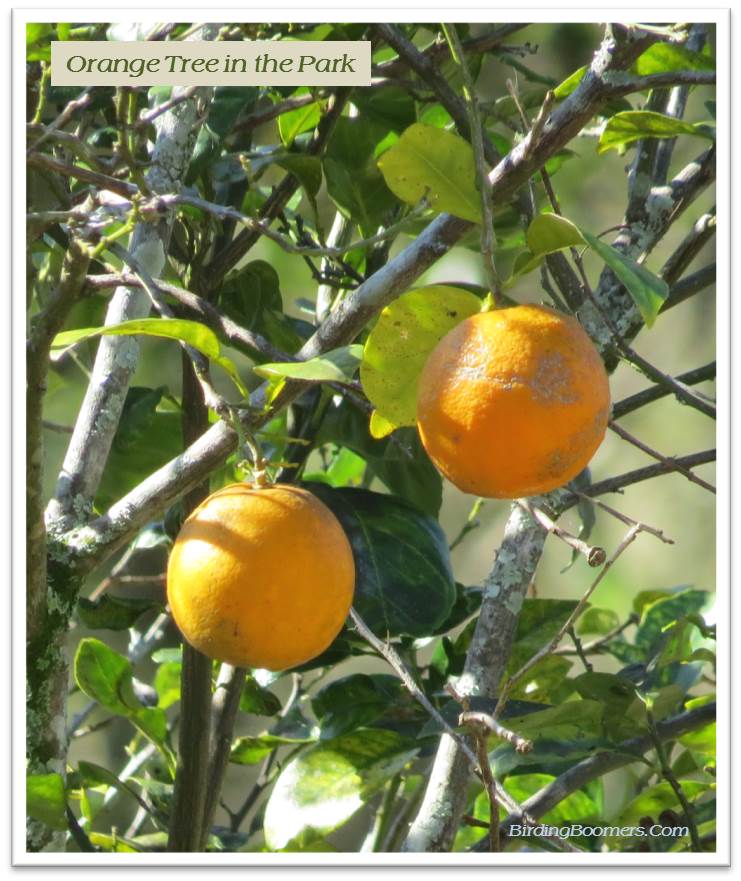
 And there would be birds in a climate that allows orange trees to grow wild in the parks. Now I have picked a few red raspberries at Quiet Waters Park in Annapolis in the past but for the most part, I have not seen lots of fruit trees in public parks with ripe fruit right within arms’ reach ready for you to just pick it and eat it. In Florida up around Ocala, there were orange trees everywhere not just in the orchards on the farms which are huge by the way. Turns out that oranges are a bit like kudzu in Florida and, with the help of birds and other critters to eat the fruit and spread the seeds, the oranges have become a bit of a nuisance to the folks who live there. But I personally cannot imagine I would ever have problems with oranges (or tangerines or grapefruit) growing out in the wild like that…..or, red raspberries either for that matter.
 I really think the cold weather helped in the birding though. Right away we were seeing Red-Shouldered Hawks all along the roadside and plenty of American Kestrels. We were driving along a busy highway in Ocala when we spotted a Kestrel and, having no place to stop on the busy road, turned off onto a side road so we could double-back and get a better look of the Kestrel. That’s when we spotted our first life-bird of the trip – a beautiful Red-Headed Woodpecker. Now, I know Red-Headed Woodpeckers are found in Maryland and one shouldn’t have to go to Florida to see one but we had not had any luck with finding one back home. It totally caught me off guard to see one right there on a power line watching us while we were trying to get a good look at the Kestrel. But isn’t that just the way birding is?
 Because of the weather, we took to meandering around heading from Ocala towards the Gulf coast. Our original plans for the trip were to spend a day with relatives near Ocala (which we did) and then head over to Crystal River to see the Manatees that come up the rivers and winter over in one of Florida’s many warm springs. Thinking I was ever so clever, before we left home I had sent myself an email with hot links to all the springs and wildlife refuges and parks we would visit along the way. My intent was to keep the email in my smartphone and then open it at intervals, click on a link, find info about the spring or park, get the address, and go there. Guess I wasn’t so clever when I checked my emails, clicked on “select all” and deleted the email with the links along with all the spam messages I had received. But all was not lost. I still remembered some of the names of some of the parks and we had a GPS so we used the feature on the GPS for finding attractions “near here”. This turned out to be a good thing and allowed us to visit quite a few parks and springs and forests as we drove along. Some of the best birding spots turned out to be parks we would never have visited had we just followed my original plans. I also got a little better at using eBird.org to find local hotspots along the way. Another good source for finding hotspots is the Great Florida Birding Trail although I had some trouble connecting the Trail locations listed on the internet to the road on which we were traveling. But I got better at it as we traveled and since we didn’t have any deadlines to meet, we pretty much birded where ever we found ourselves.
 But, while we were searching for parks and preserves along the road, we didn’t really have to search very hard for the birds. It is Florida, after all. I think I might have said that already.
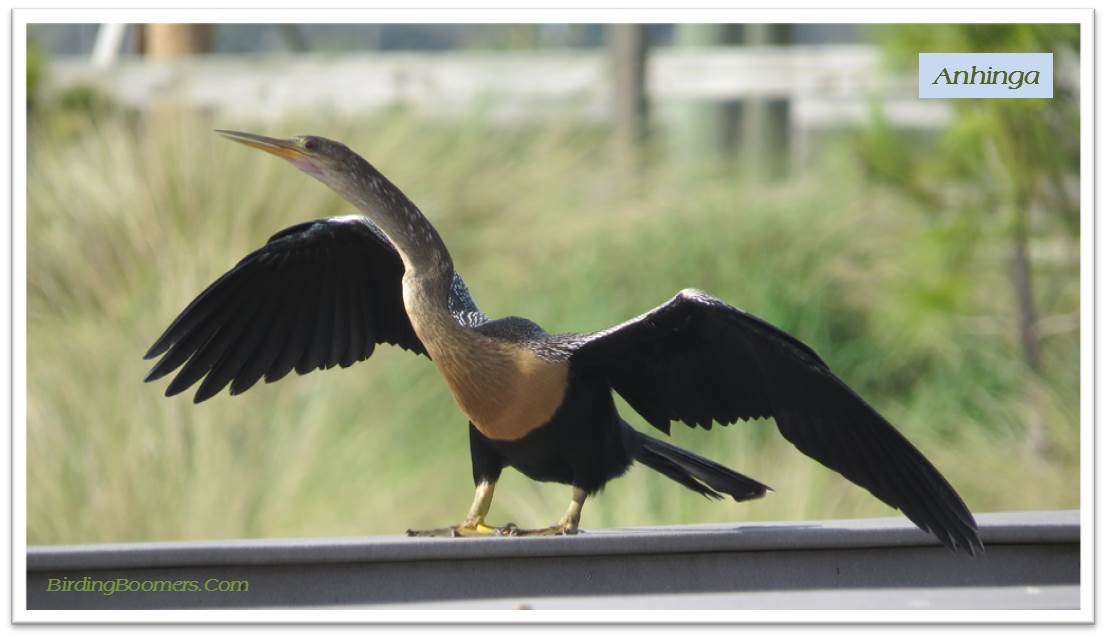
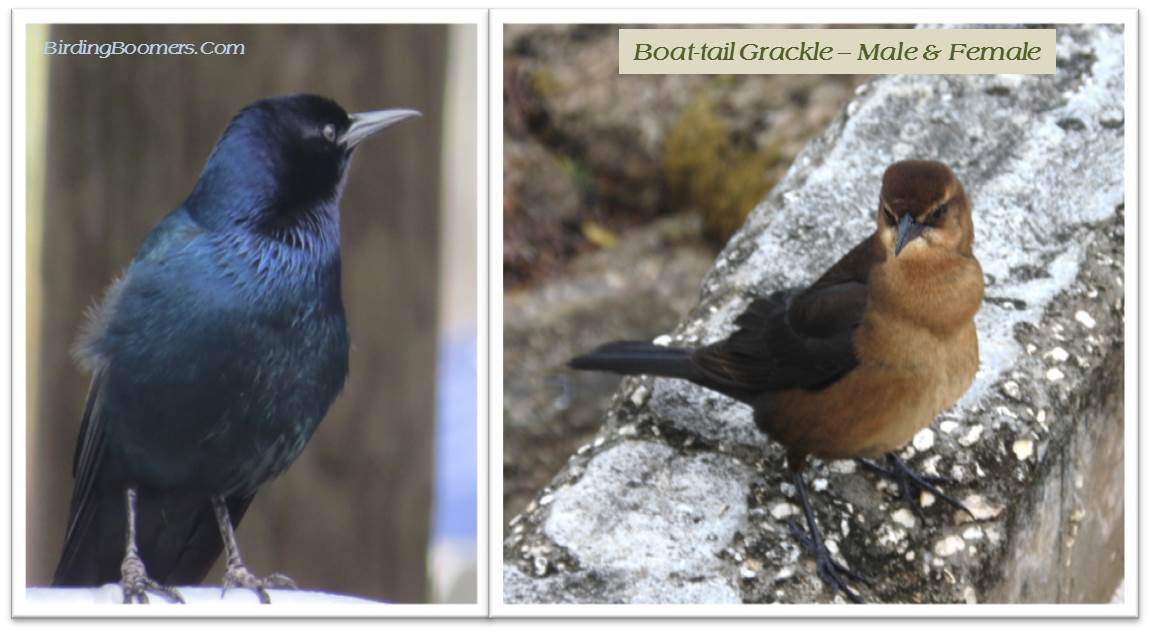
 There were Great Bearded (or Blue) Herons (GBH) and Great White Egrets where ever there was water and White Ibis’s were as plentiful as Grackles. Speaking of Grackles, we were very familiar with the Common Grackles back home but not so familiar with the Boat-Tailed Grackles in Florida. We absolutely fell in love with the female Boat-Tail – she is a beautiful dark cinnamon and rich chocolate brown. Although they appeared to be as numerous and troublesome as Common Grackles back home, we got to the point of looking forward to seeing the Boat-Tail Grackles every day as we traveled. At one park, a persistent Grackle stood on a sign that said, “Do not feed the birds” begging for handouts. We didn’t have any birdseed or I would certainly have broken all the rules and fed him – he was just that charming bobbing and cackling to us about his desire for food.
 There were some birds that I really wanted to see while in Florida. One bird I had heard about that got my interest was the Grey Kingbird. I kept seeing grey birds that I tried to “mind-morph” into a Kingbird but it just doesn’t work that way. No matter how much you want to see a bird and how many birds you try to identify as the target bird, it just never works. So the Eastern Phoebe I kept seeing and trying to call a Kingbird stayed an Eastern Phoebe – beautiful bird in its own right – and I struck out on the Kingbird.
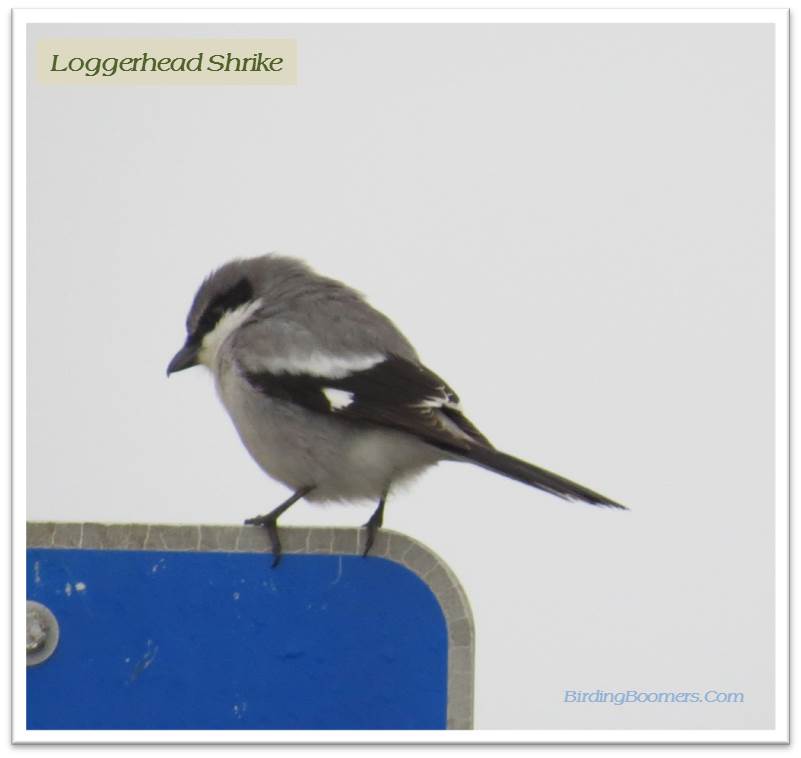
 We didn’t strike out with the Loggerhead Shrike. I had heard that the bird is similar to a Northern Mockingbird and can sometimes be confused with a Mockingbird. I could not imagine any bird being so similar to the Mockingbird to be confused with it. And the Shrike is different from the Mockingbird. But when we first spotted the Loggerhead Shrike, the first general impression was that it was yet another Mockingbird and to move on. But the distinctive mask over the eyes gave the bird away and we stopped, got good looks, and added another life-bird to the list.
 It was cold and it rained but there were birds aplenty and we discovered that exploring parks and refuges can be quite rewarding even without a plan and even in nasty weather. We had four days of cold wet foggy weather and then the cold front passed, warmer weather came in, and the layers of jackets and shirts came off. Then, we found the Florida we had come looking for – sunshine at last.
It is Florida, after all.









 Birding Boomers