
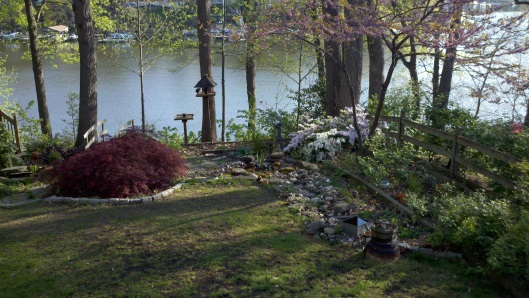
 Everyone has, or should have, a place they go mentally, spiritually, or physically to relax and find peace – a place that you call to mind when you close your eyes, slow down your breathing, and calm your mind of all the clutter and chaos you’re bombarded with on any given day. A place to bring your soul to stillness. For me, that place is a garden – not a particular one – just bits and memories of many gardens I have visited, gardens I have seen on television or in books that I would like to visit, and even flower beds I have planted and nurtured over the years. The Bible traces our beginnings to the garden of Eden where all creatures, great and small, lived out their lives in harmony and beauty. This I know — where there are trees and flowers and plants of all shapes and sizes, there are also bees and butterflies and foxes and raccoons and salamanders and there are birds. So it should not come as a surprise that, finding ourselves as “stranger[s] in a strange land” [1] and wanting to do a little exploring and maybe a little birding, we would find a garden and head out for some peace, serenity, blooms, and birds.
The Amsterdam Botanical Garden is not listed or described in the guidebook that I  purchased for our trip. I found the garden by looking for green squares on the street map of the Canal District that was given to us by the concierge at the hotel. The “green” had all the right characteristics – It was in the old town area; it was relatively close to the hotel, i.e., within walking distance for even me; and, it was located on a main street and canal and the directions were pretty straightforward, i.e., not too many turns. We set out about mid-morning on a sunny but still chilly April day. Who knew it would still be so cold in April? We had a few hours between checking out of the hotel and boarding our cruise ship so things seemed pretty much perfect for heading to the garden. It was still very early in spring so I didn’t expect we’d see too many flowers but that was okay – our objective was to see birds, pure & simple – not religion or culture – just birds and maybe a few tulips or crocus or daffodils. Set your expectations broad enough and you are rarely disappointed.
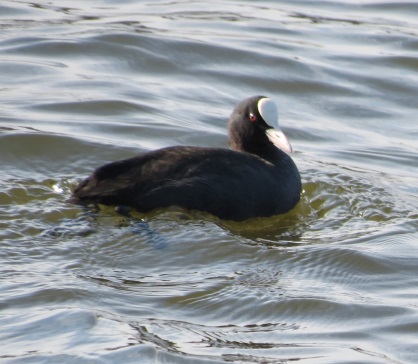 We had seen Mute Swans (Cygnus olor) and Mallards (Anas platyrhynchos) and thousands of pigeons on our walking tour of the district and were now hoping for something more – birds that were a little more “native” to Europe and that would be “new” to us. We had also seen quite a few Coots (Fulica atra) around the river basin. The Coots looked quite similar to the American Coots (Fulica americana) and I found myself checking the bird books to make sure they were actually different species. Yep, they are and when you check the books, the differences are easy to see.
I have to stop and add a note about pigeons. They seem to be everywhere on earth and they seem to come in all colors which might imply that there are thousands of different varieties of pigeons. After all, it takes a birding expert (as far as I am concerned) to  differentiate between a Carolina Chickadee (Poecile carolinensis) and a Black-Capped Chickadee (Poecile atricapilla) with some experts only willing to firmly identify a Black-Capped if they hear the song. And these are recorded as two different species. On the other hand, there are pigeons that look absolutely and radically different in terms of coloring and plumage but they all seem to be lumped into the category of pigeon. I asked some members of the local bird club why they did not “count” the pigeons on their bird walks or, if there were people who specialized in pigeons and pigeon watching who did note the differences or see them as different bird types. I was told that there were people who did this but most folks just call them pigeons. At any rate, I note that the guidebook we used on our trip (mostly), “A Naturalist’s Guide to the Birds of Britain & Northern Europe” by Peter Goodfellow and Paul Sterry [3] included the Rock Dove (Columbia livia) and noted that it was the ancestor of all domestic pigeons. And I believe I have found my answer – most pigeons we see are probably domestic pigeons that escaped their confines on farms and rooftops and multiplied exponentially and now inhabit every city and town in most parts of the world. And, although some birds that “escape” and become “non-native invasives” are still counted and photographed and added to life-lists and reported to eBird in regional reporting, most pigeons do not seem to be counted and added to life-lists. But, having said all that, we did spot what we thought was a Wood Pigeon (Columba palumbus) which is similar to a mourning dove in coloring but decidedly bigger…and is called out separately in the guide book.
As we neared the Botanical Garden, we 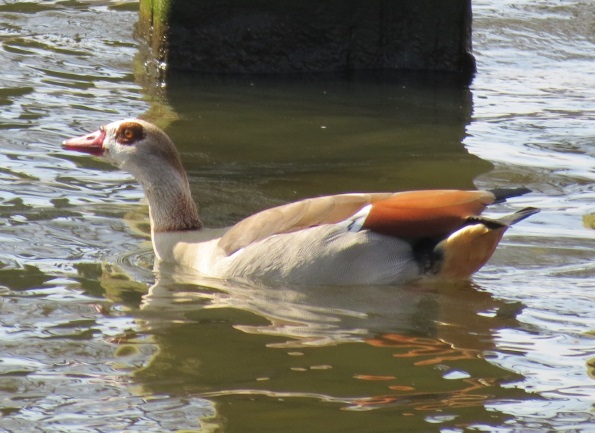 spotted our first interesting birds of the day – a pair of Egyptian Geese (Alopochen aegyptiacus). These waterfowl were totally new to us and exotic looking to say the least. Checking a different guidebook later, “Birds of Britain and Europe” by Jim Flegg and David Hosking [4], I noted that this too was a domestic bird gone rogue. That guide lists an “escape” as a domestic bird or pet that has been accidently or deliberately released into the wild. I am sensing a theme here and probably not so unusual for urban birding.
Next up, a delightful Magpie (Pica pica) – a common bird here in Amsterdam but another life bird for me and another check mark on my list. Awesome! We had spotted our first  magpie on the way in from the airport a couple days previous but here we had an opportunity to see one relatively close up and for some minutes before he flew on up the canal. Of course, every time you see a new bird, you have to stop and ponder and study and check the guidebook and try to get photos…..only to find later that you will begin to see them everywhere. I think once you notice something, it becomes common. It is not that there are more of the birds about; it is just that you have noticed them and become sensitive to them and you begin to see them more. Such is the case with the magpie – our initial delight faded into complaisance such that by the end of our vacation, we were apt to say, “Oh, there goes another magpie,” and hardly stop to notice.
The Amsterdam Botanical Garden is a place of study of all things botanical and associated with the University in Amsterdam but does open for visitors. Although the garden itself was not too large, it had attracted quite a few visitors on this Sunday morning. We found our way to the entrance, paid the fee, and headed inside.
As we moved past the tropical green house, we spotted a pair of beautiful green Ring- Necked Parakeets (Psittacula krameri) – yet another example of a domestic pet that has been released into the wild or somehow made their way many miles north from their native territories in Africa. At some point, it definitely occurs to me that the theme for the day might be about these escapees or transient migrants. We were seeing birds (not just the avian kind) that had previously lived in cages, whether physical or emotional or cultural, that were now “set free” to wander happily throughout their chosen gardens for the remainder of their lives. And why shouldn’t they? The world is made more beautiful for every bird and every creature in it regardless of how exotic or common they may be. Of course, I have to retract that statement when I start thinking about the European Starlings that have become quite invasive in America…and I’m sure there are quite a few problems associated with those pigeons that roost on buildings everywhere. But this day, I am feeling open-minded and thinking a few more birds in the garden won’t hurt anything.
 But where were the native birds? We had spotted mallards (Anas platyrhynchos) but these too seemed to be a mixed breed with coloration similar to domestic ducks, possibly a Blue Swedish (Anas platyrhynchos domesticus) considering the brown and white patches on their breasts and around their heads. And where do mallards originate anyway? They are pretty much found everywhere too.
Finally, we spotted a small bird that looked very similar to a chickadee but with different coloring. I chased the bird through the garden, past the beehives, across a bridge, and through the hedges trying to get a good look and a decent photograph. I was only partially successful. Do understand that “chasing” a bird means I’m moving slowly and stealthily trying not make a sound as I creep closer and closer only to find the bird is way too quick and sits still barely for a  moment and then dives deep in the tree or bush leaving me with the barest glimpses and totally blurry pictures. I know for a moment there you visualized me as running around like a crazy woman waving my arms frantically and screaming, “bird, bird, bird” but it is not the way it goes. We were able to identify the little bird as a Great Tit (Parus major) so all was not lost. That sounds a lot bigger than a chickadee, now doesn’t it? I often wonder at the names that were given birds. The same folks probably wanted to call a California Condor a “little vulture”.
We sat on a bench enjoying the sunshine and a couple mallards swam over, hopped up on the bank and came close, possibly hoping for a few crumbs of bread of which we had none. We had cameras, cellphones, and binoculars but no cookies – of what possible use were we to those mallards? They gave up on us, probably doing duck sighs and wondering why we would head out for a day trip without any cookies or granola to share. They waddled on back down to the canal and soon were back to business as usual ducking and diving looking for tidbits here and there.
 We strolled around the garden enjoying the few flowers and birds that we saw pausing quite often to sit on a bench and contemplate the peacefulness in spite of the many people also enjoying the day there. We admired a brown bird that looked and acted similar to an American Robin (Turdus migratorius) from back home (only without the red breast) scratching the dirt looking for bugs and worms. She (and I say she now that I have looked her up in the book) was later joined by a Blackbird (Turdus merula) which clinched her as his mate and not some sort of weird European robin. We tracked
  the pair across the garden or, maybe, they were tracking us…probably the latter since they would be so much better at it than we are.
The stork nest on the institution’s chimney was empty (alas) as it was still too early for the storks to have migrated back to the area. I would have loved to see one of those but I contented myself with taking several photographs of a gull, the familiar Herring Gull (Larus argentatus) perched nearby and several pigeons, what else? Then it was back to trying to sneak up on the Tit again which turned out to be another Tit entirely – this one a Coal Tit (Periparus ater). Both looked quite a bit like a Chickadee as noted previously, but the former having a lemony breast and the latter having rust colored sides. We watched the Coal Tit as he flitted back and forth between trees near the tropical green house. He patiently bided his time until someone opened the door and left him an opening – then like a flash he was inside. It seems that some birds like to escape their cages and others look for the opportunity to go back inside where it is warm on a cold day and possibly safer. We had not intended to go inside but,  like Alice following the white rabbit down the rabbit hole [2], we followed him inside hoping to get that elusive photograph. We lost him in the foliage inside but did see our first real blooms of the day. Appropriately, it was the “bird of paradise”.
One last look around the garden and we headed out and back to the hotel and our cruise ship. Stopping along the way at a pub for lunch, we didn’t see too many birds but did enjoy a burger and some iced tea. As we walked back down towards the docks and rounded the river basin, we were provided one last treat – a beautiful Great Crested Grebe (Podiceps cristatus), another life-bird and a great ending to a good day of birding in a very nice garden.
 [1] Bible, King James Version, Exodus 2:22 – “And she bare him a son, and he called his name Gershom: for he said, I have been a stranger in a strange land.”
[2] “Alice’s Adventures in Wonderland”; by Lewis Carroll; 1865
[3] “A Naturalist’s Guide to the Birds of Britain & Northern Europe” by Peter Goodfellow and Paul Sterry; Beaufoy Books; 2010
[4] “Birds of Britain and Europe” by Jim Flegg and David Hosking; New Holland Publishers; 1990





 Birding Boomers