
 It’s spring and plant sales are popping up everywhere. And I love plant sales more than a hoarder loves yard sales. One of my favorite spring plant sales is at the Paca House and Gardens in Annapolis, Maryland. Really, what is not to like about a plant sale at a historical garden that you get to see without having to pay the usual entry fee? It has become a bit of an annual tradition for me and one of my gardening buddies and we pretty much turn it into an all day thing by lollygagging over lunch at a local haunt talking about what plants we bought and where we are going to plant them and so on and so on. And not to be left out, I’ve recruited my dear sweet husband to do all the driving and negotiating those tiny alley sized roads in downtown Annapolis. He just drops us off at the sale and then comes round to pick us up an hour or so later. We also let him buy lunch — it works out splendidly.
Never been to Paca House? Well, me neither – not actually. I’ve only seen the back of the place from the gardens. But I’m sure it is quite lovely inside the house and I’m sure I’ll go there one day but not this year. I’ve actually never seen the front of the house either since we always come in from the rear on East Street right by the Water Witch Fire Station #1 in Annapolis. And every year I take a photo of the Water Witch #1 and tell myself I will look this up on the internet and find out some more about a Water Witch Fire Station. And this year I did!
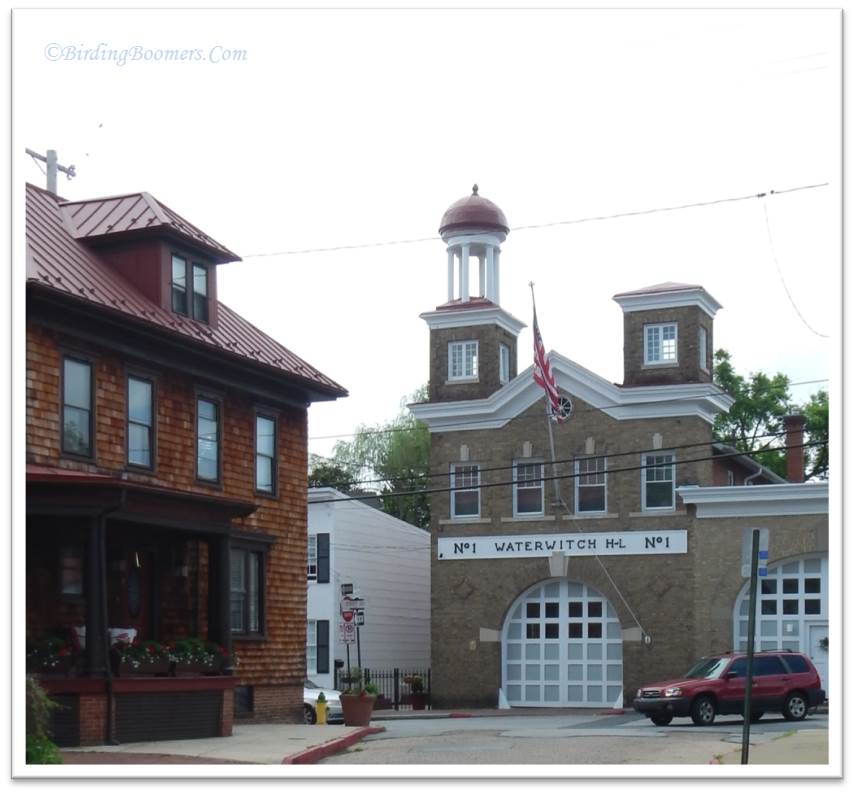 What I found out was that this is not a fire house anymore. It has been “re-purposed” into office space. Rats! What is the good of having a cool looking fire house when it is not used for a fire house anymore? Oh well, it once was one of three fire houses in Annapolis: Water Witch Company on East Street, Independent Fire Company No. 2 on Duke of Gloucester opposite City Hall, and Rescue Hose Company on West Street next to Loew’s Hotel. The three fire houses were consolidated into a new facility located on Taylor Avenue….so no more Water Witches….in Annapolis, that is. But there are Water Witches in Port Deposit/Conowingo and somewhere in Cecil County so all is not lost. Out there somewhere is a water witch just waiting to put out a fire or two. But knowing that doesn’t help me get to the bottom of why it is called a water witch rather than a pump house or a fire station in the first place.
I seem to recall something from my childhood about water witching being another name for dowsing and guys who would come out to your property with bent willow sticks to help find water. But I never heard them called water witches. But this is pretty much what I found out when I checked good old reliable (sometimes) Wikipedia for water witch. But it doesn’t tell me how a fire station became a water witch…..was it the job of our very first volunteer firemen to go out and find water? Of course, there is the obvious connection of fire trucks pumping water but I’m not sure that really explains it. On the other hand, I can just imagine a volunteer fireman walking around with a bent willow stick witching out a good spot to dig while the town burns down all around him. Oh well, if anyone knows, leave me a comment so I can stop wondering about it and get back to the gardens at the back of the Paca House, which, by the way, was probably established right about the time that old Water Witch #1 was founded so the estate was, no doubt, a big potential customer for the Water Witch in case of fires.
 So William Paca House (to be precise) was built by the gentlemen for which it is named between 1763 and 1765 making it, as the brochure says, a beautiful example of a “Pre-Revolutionary War” home and garden. Now, aren’t we thankful that those dastardly British skipped Annapolis on their way to burn Baltimore during the War of 1812? Otherwise, we’d not have this example of the houses built prior to the war. As for William Paca – he is known hereabouts as being a signer of the Declaration of Independence as well as for being the Governor of Maryland for three terms.
The house is a Georgian mansion and I realized I wasn’t exactly sure what made it a Georgian mansion as opposed to say, a Federalist mansion. I’m not really up on architecture so I had to take a moment and look that up too. (Now, you’re wondering if I will ever get to the part about buying plants. Maybe not, but I promise to show you something of the garden as we go.) Turns out Georgian architecture refers to the “styles” that were current between the years 1720 to 1830. And you know why? Because those were the years when Kings George I, II, III, and IV ruled in England. So for a hundred years or so the King was named George and the architecture became known as Georgian. If you want to know more about Georgian architecture, look here. Essentially, the houses are simple 1-2 stories, kind of boxy, and very symmetrical with the front door in the center of the house, with rectangular windows capped with elaborate crowns and cornices with decorative moldings/dentilwork. I think maybe when the Levitt Brothers pared them down in size, dropped the fancy moldings and made them affordable for all Americans (certainly on the East Coast), lost the “mansion” part and became those “colonials” so popular in America today…built some years after the Revolutionary War, of course. For those of you who live around here but didn’t know, the Belair section of Bowie, MD was built by Levitt and Sons.….the Levitts didn’t just build Levittown, you know……they were building those houses everywhere.
 And moving right back to the gardens: So my friend, Glo, and I grabbed our cardboard plant boxes (or whatever they are called) and started filling them with herbs and native plants. The plant sale area is laid out such that you get to spend some time looking at herbs and vegetables, then you walk up through the wall and into the bottom part of the garden and then back up the walkway and through the garden wall (it is a walled garden after all) and into the area where the rest of the plants – annuals and perennials – are laid out to be sold. So, on your way, you get to tour the garden. So, with our boxes about halfway full, we found a nice place to stow them giving us plenty of time to explore the two acre walled garden before tackling the annuals and perennials.
One thing I always notice about this garden is the pollarded and espaliered fruit trees. Pollarding does get my attention and I do find myself thinking that it is really akin to butchering the trees. The pruning technique is radical (to me) but has been used in Europe for many (hundreds of) years. I recall seeing trees that had been pollarded when we visited Amsterdam several years ago.
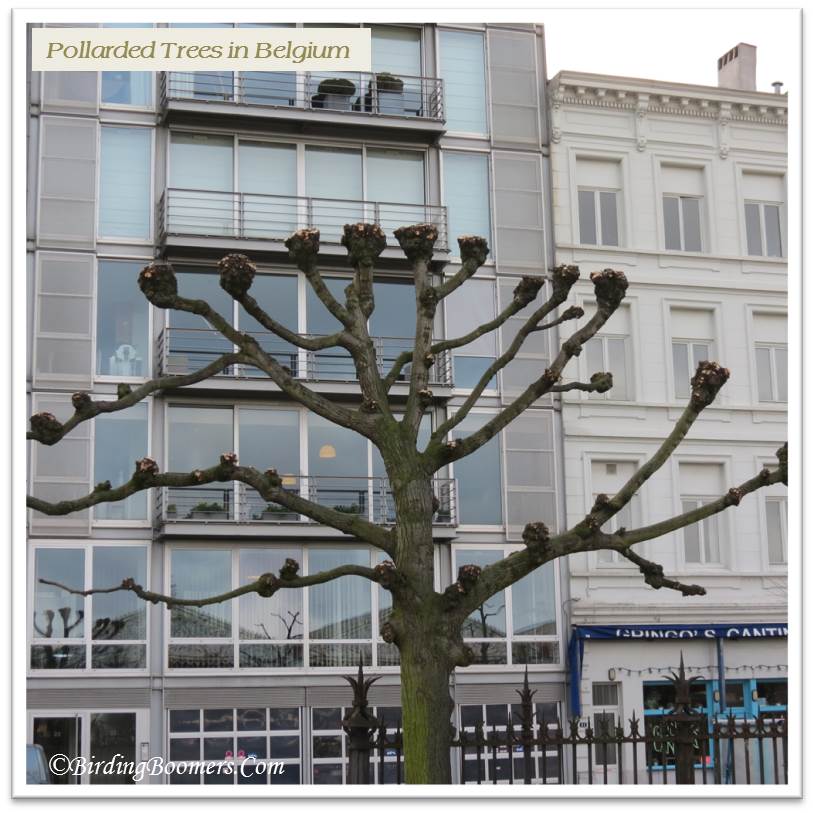 The trees lined the streets but looked more like huge sculpted tree menorahs than trees. I asked about the trees and was told they were mostly Linden Trees and would look lovely when the foliage grew back in spring. In this country, we see this process used on Crepe Myrtles – extreme pruning leaving the trees looking pretty horrible (to me) in spring. But the trees do seem to recover okay although they look like sticks and then sticks with powder puff leaf balls before they ever start looking like trees again. I will say that I do not pollard the Crepe Myrtles in my yard and they bloom just fine…..for those who would say the process means more blooms. Proponents of the technique say that it makes the trees live longer because they [the trees] are always having to recover and renew themselves and are never allowed to grow old [as trees go]. (You should read that sentence like you are a snobby hoity toity landscape designer who never deigns to actually get his hands dirty.) I’m not sure I buy that explanation but I do like the explanation that, in Europe, they do not have a problem with large tree limbs falling into power lines in those towns with pollarded trees during storms……because there are no large limbs to fall….now that makes sense.
 At Paca House, there are two ancient figs that are pollarded (or appear to be) and are also trained against the brick garden wall. As it is early spring when the plant sales are conducted, I have never been able to see the figs with leaves. But the ancient-looking gnarled tree trunks are quite impressive even without the leaves.
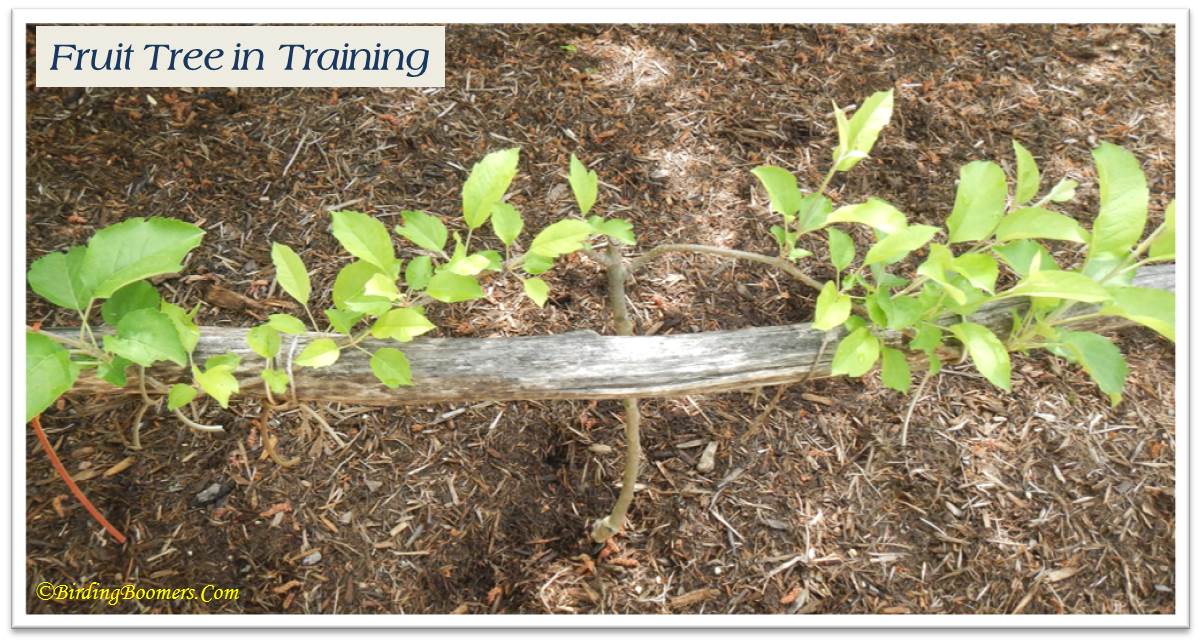 Now, the apple trees on the other hand are trained and espaliered to make a low edging to the walkways. I have never seen this before and I do not know what the technique is except to call it espaliering….or, making short walls out of trees. In years past, I have seen the trees filled out and marveled at the effect. And, yes, I have seen the tiny knee-high trees (some peach but mostly apple) with lots of setting fruit so I have to assume they are very productive trees regardless of their height. In the last couple years, the garden appears to have been re-vamped completely and the little apple tree walls have been removed (I suppose they get too old and start dying out) and new trees have now been planted and are now in training. Just the thing to get me back next year so I can see how the trees have progressed.
 There is also an apple tree archway that provides a covered entrance to another part of the garden that is pretty neat – no other way to describe it. It is just pretty neat to walk through an archway that is an apple tree or maybe several apple trees together. I like to imagine just taking a stroll in the garden and reaching up overhead and picking a little snack and you go from the vegetable garden to the topiary garden….find a bench….read a book….gardens can affect you that way.

 The garden is really pretty formal with gigantic hollies pruned into perfect cones and a centrally placed circular herb and rose garden that should be lovely later in the year.
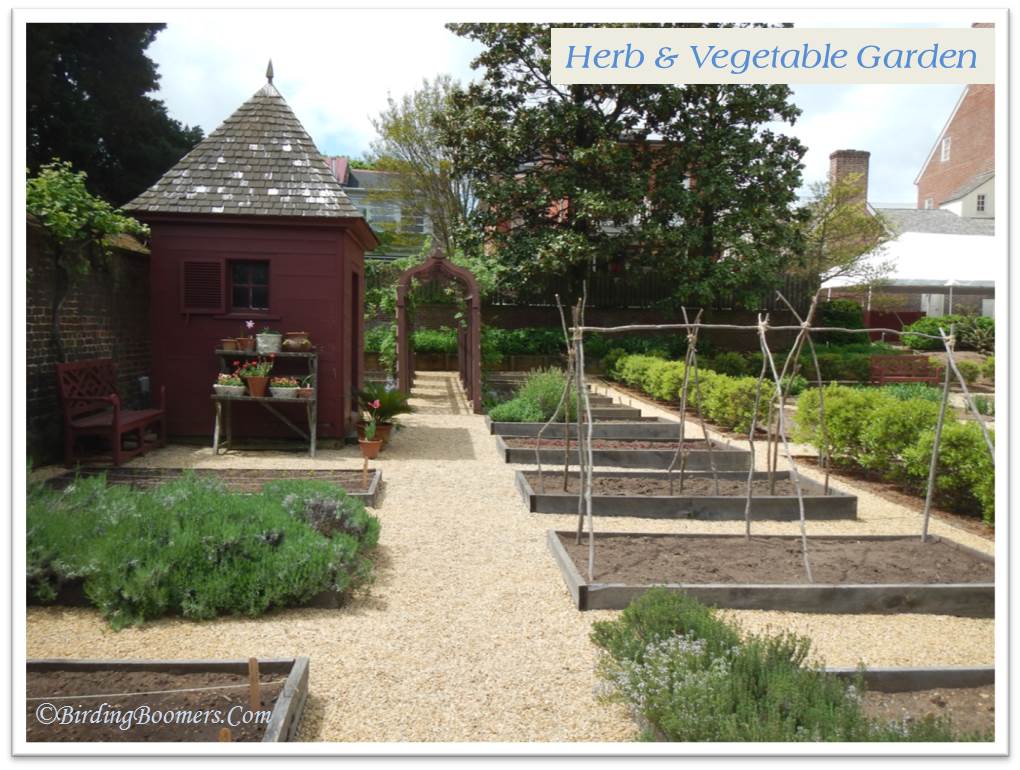 There is a side/kitchen garden comprised of maybe ten raised beds that appear to have been planted in but so far no little sprouts are showing this early in the year although the Rosemary and Lavender is growing like weeds…..err, maybe more like herbs.
 If you stand just at the back of the house, there is a broad graveled walk that goes all the way to the summer house at the very back of the property. There is also a pond with a lovely arched bridge just before you reach the summer house (or folly as I would think of it).
 But what always grabs my attention is the beautiful and very large Buckeye just to the right of the summer house. It is always in full bloom just in time for the plant sale each year. I fell in love with it the first year I went to the plant sale. I guess I had never really seen or noticed a Buckeye Tree before so didn’t realize they bloomed. When I asked about it, I was informed that the tree was a very special Buckeye – it was a cutting from a tree that was on George Washington’s estate, Mount Vernon, down near Alexandria, Virginia. I am not clear on whether or not the seedling was taken from a tree that George Washington actually planted or just one that is planted there today as being consistent with trees that George might have had on his estate. I think maybe the latter because I do not think Buckeyes live so long….but you never know. For want of a better name, the lady I asked just called it the George Washington Buckeye but I think it is really a Red Buckeye Tree.
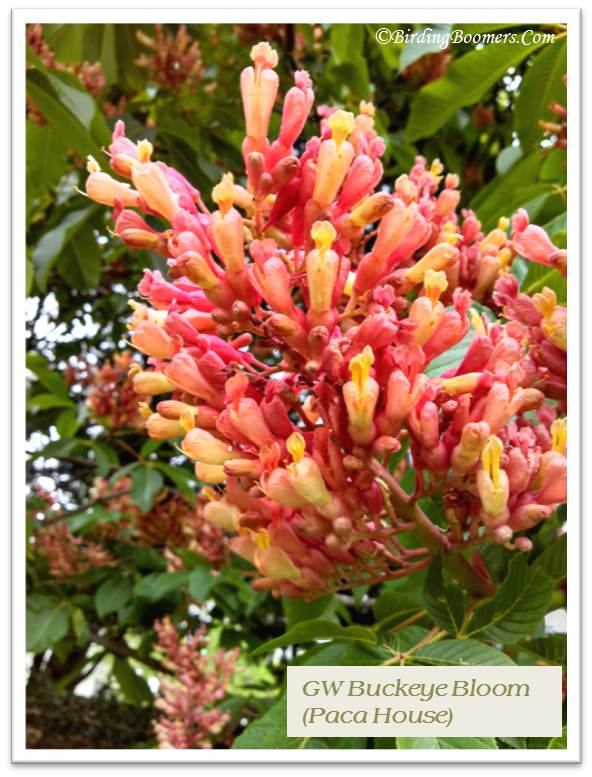 Well, you know I had to have one….and you know they just happened to have a seedling on sale right there at the plant sale that very day….and you know I had to buy it right on the spot. What else could I do? I brought it home and potted it up – it wasn’t much more than a stick after all – and I nurtured it (sort of) for a couple years and when it got big enough (bigger than a stick), I planted it in the ground. It is doing splendidly and this year produced its first bloom – a beautiful red bloom just like I had seen on the mother tree. Not a single regret do I have in buying that tree…..my very own bit of history and connection to good ole George right in my front yard.
 So, now we’ve circled the garden and it was time to get back to the good part – buying flowers. And, as it turns out, there’s not much to talk about for that part. They had mostly native plants and plants that might have been planted in gardens back in the 1700’s. I bought a couple more hollyhocks to replace the one I had bought last year. Since hollyhocks are biennials, last year’s plant is doing well and should bloom this year before dying out. The two new plants will grow this year and bloom next year. It’s a circular process that means I’ll have to keep putting in new hollyhocks each year to replace the ones that bloom and die. Not as good as perennials but better than annuals. It keeps a gardener digging in the dirt year after year after year.
 I also got the herbs I had mentioned and some Swamp Milkweed in my never ending quest to attract butterflies and, specifically, Monarchs to my flowerbeds. And a little Thyme and Bronze Fennel (love that color). I did not get Rosemary this year – just haven’t had luck with it in the past. But I did get a Cardoon plant to try…..it sounds so Madagascar so why not? And then there’s the Hyacinth bean vine for the trellis in the Hosta bed and a new little lemon colored miniature Hosta and a Moonflower vine for a hanging pot for the deck and……well, you get the gist of it, I filled my box so the good folks at the Paca House got their money’s worth out of me….til next year, that is. (Oh, in case you’re wondering, the box was full…..I just forgot to get a picture before some of the plants were planted.)








 Birding Boomers