
Fallingwater – Pennsylvania Trip Notes
Imagine, if you will, that you are an architect who has been given a commission to build a summer home, a weekend cottage, in the Laurel Highlands in western Pennsylvania. You travel to Pittsburg and then head south west and drive into the mountains where native rhododendrons and mountain laurel fill the forests and swiftly flowing white water creeks fill the ravines. You are an experienced and rather famous architect, Frank Lloyd Wright, and your clients are well-known and wealthy business owners from Pittsburg, Mr. & Mrs. Edgar Kaufman, Sr. Your first glimpse of the proposed home site might be similar to this one. (I have taken some liberties with the photo with my nifty photo edit software to try to capture the scene as it might have appeared to the architect.)
You note the sandstone, limestone, and shale ledges, the cooling green forest, and the cascading waterfalls and a vision starts to form in your mind of what a house should look like in this place. Your clients have asked for a vacation home that overlooks the falls, a peaceful haven, a place to get away from the hustle and bustle of city life in Pittsburg. Money is not an issue – your clients are very wealthy. You know in your heart that this is a unique opportunity to build that once-in-a-lifetime dream house and you are anxious to get started to make this vision a reality. What kind of house do you see?
Frank Lloyd Wright saw and built this. He named it Fallingwater…for obvious reasons.
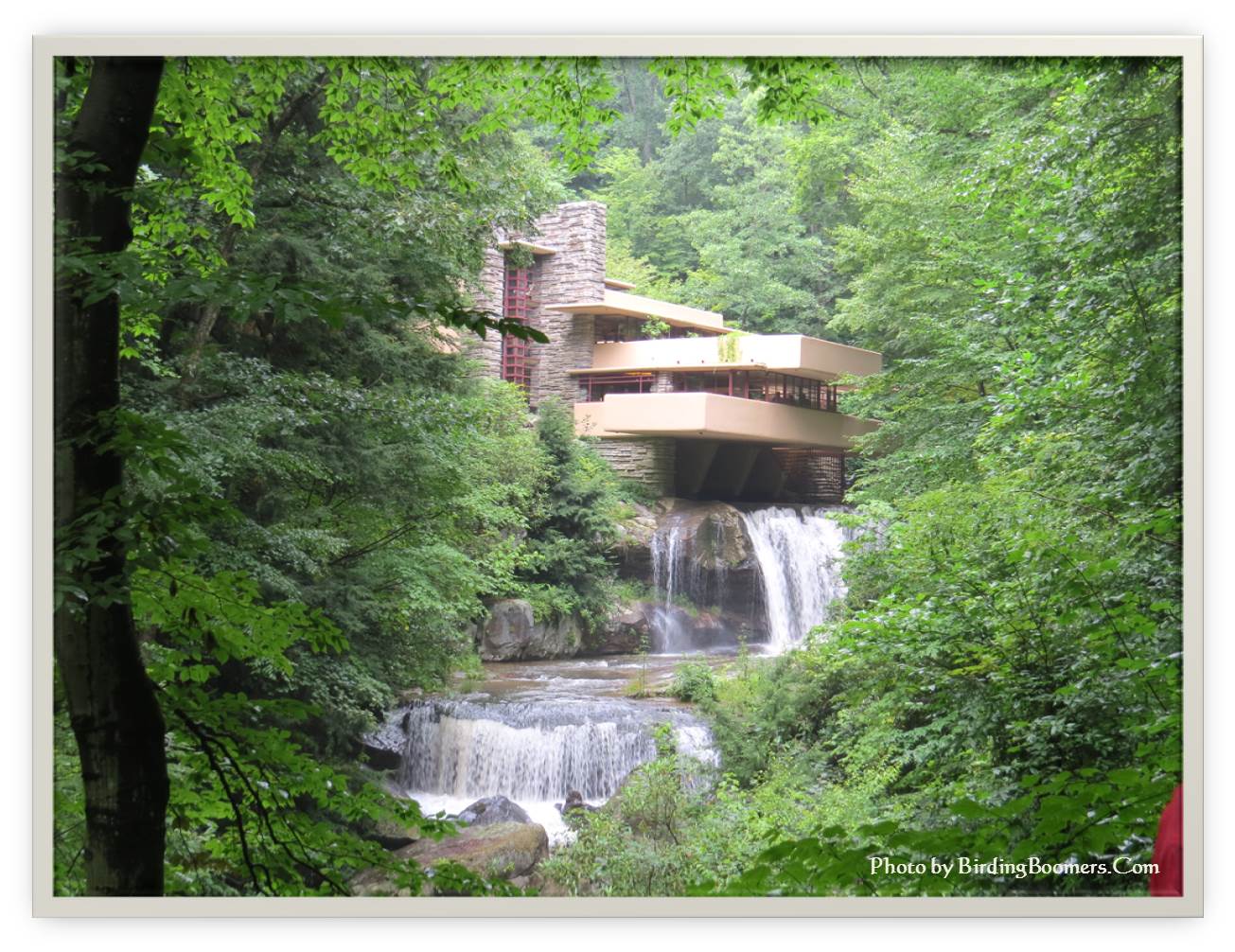 Recently, I got the opportunity to visit this magnificent property. My husband and I traveled to the Pennsylvania Laurel Highlands and toured the property near the village of Mill Run. (I am glad that we elected the longer tour (2 hours) and did not simply go with the basic tour.) This house is probably more famous than any other in the United States short of the White House in Washington, DC. We are now among the 5 million people who have toured the house since it was built in 1937. I imagine that Fallingwater has probably been toured and studied by more architects, designers, artists, writers, and engineers than any other private property anywhere in the US. You can certainly find books written about the property and dozens of magazine articles and thousands of photographs and, no doubt, hundreds of travel blogs without trying very hard; the internet showed 32M hits when I keyed in the name.
But let’s get back to my imaginings. According to our tour guide, Frank Lloyd Wright wanted to emulate the strong horizontal lines of the rock (sandstone, limestone, shale) ledges and to incorporate the cooling waterfalls into the structure. He wanted the house to be organic and to meld in with its wooded surroundings…strong horizontal lines of the rocks, tall columns reaching to the sky like the trees. A well-known story goes that he wanted the color of the façade to repeat the color of rhododendron leaves in the fall. This gave me pause and I actually had to go look rhododendrons up on line. In my experience gardening and growing rhododendrons, I thought that they were evergreen so was somewhat taken aback that Wright wanted to blend the house in with the fall colors of the rhododendrons. Why, wouldn’t that be green? Well, turns out that some rhododendrons and mountain laurels are deciduous and the leaves would turn golden colors in the fall and would probably at some point be this light khaki color and the house would blend in quite nicely that being the case. But it isn’t always light khaki like it looks in the pictures (above & below)….I am told that sometimes the house color appears to be more of a peach color or maybe more in the mauve color set. The sunlight, the seasons, and the various hues of the deciduous trees all affect the color of the house. I suppose a photographer or artist like Claude Monet might make multiple visits to try to capture the house in each season and in the ever changing light. Perhaps, I too should visit the site in autumn to see if Mr. Wright got it right.
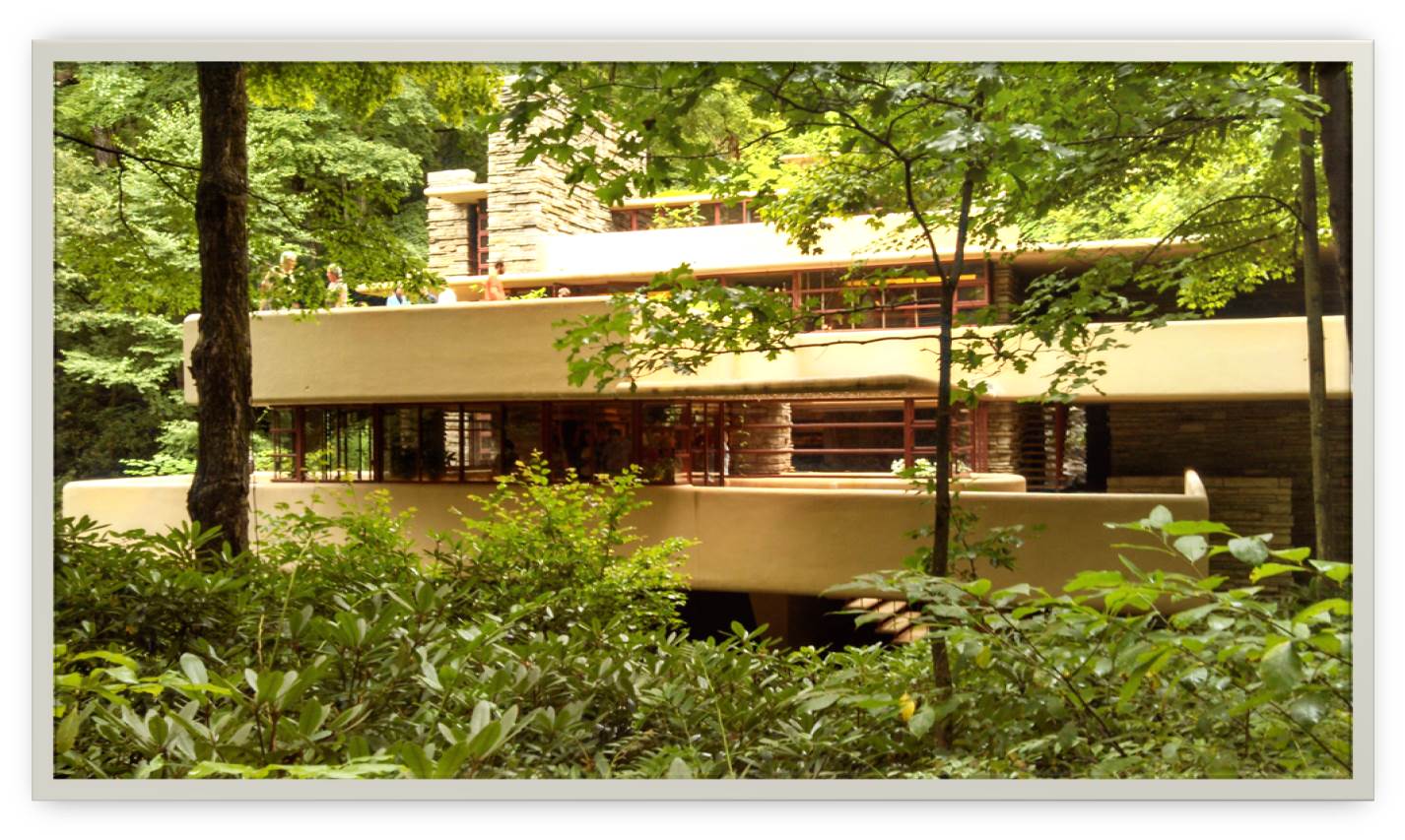 There are certainly some challenges to building a house over a waterfall, even a couple little falls like these. I find that I am lucky to be touring the house with my husband. We’re a bit of a right-brain, left-brain composite. I am taken by the aesthetics and beauty of the place, wondering what kind of fur drapes the sofa (raccoon), noting how the windows perfectly capture the outside views (except the waterfalls), falling into rhythm with the steady sound of the cascading creek and pondering how beautiful things would be in winter watching snow softly fill the ravines. I sense the serenity and peacefulness of the place. My questions revolve around Wright’s desire to build a more organic structure bringing the outside beauty into the inside of the house and I think how forward-thinking he was to build all the patios and decks allowing the living space to flow easily between the inside and the outside. I also am reminded of how many designers and architects have tried to emulate his work over the past 50 years or so.
So who wouldn’t like a staircase going down from their living room into the cool waters of a creek on a hot summer’s day?

 Note the small wading pool to the right of the stair. No, you do not have to crawl over the wall; the pool has its own entrance from the house just out of sight in the corner opposite the statute. There is also a larger pool outside the guest quarters behind the main house. Both pools are filled with creek water so no chlorine or other chemicals are used in the water that might pollute the natural stream. Note also the color of the rock and sandy shelf under the creek at the bottom of the stair and how it is pretty much the same color as the deck above.
Moving on to more left brain perspectives, my husband is all technical and his questions are all about the engineering of building such a structure; which walls are load bearing, how the conduits were run through the house, what kind of caulk was used to seal up the windows (something new for the time called silicone glass), how the electric lines were run along rock walls, how the radiators were all built into the desks and shelves to hide their industrial nature, what, if any, construction codes were adhered to in the building (none that the tour guide knew of) and how the rebar and steel were used to strengthen the cantilevered decks. This last question brings to mind the thought that maybe just one or two more little steel I-beams might have kept the decks from sagging over time. The guide assured us that the decks had been shored up to prevent further sagging but even the photographs show that the lower deck is not quite level anymore. (I have since read that the building was shored up in 2002 and is safe and there is no additional sagging but that rehabilitation of the whole structure would cost more than $11M.)
Right brain or left brain, we were both impressed. At first look, you have an emotional response to the beauty of the house and its setting. Then you start to look at all the details and you become impressed with the technical accomplishment and how many obstacles were overcome to build the place and not have it topple into the creek after the last stone was laid.

 I understand Wright’s need to design and “own” everything about the project and notice the craftsmanship of all the cupboards and furniture. The walnut veneered cupboards and cabinets are quite beautiful.
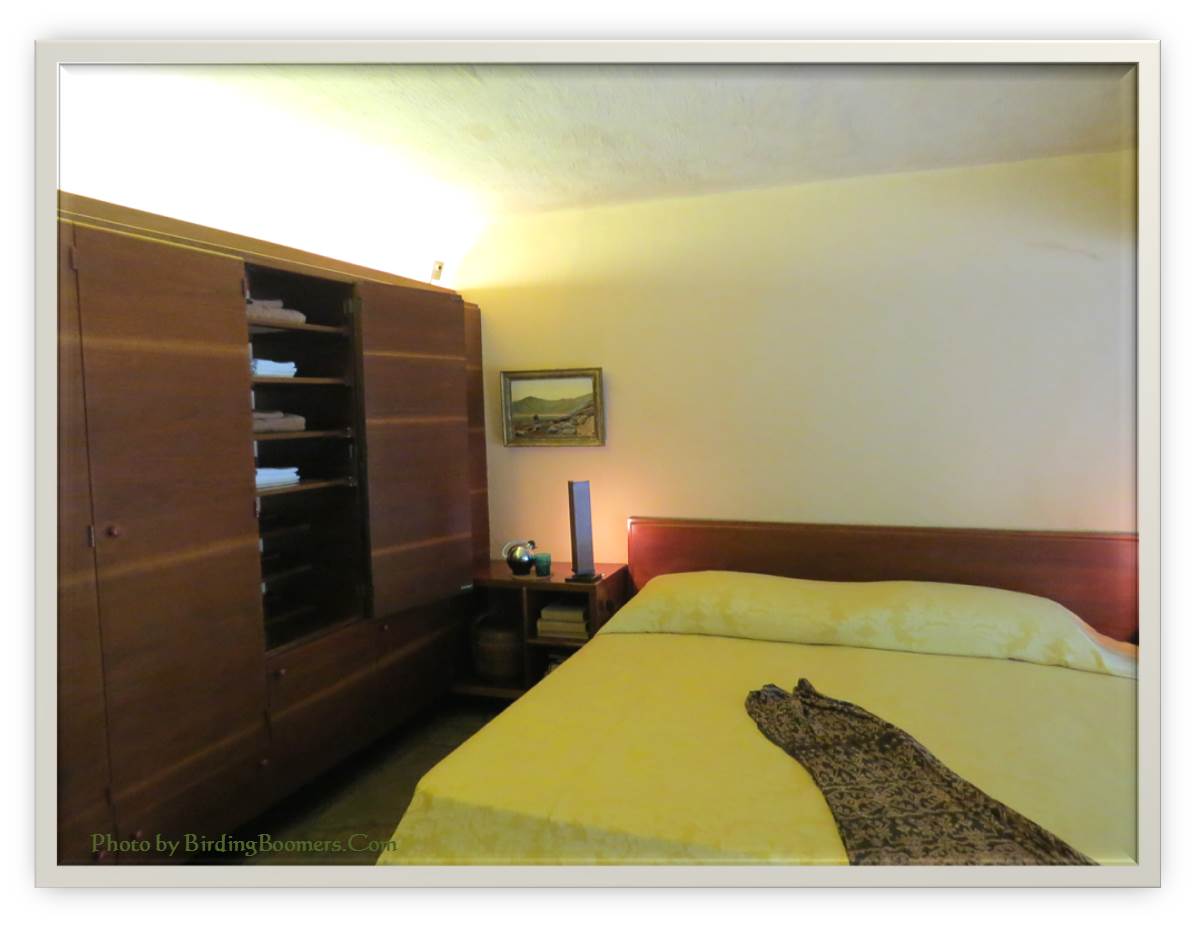 I read that Wright left an apprentice to oversee most of the work and that there were issues with the building contractor. (Isn’t that always the way it is?) The architect liked things to be very neat and uncluttered so every accessory was chosen with care by Mrs. Kaufman (who was known to be quite talented in her own right) and even the bedside lamps were designed by the Frank Lloyd Wright. Everything is beautifully rendered and placed “just so” exactly to the architect’s specifications. It appears that there were some details that the lady of the house took issue with and there were some accommodations….but not as many as I would have expected. But thinking like someone who might daydream about living here, this is where I find some things that I do not like about the house.
 I marvel at the expanse of the great room but I quell against the concept of having all the furniture neatly lining the perimeter of the room. The built-in couches hug the walls and the view when one is sitting there would be to the inside of the room rather than to the outside….your back would be to the view. Great for your guests though who can look over your head and out the windows to perhaps ignore the conversation altogether. Anyone sitting at the dining table would see his/her dinner companions across the table but then a stone wall or the kitchen doorway directly behind the table.
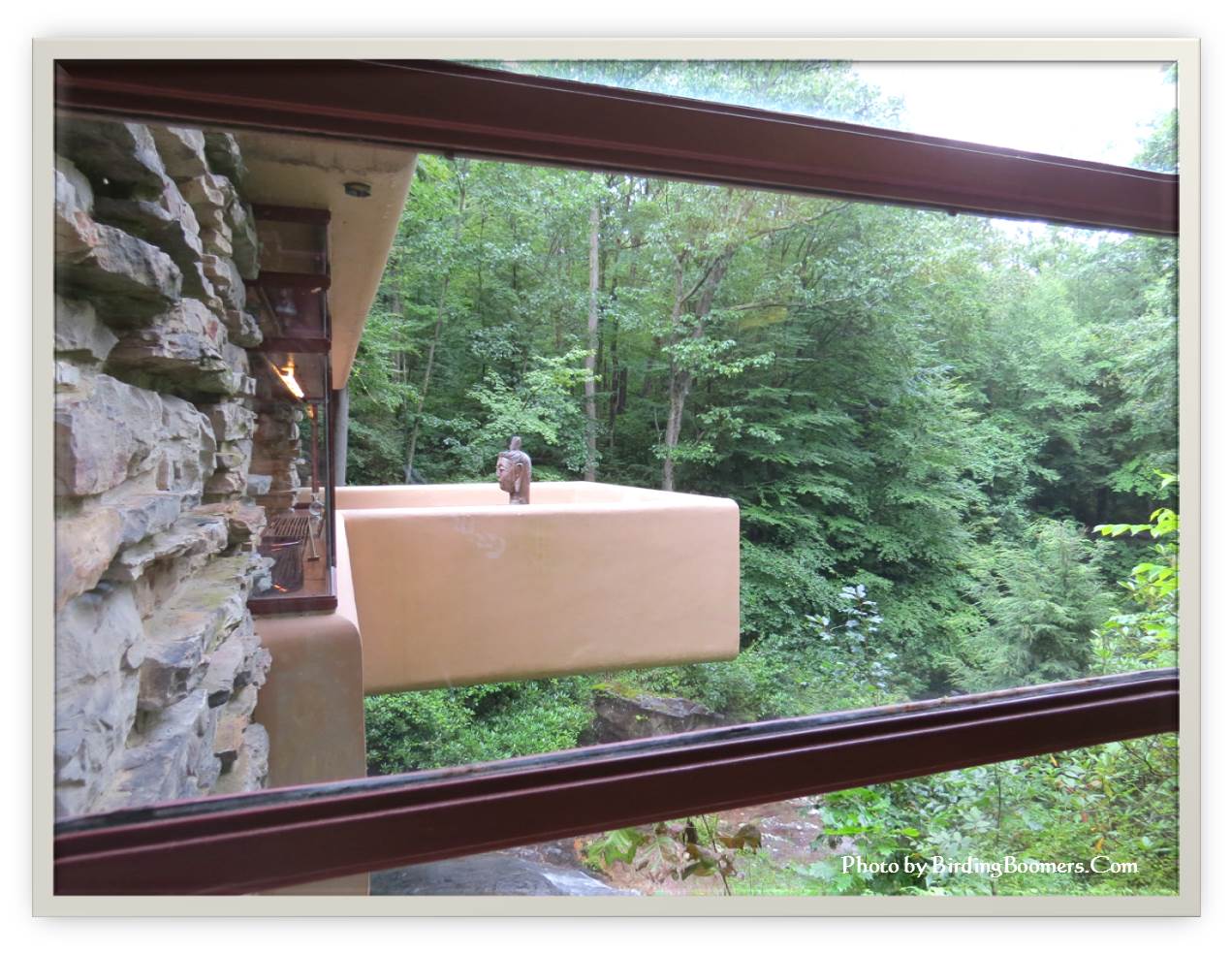
 Bear Run flows swiftly under the decks but your only view of the waterfall from the house itself requires that you lean over the deck walls which can be a little bit precarious since the walls (again, no building codes) are not as tall as you would think for a deck overlooking a significant drop to the creek below. I asked about the low deck walls and discovered that Mr. Wright did not want to disrupt the “lines” of the structure so that the lower deck walls are in line with the back of the couch in the great room and the upper deck walls are lined up with the built-in desks and shelves in the upper rooms. To maintain a certain perspective for the overall house, the house is designed so that the lower level is larger than the upper levels with the lower levels having higher ceilings which become lower as you go higher. It is the same with the deck walls – the higher you go, the lower the walls it seemed. All good if you just remember not to lean too far over the deck on the upper levels.
 While you do get some cooling breezes throughout the house when the windows are open, there is no air conditioner. I think maybe that central air was not something that was prevalent for private dwellings in the early part of the 20th century although there were skyscrapers being built at that time. Wright had designed and built office buildings in Chicago that would have used/required some sort of cooling and ventilation so I ponder that he did not include some sort of mechanical ventilation here. But every window opens and the furniture is built to accommodate the open windows and there is good cross-ventilation when the windows and doors are opened. Per our guide, the Kaufmanns added the screens to the windows although the architect did not want them added. Mr. Wright thought that screens blocked the view through the windows. It appears that keeping the bugs out when the windows were open (and the windows would be open in the summer’s heat) won out in that whole debate.
 And there is absolutely no additional storage space in the whole house – no basement (ok, a tiny one that holds a hot water heater), no cellar, no crawlspace, no attic; therefore, no place to store Christmas decorations or any other of the bits of paraphernalia we humans seem to collect around ourselves and need to stow in some dark closet or garage. But it was intended to be a vacation home so perhaps all that stuff was left back at the main house in Pittsburg.
 Overall, it seems that the owners considered the house to be a work of art and therefore probably not bothered by the things that caught my attention.
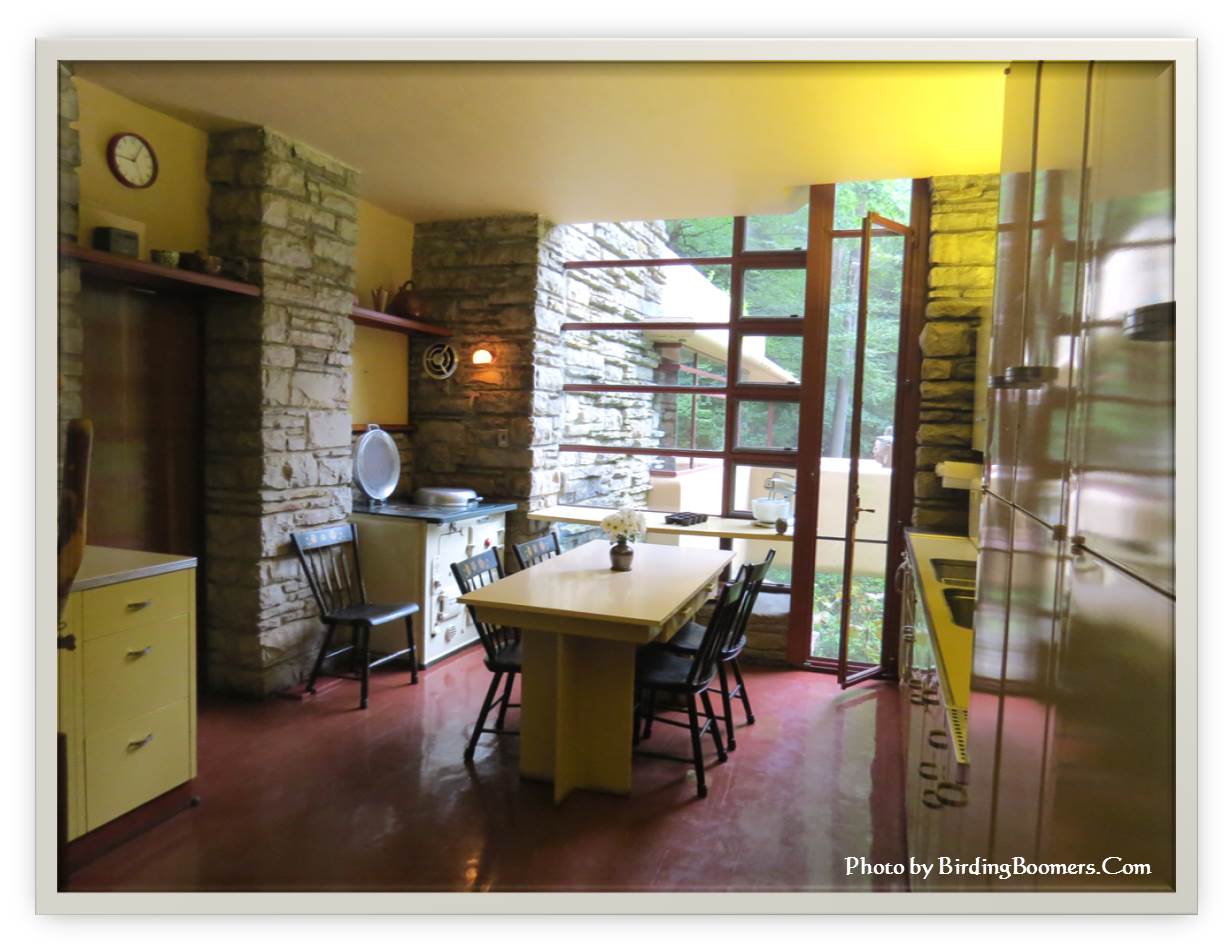 But there were more things to appreciate than to dislike. I took just about 200 photos of the place. There is something so intriguing about the house and its location that encourages lots of picture taking. I had wanted to see it for many years and the house was every bit as interesting as I had hoped it would be. The kitchen (above) is quite modern for its day and it included a double door refrigerator….I didn’t even know they had them back in the 1930’s.
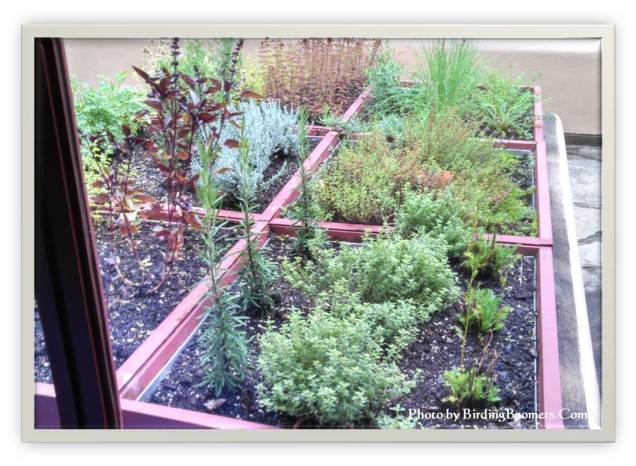
 The gardener in me particularly loved the herb garden on the top deck….not to mention the fig trees in pots on the middle deck or the geraniums growing in the window boxes inside the house. And each bedroom has its own private bath – can you believe that for a house built in 1935? Remarkable!
 But my vain imaginings got me to thinking. If I were Frank Lloyd Wright for a day, how would I have built the house? I think I would have positioned the house downstream of the waterfalls looking back towards the falls. The location called “the view” where everyone stops to take the photos of the house (seems to me) would have been the perfect spot for the house itself. I think I would have built on either side of the creek using the horizontal cantilevered decks (maybe not so big) running parallel to the creek in much the same way the natural stone borders the creek. Maybe I would put the great room and the living spaces on the western side of the creek and put the office, library, guest quarters and garage on the other….with a large storage room. The great room would view the falls upstream and the master bedroom would look out over the creek and ravine downstream. In my wildest dreams, I would connect them with a beautiful arched bridge spanning the creek allowing you to stop mid-bridge and look back to the waterfalls on one side and further down creek on the other. Maybe make the bridge wide enough to include a small bistro table and chairs to allow coffee and breakfast over the creek. I would use the same oriental aesthetic that Wright seemed to love and add Japanese style lanterns across the bridge to light the way. I only wish I could sketch so I could show you exactly what I mean. Of course, I’d need someone with more training, imagination, and talent than me to help me figure out things like how to handle moisture and how to keep the bridge from freezing over and how to more organically connect the two sides of the building and how to make sure we had central air and heating…..maybe an architect….perhaps someone like Frank Lloyd Wright.
**********************************************************************************
Look anywhere for information on Fallingwater and Frank Lloyd Wright…but to get you started, here are a couple sources of information that I found enlightening:
Official Website for Fallingwater: http://fallingwater.org/
Wikipedia Overview: http://en.wikipedia.org/wiki/Fallingwater
Frank Lloyd Wright Foundation: http://www.franklloydwright.org/
Wikipedia Overview of Frank Lloyd Wright: http://en.wikipedia.org/wiki/Frank_Lloyd_Wright
Fallingwater is now owned and managed by the Western Pennsylvania Conservancy. Information about the Conservancy and its efforts to preserve Fallingwater and other sites in Western Pennsylvania can be found at: http://www.waterlandlife.org/legacy/
For those of you who have visited Fallingwater and know that the Conservancy has restrictive rules about taking photographs of Fallingwater and publishing the photo, please be assured that I requested permission to add photographs to my blog about my visit at the end of our tour. I was advised that, as long as I was not using the photographs commercially or attempting to make money by selling the photographs, then I could add them to my travel notes for my blog.
Please do not make copies of my photographs, share them to social media sites, publish them elsewhere or “pin” them on Pinterest as this would be a violation of the rights held by the Conservancy and the permission that I was given allowing me to add them to my blog for personal uses only.








 Birding Boomers