They came in 1741 to find a place of their own, a home for their families, and a place where they could live in peace and worship God in freedom and reverence. Nicolaus Zinzendorf and David Nitschmann led a small group of Moravians to a fertile valley at the confluence of the Monocacy and Lehigh Rivers in eastern Pennsylvania. The story goes that Nicolaus (a bishop of the Moravian church) noted how the beautiful night sky reminded him of the birthplace of Jesus and so the newly founded mission site was christened “Bethlehem” on Christmas Eve in 1741.2 Not surprisingly, it was here in this small village that local history records that the first decorated Christmas tree in the United States was displayed.1 (Bethlehem is just one of several Pennsylvania towns inspired by Biblical sites such as Emmaus, Jordon Creek, and Nazareth.)2
The Moravians ministered to the Lenape Native Americans2 in the area and established a growing religious community in the area that continues today. But the peacefulness they sought in that valley would not linger too many years before the Industrial Revolution and its entrepreneurs found that the town was ideal for new things and progress on a different front. Nearby Allentown just northwest of Bethlehem was founded in 1762 and iron ore was discovered there in the 1840s3. Iron ore – pig iron – the main component in making steel…. steel which was needed by a young country on the move in order to build the bridges and buildings and ships and weapons that would be needed to prosper.
The Lehigh River at 109 miles long is a tributary of the Delaware River and ultimately the Delaware Bay – perfect for shipping goods down to Philadelphia and via the Atlantic to all parts of the world.
Both Allentown and Bethlehem became vibrant steel-producing cities. (Now, doesn’t that get you to humming Billy Joel’s “Allentown”4?)
Not to overwhelm you with too much history….but the first iron works facility was built – Saucona Iron Works – in Bethlehem on the Lehigh River in 1857. The name was later changed to Bethlehem Iron Works in 1861 and finally to Bethlehem Steel in 1899. Bethlehem Steel, which would quickly become one of the world’s largest steel producing and shipbuilding companies.
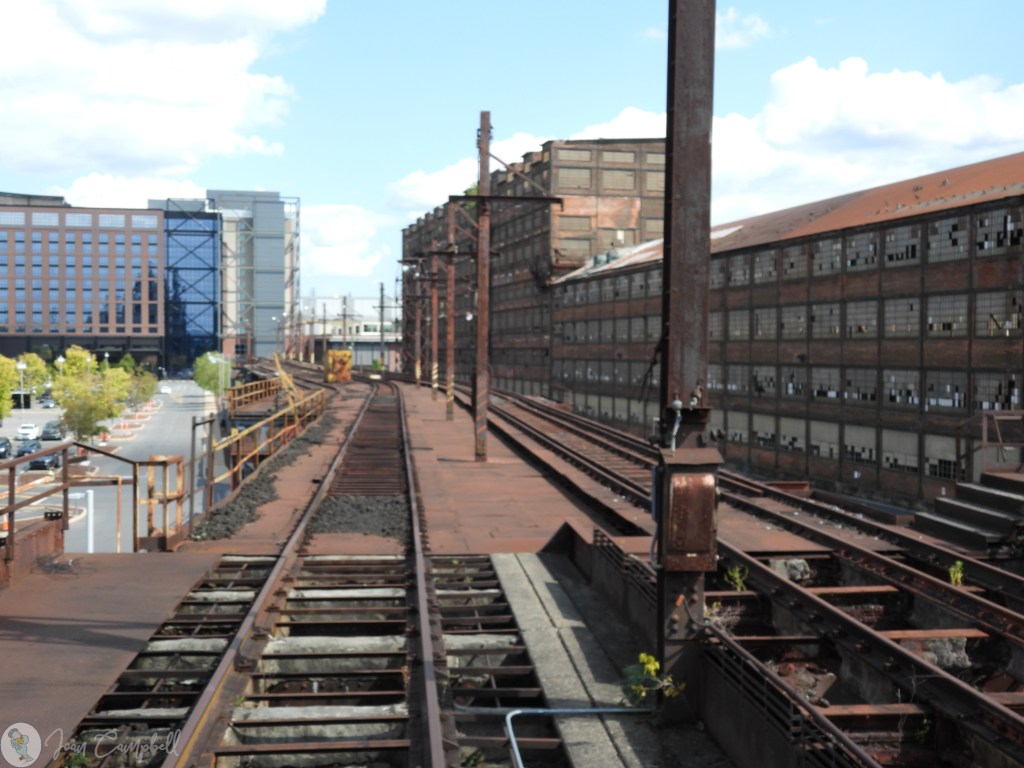
Machine Shop #2 – Just about 1/3 of a mile long.
Once incorporated, Bethlehem’s first elected mayor was Archibald Johnston, not surprisingly, a Bethlehem Steel executive2.
My personal favorite on the list of accomplishments was provision of the iron that was used to build the 45.5’ steel axle for the world’s first Ferris wheel (264’ tall) created for the 1893 Chicago World’s Fair.2
While the Moravian community up on the hill would continue, it was Bethlehem Steel with its manufacturing plants at Sparrows Point, Maryland, Johnstown, Pennsylvania, Lackawanna, New York, and Burns Harbor, Indiana, that would dominate the growth and economy of the little town for more than 140 years until its closure.
So, all good things must end, I suppose, and that would include Bethlehem Steel (later to be merged with US Steel). The great furnaces that roared continuously night and day for eighty-one years from the first firing in 1863 were silenced forever in 1982. Finally, in 2003, the once mighty Bethlehem Steel was done.
It seems that there were many reasons for the demise of this great company – bad investments, mismanagement of pension plans, increasing competition from overseas companies, rising labor costs, less labor available altogether…. the list is a long one.
Today, Bethlehem is quiet and again (for the most part). The town itself thrives and is home to two universities – Lehigh University and the Moravian University.
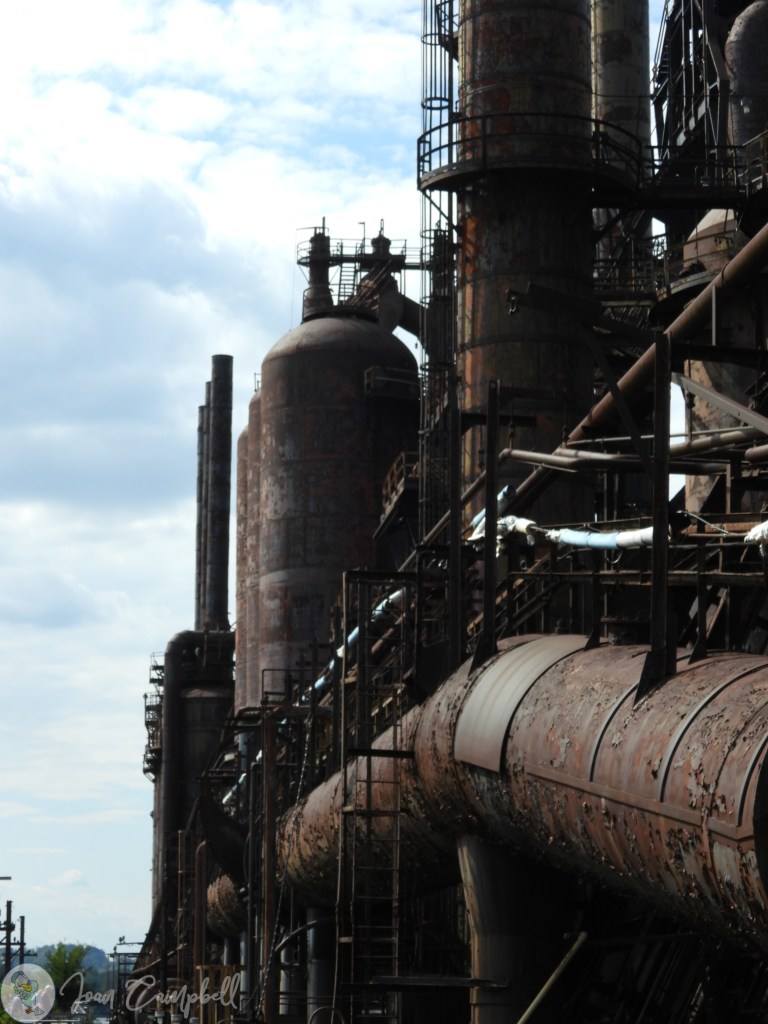
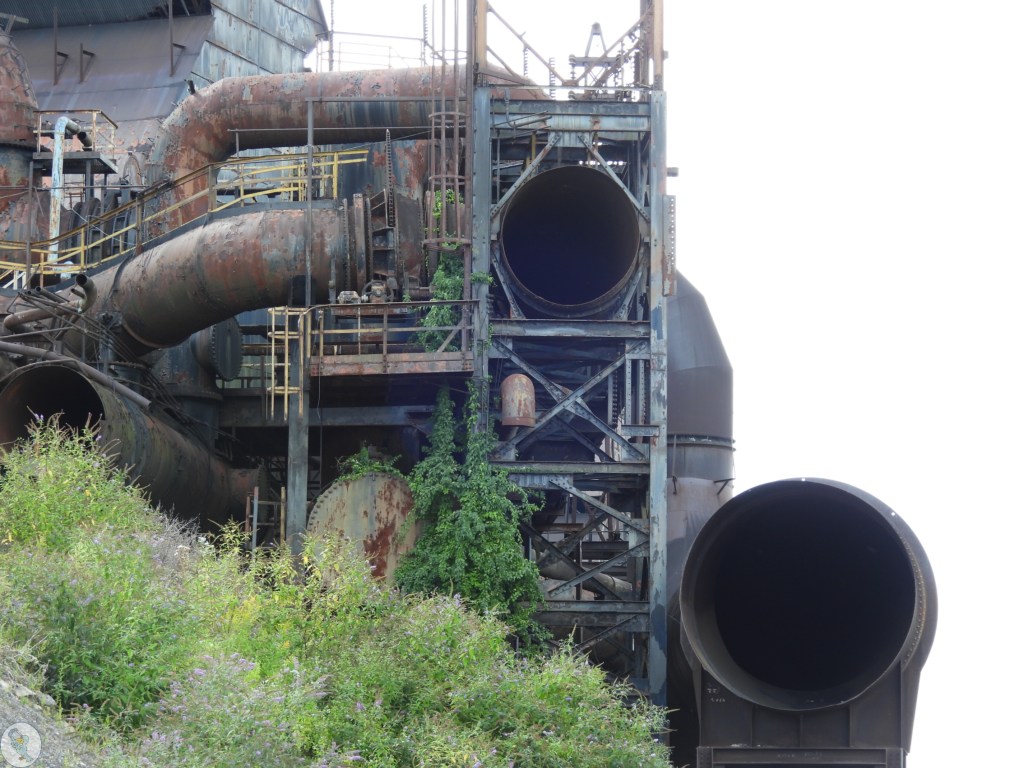
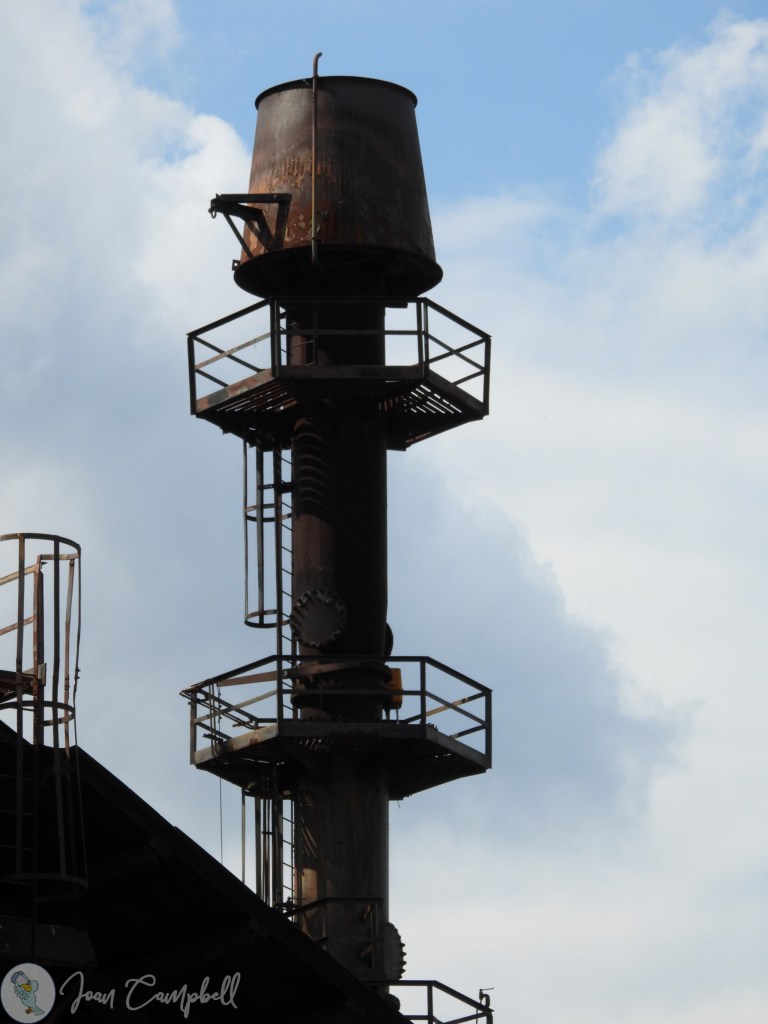
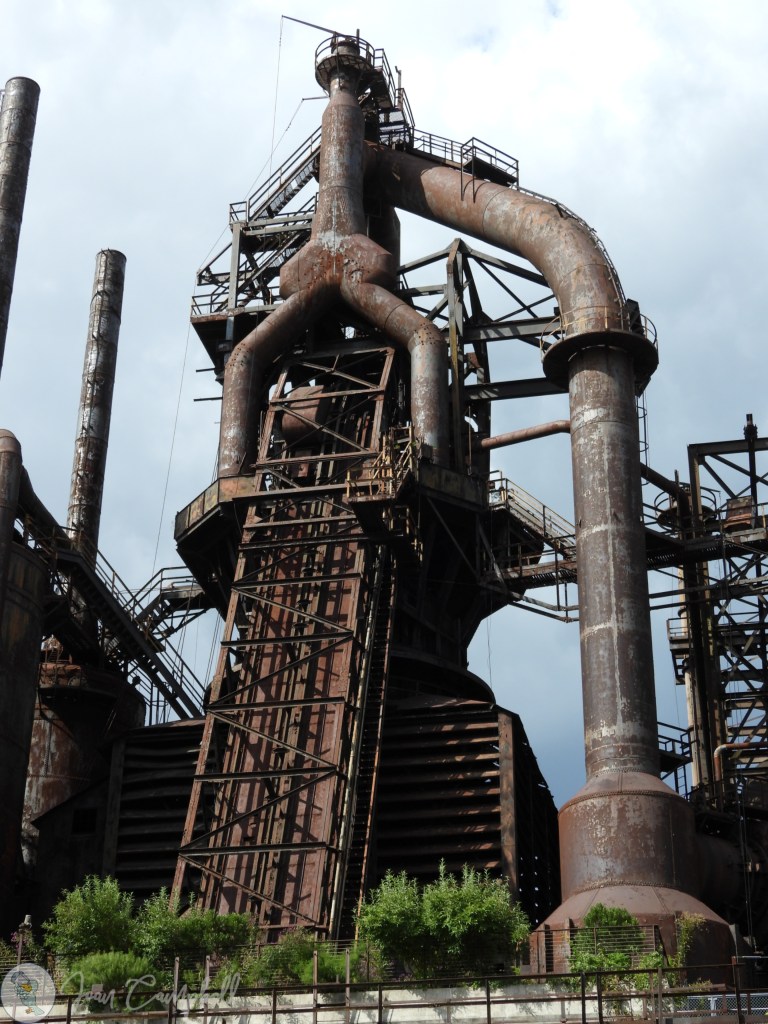
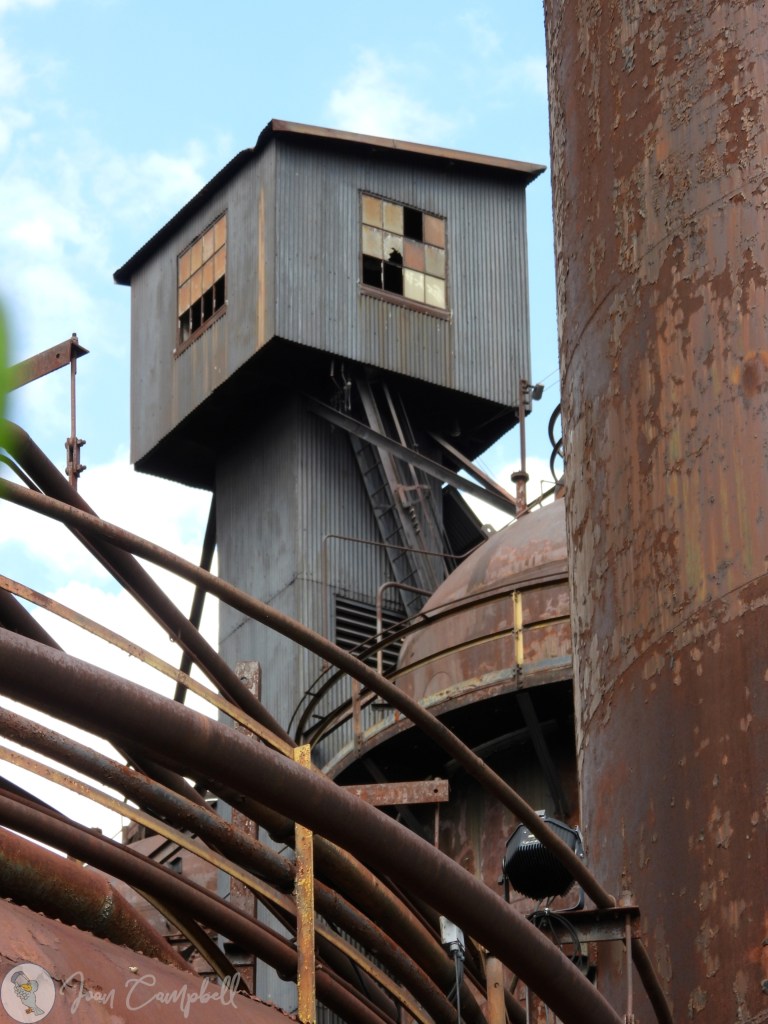
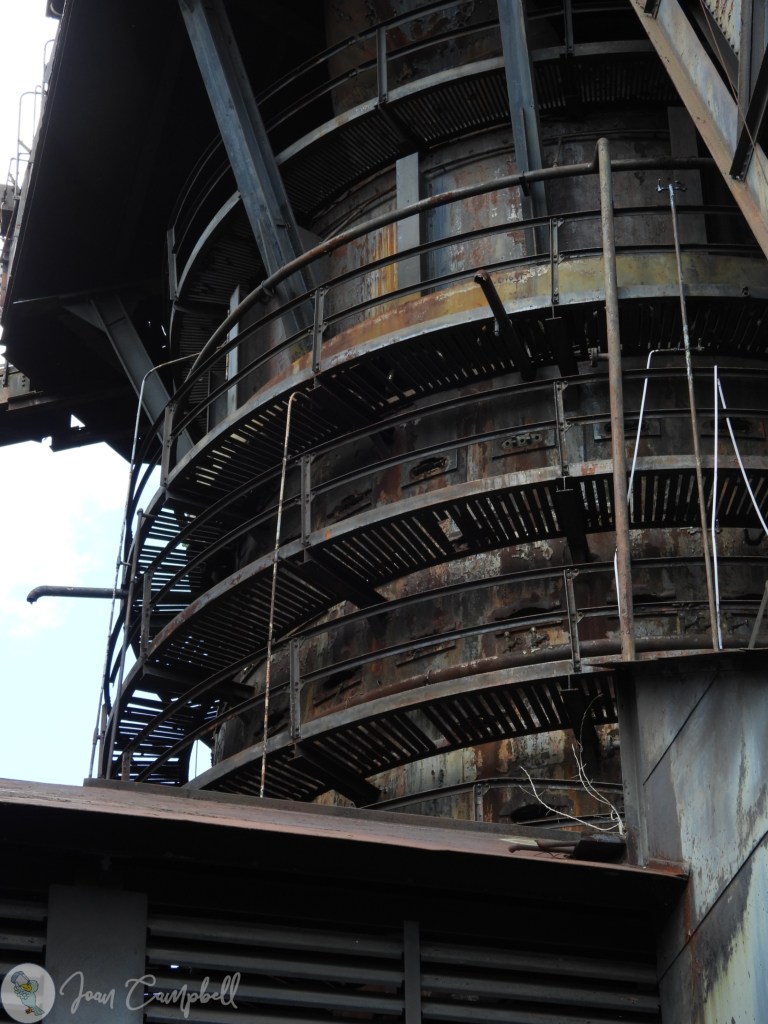
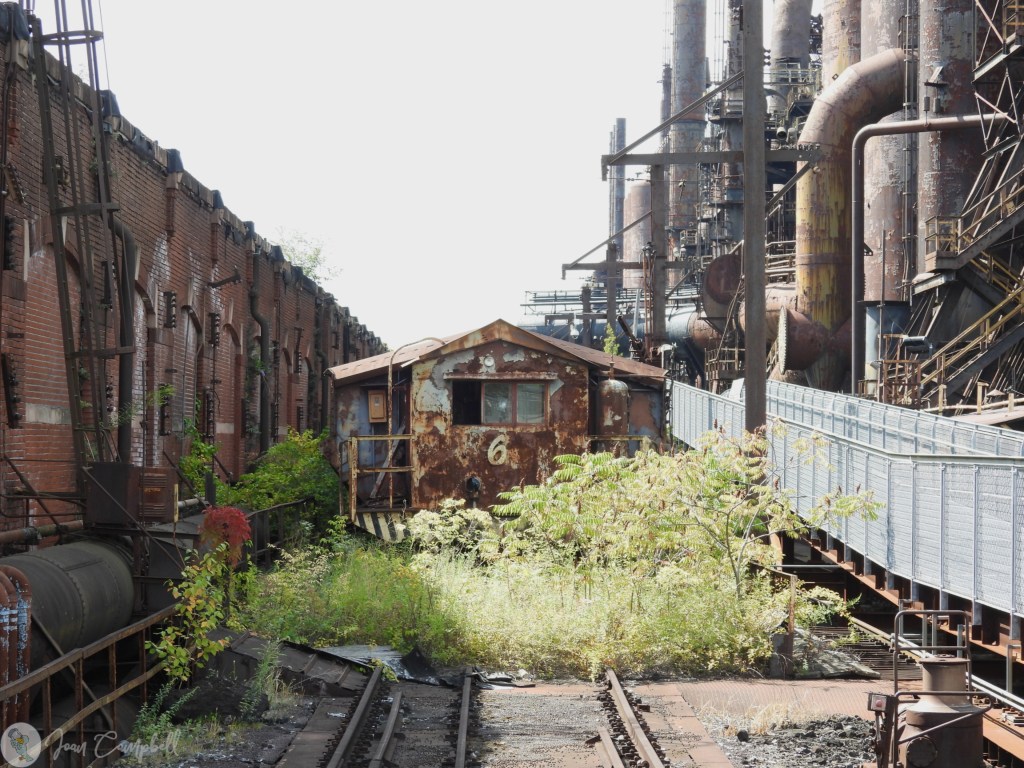
As for the steel industry, the town has preserved its history in “The Steel Stacks” that remain down by the river. The area has been transformed into a park and event venue that is dominated by the old steel furnaces and industrial buildings. Most of the buildings are slowly but surely rotting away. All have been fenced in for safety of visitors and are no longer accessible. The “Stacks” themselves are also fenced in, but a catwalk has been built alongside the old infrastructure where visitors can walk and view the rusting furnaces of the abandoned mill. We spent an afternoon exploring the park and strolling along the catwalk gazing in amazement at the size and sheer “presence” of the steel stacks that dominated this valley for so many years.
As Billy Joel sang of “Allentown”3, you might also sing for Bethlehem, still vibrant but peaceful again after all these years.
“Well, we’re living here in Allentown And they’re closing all the factories down Out in Bethlehem, they’re killing time Filling out forms, standing in line”4
Bethlehem is in Pennsylvania just about 45 miles west of Philadelphia, 72 miles south of New York City, 197 miles northeast of Washington DC, and 149 miles northeast of Baltimore – easy to find and only a couple hours’ drive – just right for a daytrip. There is also a small museum at the site where you can learn lots more about Bethlehem Steel and enjoy a guided walking tour along the catwalk.
Yesterday I gave you a little bit of Bethlehem’s history; today, I give you a little bit about our visit there last February.
Outside the Church of the Nativity in Manger Square, our Palestinian Christian guide gives us an overview of the church. While in Bethlehem, our Israeli guides were replaced with a Palestinian guide. The Church of the Nativity was the home church for our guide – his family had attended for many generations. But he said that he and his immediate family now attend a church closer to their home for regular services.
Our first glimpse of the Church of the Nativity was from Manger Square which is the site visited on Christmas Eve by thousands of Christians who come to celebrate the Lord’s birth. You enter the actual church through a very low door known as the “Door of Humility” which forces you to bend down to enter – being made to be humble as it were.
Entering the Church via the “Door of Humility”
But the story behind the door is much more interesting but not very spiritual at all. Sometime after the Ottoman conquest in 1516, the church had fallen into decay and was being ill-used by the locals. The large main doors were walled up to prevent people from riding their horses right into the sanctuary. The small, low door kept the horses and other animals out of the church.2 While the original intent of the small door may not have been about humility, it does feel a bit like you’re going into a very sacred place when you bow down to enter that door which opens up inside to a large open sanctuary.
Looking back at the “Door of Humility” from inside the church. The stone archway gives you an idea of that the original entrance might have been. Looking at the changes in the stonework helps to imagine the location of the large wooden doors of the original church.
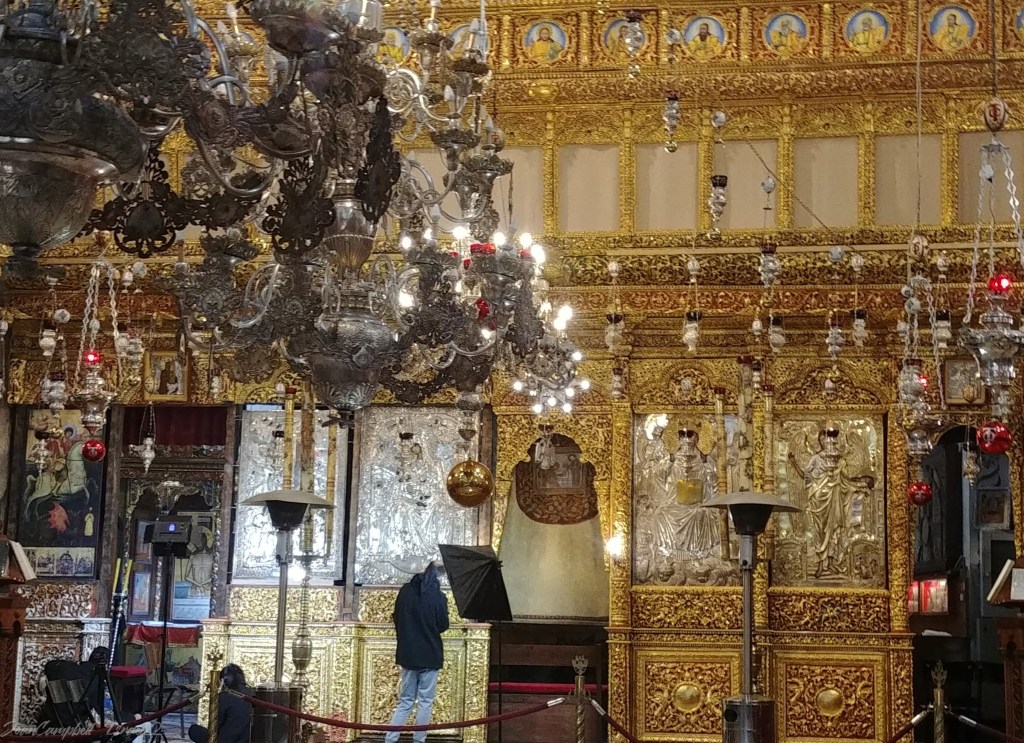
I have only been into one Orthodox church in my lifetime and never into one so old. This church is the oldest Christian church in Israel and, in terms of active continuous worship, possibly the oldest in the world.2 Being someone who grew up in a little country church in the US with very little embellishment besides possibly a large wooden cross over the altar behind the pulpit, this church seemed a bit overwhelming to me. The floors were marble flagstones with marble columns lining the aisles up to the altar which was all gold and silver and lit strategically to enhance the glow and sheen in the flickering candlelight.
Inside the Church of the Nativity (Eastern Orthodox). The marble flagstone floor is not the original; there is supposed to be a trapdoor that lifts to show the original mosaics of the Justinian-built church, but it was not open for us the day we visited.
We were advised by our Palestinian Christian guide that the gold screens behind the altar had tarnished to a dull grey over the years but were being restored to their original gold & silver especially in the past couple years while there were few, if any, tourists during the Covid pandemic… that we were lucky to see everything “gold” again.
A closer view of the gold & silver panels at the altar. On the left side of the photo, you can see three people (one standing just left of center and two others sitting on the floor) working to restore the patina on the panels. At the far left on the bottom, you can see the tarnished panel not yet restored.
There were sanctuary lamps of gold and silver hanging everywhere…. hundreds of them. I was quite fascinated by all these lamps…. they appeared to be lit with candles or, maybe oil. I have read that the lamps signify the eternal flames and everlasting light that is Jesus.2 Who lights these lamps every morning…or whenever they go out? Does some priest come in with a very tall ladder every morning to ensure the lights never go out? If the lights do go out, does some poor caretaker get fired? There were just so many of them and I saw no hint that anyone was actively monitoring them while we were there. (This is the way my mind works.) And, yes, there were electric lights too.
Sanctuary Lamps in the Church of the Nativity
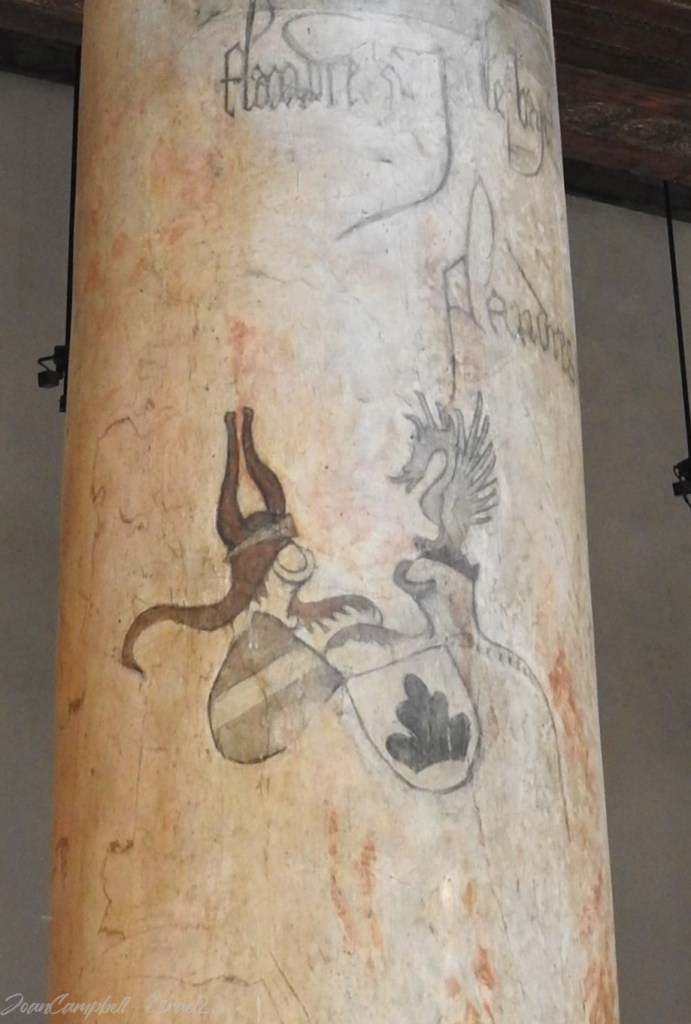
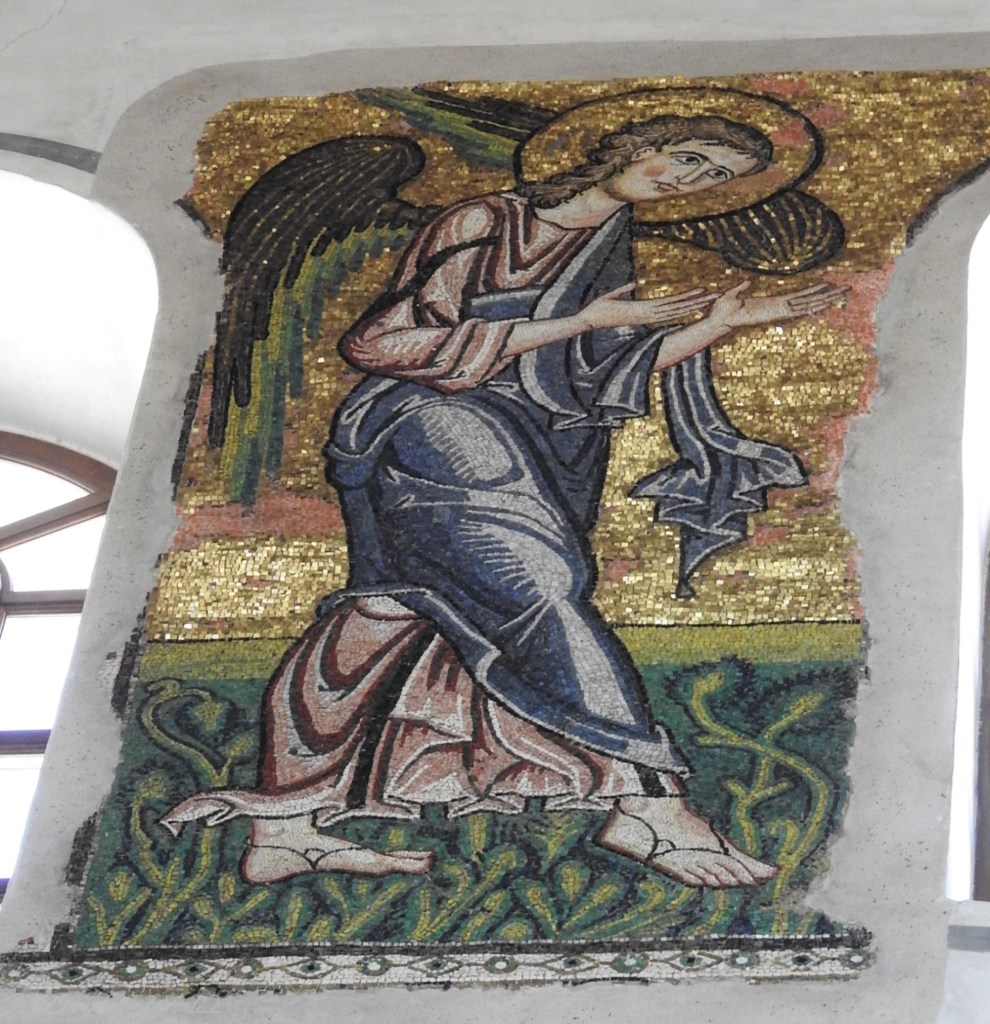
The walls near the ceiling were covered with mosaics depicting saints or scenes of the life of Christ and there were many old paintings and other gilded icons everywhere. The marble columns also included life-size portraits of saints although many were covered with graffiti from crusaders, Ottomans, pilgrims, etc.2 We humans seem to have a need to leave our mark everywhere we go – you know adding our own “Kilroy was here” – even in places where we know we shouldn’t.
Columns inside the Church were painted with portraits of saints (official), and some include graffiti (not so official) including the artwork on the right which might have been added at the time of the Crusades.
The Grotto of the Nativity is behind and underneath the altar. To descend to the cave, we were directed into a line to the right of the altar, past the charity box, and back to a narrow stone stairway down to the lower level and into the cave.
Probably the most ornate “Poor Box” that I have ever seen.
The actual place of the birth is curtained off in a little marble lined alcove with ornately embroidered curtains. The “nativity” marked by a 14-pointed silver star. The star was placed there by the Catholics in 1717 and is inscribed in Latin – “Hic De Virgine Maria Jesus Christus Natus Est – 1717” which means “Here Jesus Christ was born to the virgin Mary – 1717”.2 The 14 points symbolize 3 sets of 14 generations in Christ’s genealogy (see Matthew 1 for more on the lineage of Christ). The 1st set of 14 generations are from Abraham to David, the 2nd set is from David to the Babylonian captivity/diaspora, and the 3rd set from Babylon captivity to Jesus’ birth.2 Fifteen (15) silver sanctuary lamps hang around the star – 6 representing the Greek Orthodox Church, 4 for the Roman Catholic church, and 5 for the Armenian Apostolic.2 In the middle of the star is a circular opening so that pilgrims and worshippers can reach down inside the star to touch the actual stone floor of the cave where it is said that Mary actually laid down to give birth.
The Nativity where (per tradition) Mary laid on the cave floor and delivered the baby Jesus. Although visitors are no longer permitted to do so, the hole in the star would allow visitors in the past to reach through and touch the floor of the cave.
But not today – no touching anything or reaching into the opening is allowed. As I bent down to see into the nativity alcove and get a photo, I was advised to bow down before the nativity. I certainly didn’t mean to be disrespectful, but bowing was out of the question (I would have had some trouble getting back up at my age) so I squatted down as low as I could and got as much of a look as I could before I was hurried along so the next person could do the same.
Directly across from the nativity is another spot that is called the Grotto of the Manger where it is said that the manger stood where Jesus was laid after he was born.2 Across from that is the Altar of the Magi where the wise men were to have stood to see the newborn king.2 I will admit that I am not really sure where the Altar of the Magi was (is) or even if I noticed it. Per my recollection of scripture, the wise men visited Jesus and the family sometime after the birth in a different location altogether (Matthew 2:11). Perhaps, the altar there is just symbolic of the visit. So, I have little recollection of that third altar being pointed out in the short time we were in the grotto which is very small and crowded and the line of people waiting is long and the actual time for each person to view the nativity is very short. (Bow down, look, get up and move on.) After only a few minutes, we departed the grotto via the stone stair directly opposite and identical to the one we used to come in.
The Grotto of the Manger. Per tradition, the is the spot where the manger stood and where Mary placed the baby Jesus. If you look to either side of the altar, you get a glimpse of the original cave walls.
We spent some additional time in the church taking photos (yes, everyone needed a selfie in front of the altar) and admiring the mosaics, paintings, and carvings.
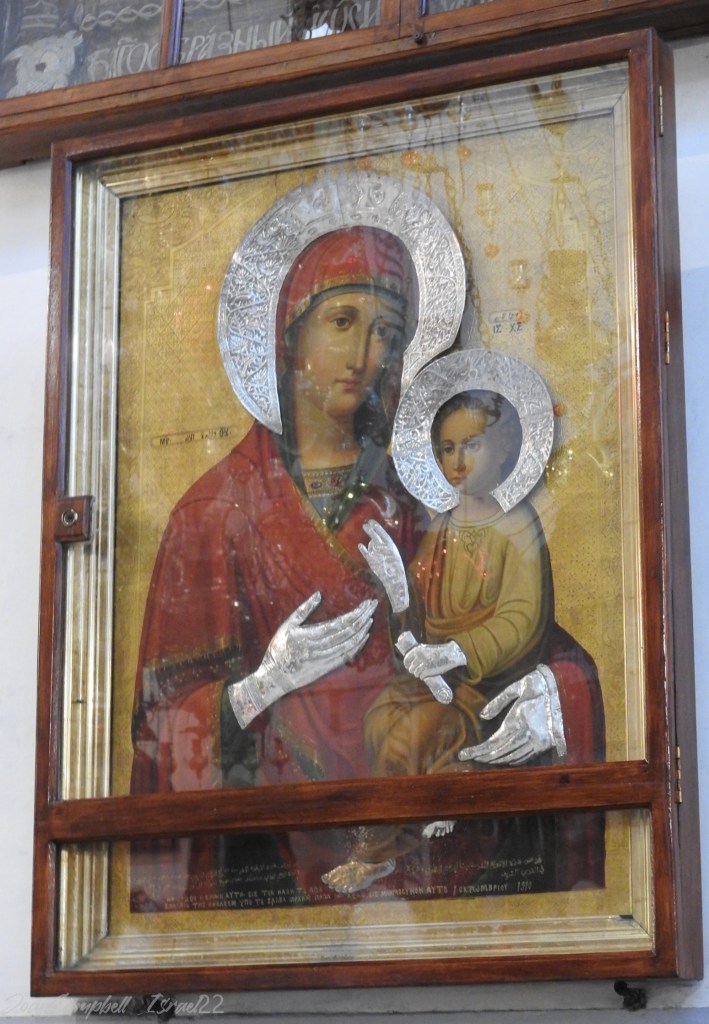
Madonna and Child. Note that the hands and halos in the painting have been covered with actual silver.
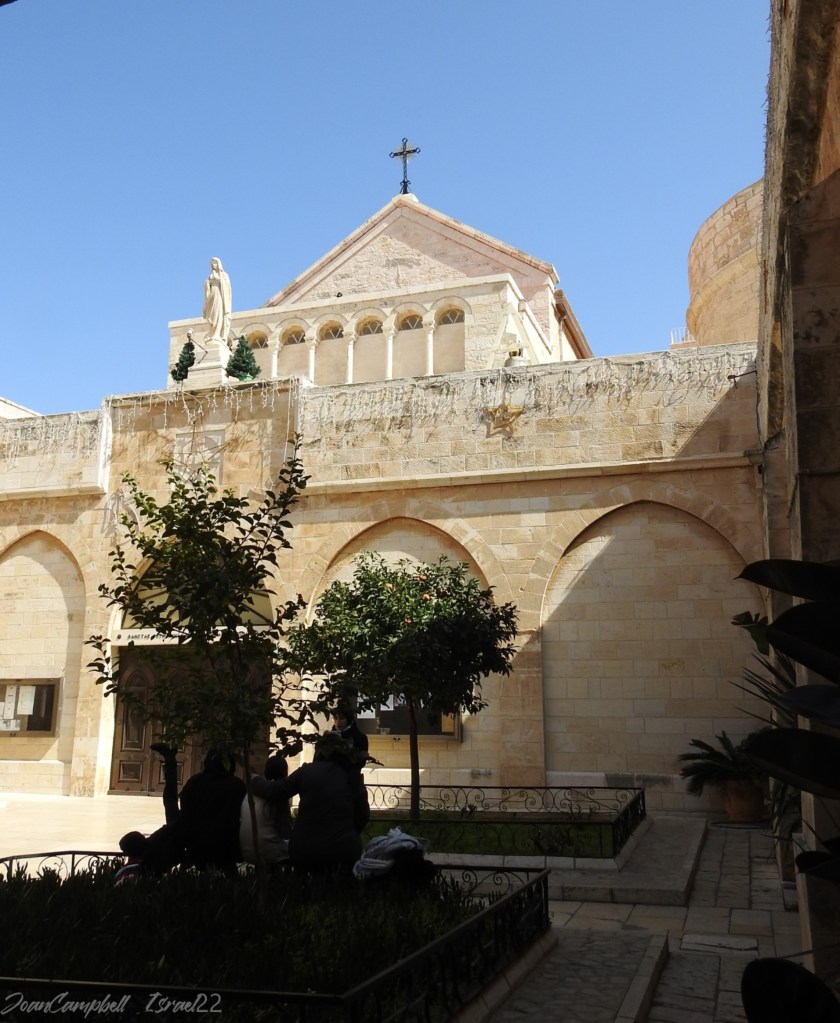
We exited the church to the left of the altar and entered the small courtyard garden just outside the Catholic church, St. Catherine’s. It is a newer church dedicated to Catherine of Alexandria in 1347.12 It was closed to the public on the day that we visited although I believe that parishioners could enter for services. I would certainly have liked to see inside the church. St. Catherine’s building is directly connected to the Church of the Nativity and built over the series of caves that include the Nativity of the Grotto.2
Roman Catholic Church, St. Catherine’s that is connected to the Church of the Nativity. It is also built over the system of caves where it is thought that Mary & Joseph took shelter and Jesus was born. Services also continue to be held in this church although it is not as old as the Church of the Nativity.
The caves underneath the two churches are connected via a tunnel that is kept locked.2 St. Catherine’s is noteworthy in that St. Jerome is said to have lived there during the years when he was compiling the Latin Vulgate translation of the Christian Bible. His “office” is said to have been in one of the caves under the church.1
I’d like to say that I had some deep abiding spiritual experience when we visited the site of the Lord’s birth in Bethlehem, but I didn’t really that I recall. I found the Church & Grotto of the Nativity extremely ancient and interesting from a historical sense and a religious sense. All the lamps with candles and the bright shining silver & gold of the altar screens gave the place an ancient and eternal feel and made it easy to believe that this was, indeed, a sacred place where the birth of Jesus had occurred; but it was all a bit foreign to me with my simple country church background. And there just wasn’t really any time to stop and meditate on the significance of the place, which might have made it more enlightening and spiritual for me.
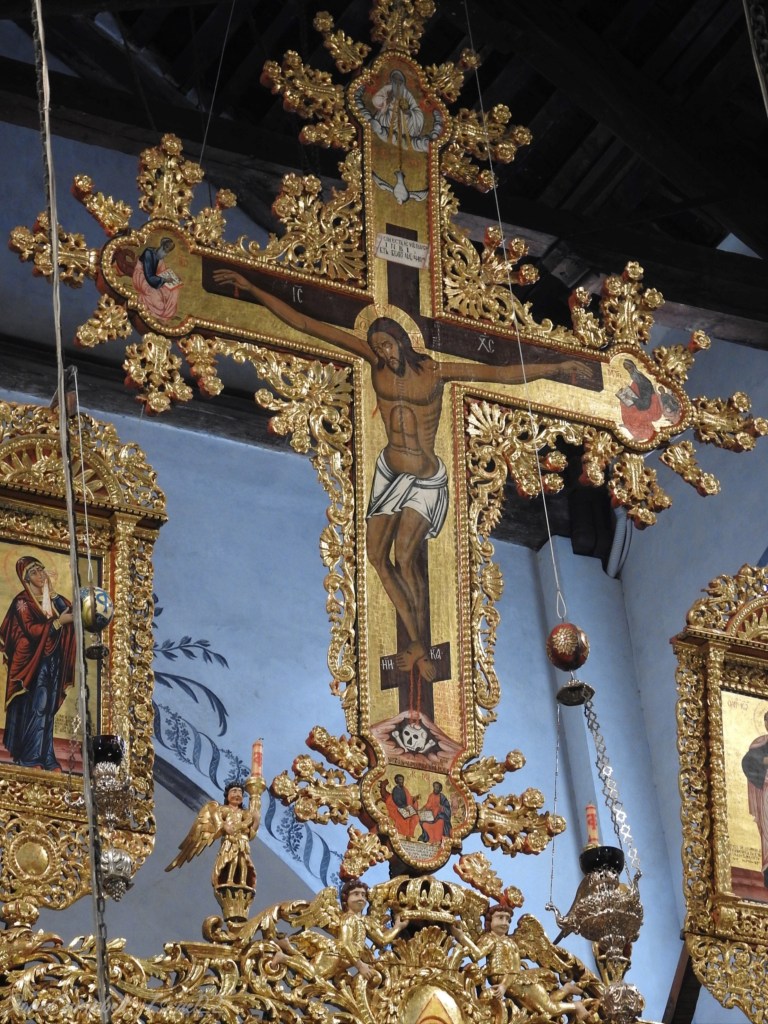
Crucifix over the altar in the Church of the Nativity
Then again, maybe my emotional response is just evolving slowly over time. I marvel that I was there – in Bethlehem – where Jesus was born – not at that specific place maybe but we know he was born somewhere in the city. And I actually walked through the Church of the Nativity, entered the cave, and saw the spot – quite possibly the actual spot – where he was born and laid down to sleep in a manger while a star shone brightly overhead and angels sang to shepherds out tending their flocks in nearby fields.
I am left with a thought that brings me back to David and God’s promise to him. David – a shepherd boy born in Bethlehem who was raised up by God to become King of all Israel….and just as promised, some thousand years later, a King – the King – Jesus – gave up his throne above to become a lowly shepherd to his followers… the birthplace of a shepherd who became a king and a king who became a shepherd.
The Good Shepherd – Jesus – who was raised up in death to forgive us all and give us eternal life…born in Bethlehem, the City of David.
“Rejoice in the Lord Always.
I will say it again.
Rejoice,9
Mosaic of an angel near the ceiling in the Church of the Nativity
Sources for Information:
The Holy Land for Christian Travelers, John A. Beck, 2017, Baker Books, Baker Publishing Group, Grand Rapids, MI, www.bakerbooks.com , USA, Dan, pages 89-91











 Birding Boomers