
 Let’s face it – going to the Netherlands in the spring is about tulips. It is what it is. You can talk about the canals and the red light district and smoked sausage but pretty much everyone who goes to the country in spring is looking for tulips…and their counterparts, the daffodils and the crocus. And we were certainly no different. We had dreams of seeing fields of tulips like gigantic impressionist paintings spread across the landscape…..Monet or Van Gogh in dirt, if you would. And we had planned and checked and cross-checked and scheduled so that we would be in country when the tulips were in full bloom. But it was not to be. Although the tour company had assured us that the first week in April was the optimum week for visiting to see the best and the most tulips, Mother Nature had other things on her mind in 2013. Things like blackberry winters and whirling snowstorms in Europe in late March. There is nothing like a late cold spell with freezing temperatures and snow to keep the bulbs dormant, snug and warm underground. As we flew over northern England and noted lingering patches of snow on the hills, I had a sinking feeling about our chances for tulips but I had high hopes nonetheless and it didn’t do to fret over it too much….when you’re flying over England and the North Sea, it is a bit late to change your travel plans.
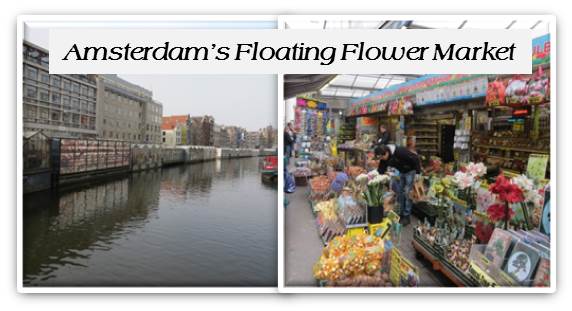 And so, we continued. We spent time in Amsterdam and saw wonderful old buildings and canals and some birds and enjoyed cool Amstel lager and a very expensive margarita but there were no tulips or daffodils or crocus. We did see an herb garden growing in a sunny window and the largest, if not the only, floating flower market in the world. We went to Kinderdijk and saw beautiful windmills and geese and lots of rain. We traveled in layers – long sleeve shirts with sweaters and jackets – because it was still very cold in country and you never knew when the sun would come out and bless you with a little warmth allowing you to strip off some of those layers. We visited a lovely town called Hoorne – more canals, more birds, a lovely visit with a former mayor…but, again, no tulips or any flowers to speak of except maybe a few lonely crocuses (croci?). We visited a former royal palace, Palais Let Hoo, with beautiful formal gardens but not a blooming flower in sight. So, you can imagine how excited we were to go to an actual tulip farm. Hallelujah, we are finally going to see some tulips. Or not.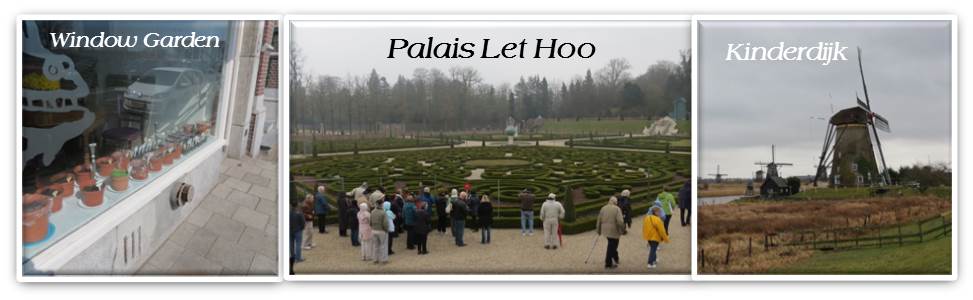
The farm was a wonderful experience. We got lucky and our guide for the farm tour 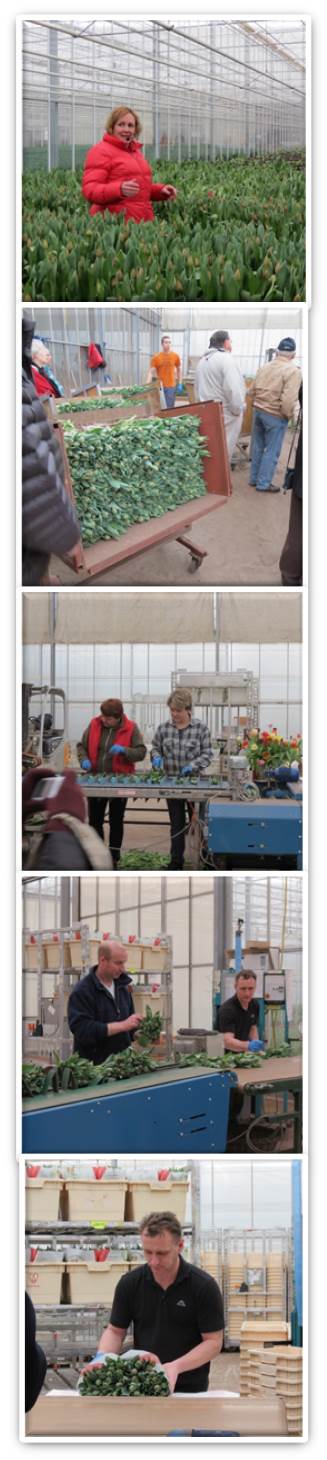 was the farmer’s wife – no one would know better what’s going on at the farm than the farmer’s wife – her business to keep up with absolutely everything. (Do notice the down jacket.) We were advised that the Dutch think of the farms as “bulb” farms because what they are growing as a sellable crop are the bulbs. Hmm. I hadn’t thought of it that way but it makes perfect sense. So, they grow tulips in order to harvest the bulbs and sell them all over the world. In the fields – some of which, unfortunately, were under plastic in an effort to warm the fields and allow the tulips to grow in spite of the cold weather – the tulips are planted in the fall for harvest the next summer. When the tulips come up in spring and bloom, the blooms are cut off to allow the plant to recapture all the nutrients in the stems and leaves to be absorbed back into the bulb and to prevent the loss of nutrients by producing seed heads after the bloom. So, in fact, there is a limited viewing period for blooms in the fields under any circumstances. They actually have a tractor that goes through the field removing the blooms and capturing them to be used as compost. It seems a bit of a shame to have all those glorious blooms just whacked off and thrown away…but their money-maker is the bulb, not the bloom. In the fields, that is.
But there was a second line of business for this tulip farm and that is for cut flowers. So there were huge (and I mean huge) greenhouses that were used to grow tulips to sell in the flower market in Amsterdam. The season for cut flowers is from December until May so we were visiting at the end of the season. This farm sold about 6 million cut flowers per season, all tulips. Yes, I said 6 million with an “m”. The whole farm was quite an operation but the scope of the greenhouse operations was very impressive. I cannot keep saying “gigantic” and “huge” but “large” just doesn’t describe the operation there. The cold storage unit was probably bigger than our house back home. The “fridge” as relatively empty at this point but we were assured that the space was not wasted – in autumn when they bring in the bulbs to plant, the unit is packed to the gills – floor to ceiling – with hundreds of thousands of bulbs. Some of the bulbs will chill in the coolers to give them time to go dormant to be grown in the greenhouses over the winter to sell as cut flowers. And the rest will be planted in the fields where they will rest throughout the winter waiting for spring to become next year’s bulb crop.
But back to the greenhouse business…… fascinating. I am often reminded of how many details there are to running a successful business and how most of us take it all for granted and, perhaps, think that tulips (or automobiles or houses) just pop up out of the ground and it’s all so easy and no one has to work at all as things just sort of happen on their own. But that is far from the truth, of course. Even on a farm where things, like tulips, do literally pop up out of the ground, there are a million and one details that have to be attended to in order to get to harvest. The bulbs are planted in the greenhouses on a staggered schedule to provide for cut flowers throughout the winter. When the plants are at the bud stage, they are inspected and sorted by a specialist whose job it is to know from  just looking at the bud, whether or not, the bloom will be beautiful and full or not. The sorter picks the flowers (pulls it up by the bulb) that pass inspection and leaves the rejects – blooms too early or too late or has a virus or is mal-formed – to become compost. Yep, lots of composting going on at this farm. The bulb is sliced in half and the stem is plucked from inside so that every inch of the stem is available as part of the cut flower. It seemed strange that they would go to so much trouble to get an eighth of an inch more stem but that mystery was solved when we were advised that the flowers are sold by the inch. While an eighth or fifth of an inch doesn’t sound like much and would only bring in an extra tenth or so of a cent per individual stem, the fractions can add up when you are selling thousands of the flowers per day. Let’s see, six million cut flowers multiplied by a fraction of a cent….well, you get the picture, those quarter- inches can add up to real money by the time all is said and done. The farm employs about twelve workers for the process of processing the cut flowers, which are really just buds at this stage. The flowers are harvested at the tight bud stage so that they will be fully opened as blooms at your local florist and not an hour before. The flowers are packed by the dozen and transported to the flower market every afternoon to be sold at market opening early the next morning. By noon, the next day (less than 24 hours after picking), the flowers are on their way to all parts of the world.
 One final note about the tulip farm in North Holland. The farm is a family farm that has been passed down for several generations but is on “reclaimed” land – that is, land that used to be under the sea. It has been “reclaimed” several times over the past few hundred years. The farmer’s wife told us that they used small “kennels” to irrigate the fields – turns out she was saying “canals” but I kept hearing kennels and trying to figure out if it had something to do with dog runs. Just a little loss of communications there for a moment. At any rate, she said that occasionally the salt would come up out of the ground in spots and they couldn’t plant there for a season or two. It seemed as if the sea is always ready to reclaim the land from the Dutch who are always ready to reclaim it from the sea. For hundreds of years this battle has been going on and I suppose it will continue as long as there are crops to be planted and people to plant them.
So we got a taste of tulips and the overall industry but we still hadn’t really seen any tulips to really write home about. We had one last shot at seeing great masses of tulips – the Keukenhof Gardens at Lisse, Holland. And we couldn’t wait – finally we are going to see tulips. Or not.
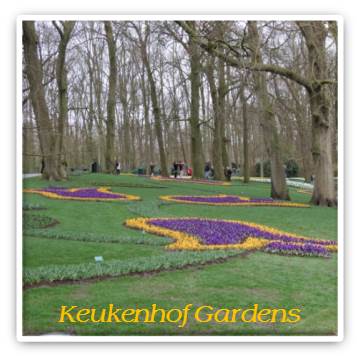
Keukenhof Gardens are only open during the spring every year (mid-March through mid-May). The Keukenhof is a private flower garden – the world’s largest, I am told – that is open to the public for tourists and visitors but the primary purpose of the gardens was originally to allow growers to exhibit their flower bulbs and dealers and buyers to see the all the varieties of tulips and daffodils and crocus in a garden setting. According to the guidebooks, there are about 7 million flower bulbs planted over 32 hectares – or about 79 acres. (Just in case you find yourself trying to figure out hectares and acres someday, there is a converter on line at http://www.asknumbers.com/HectaresToAcresConversion.aspx.)
 In the very beginning, the garden was set up to grow herbs for the kitchens for Countess Jacqueline of Hainaut, hence the name related to the kitchen gardens. The garden is set up to display the flower bulbs and there are also pavilions showing the flowers in more of a “display” setting with information about the varieties and their availability. And, finally, the garden is set in the midst of farms and fields where the tulips, etc. are grown.
We visited in the rain, of course, and it was cold, again, so we spent a good 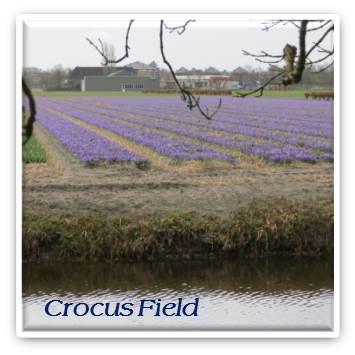 bit of time in the pavilions where it was warm and dry. And where there were lots of tulips and daffodils and amaryllis and every other bulb plant you could think of. And they all were quite lovely and I took tons of photos to bring home to show everyone we had, in fact, seen tulips. We also did a little bit of birding in the gardens – why waste an opportunity to do so when birds do love gardens too? And we only got lost once and we almost missed our ride back to the ship but that was because I was buying souvenirs and that is another story entirely.



 Birding Boomers