
In this country (USA) and in most of North America, we tend to think in terms of hundreds of years when we see “old” sections of modern cities and wonder just how old they are. In visiting some cities along the east coast, I have found myself in awe of old colonial buildings that are three to four hundred years old. Oh, I say, “If these walls could talk”, imagining the people who lived there in the 17th or, maybe 18th centuries…. not to mention that George Washington might have even slept there at some point or another.
But in the “Old World” – in Europe and Asia, my imaginings have had to be adjusted….old cities are not just hundreds of years old, but hundreds of hundreds of years. Some archaeological remains date back to well beyond the Common Era (CE), or, as I still call it, Anno Domini (AD), and maybe for a few thousand years Before the Common Era (BCE) or Before Christ (BC)3. Particularly, cities in the middle east are dated in terms of thousands of years…by definition, “ancient” and not just “old”. Archaeologists never really know how many cities there are in a given location when they start to dig down because cities were built one on top of the other. When one city fell to conquest or was abandoned, in many cases, another city was built at the same site using the old building remains as new building materials. If there was a value in being at that location (money, security, power, etc.), then another city was built right on top on the last city. Out with the old, in with the new. Still happens today – tear something down, build something new right on the same “footprint”.
Thus, it was for Caesarea Maritima on the Mediterranean, the first stop on our tour of Israel earlier this year. Originally, there was a Phoenician port city called Strato’s Tower (Stratonos pyrgos) assumed to be named after the King of Sidon, Stratos I. I’ve seen Sidon mentioned several times in the Christian Bible and it is usually coupled with Tyre, as in Tyre & Sidon. Sidon today is known locally as Sayda or Saida and is the third largest city in Lebanon just up the coast. When I was in elementary school, I remember hearing about the Phoenicians, sailors and navigators of some renown. I just never knew where these Phoenicians lived. Apparently, some of them lived and built a port right here at what is today called Caesarea Maritima.

In 90 BCE/BC (remember BC counts backwards from zero and AD counts forward), the city was captured by a Jewish leader, Alexander Jannaeus, and it became part of the Hasmonean Kingdom. In 63 BC, Jerusalem was conquered by Rome (Pompey the Great) and it became part of the Roman Empire along with Caesarea. In 47 BC, Herod the Great was appointed the provincial Governor of the area and in 30 BC, Caesarea was given to Herod. Yes, I’m skipping through the history like stones thrown across a pond. When a city is thousands of years old, there are just too many historical details to get into a single blog.
So, we are up to Herod the Great4 and his building projects, one of which was Caesarea Maritima which he named for the emperor, Augustus Caesar. The man knew which side his bread was buttered on…since the Jewish people didn’t like him one bit… more on that later. I do like that he named the new port city Caesarea and not Augustarea. Hey, if Augustus was deposed, then the name still worked, right? Caesars come and go; the city’s name stays the same. (Although the new harbor built by Herod was known as Sebastos Harbour, which is Greek for Augustus so he had it covered both ways.)
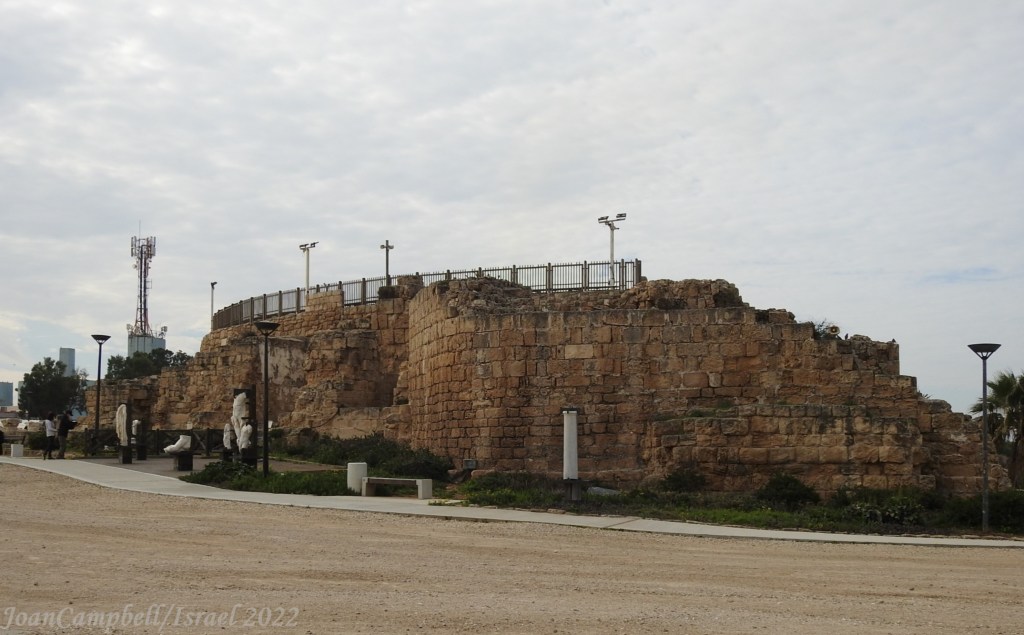
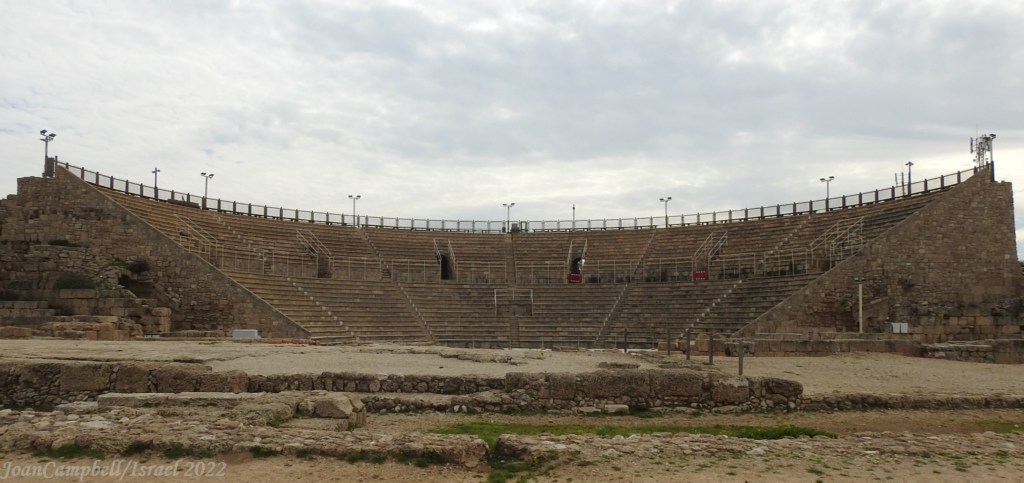
Herod turned Caesarea into a showplace. It had a theater, bath house, a hippodrome, a new fortified state-of-the-art port, etc., with a Roman aqueduct that brought fresh water all the way from the springs at Mount Carmel (about 43 kilometers away). The theater was known to sponsor sporting events, chariot races, gladiator games, theatrical productions and, unfortunately, in its later years after the Jewish revolts, too many public executions.

But the amphitheater could seat 4,000, the Hippodrome 20,000; the breakwaters provided safe harbor for about 300 ships; and, one of my favorites bits of trivia, the city had a sewer system that was flushed out by the tide. For all Herod’s faults (and many might say he was “pure evil”), he was quite the builder. And, speaking of faults…. Caesarea was built right on a fault line between tectonic plates….which explains further damages to the port city by earthquakes and tsunamis over the years.
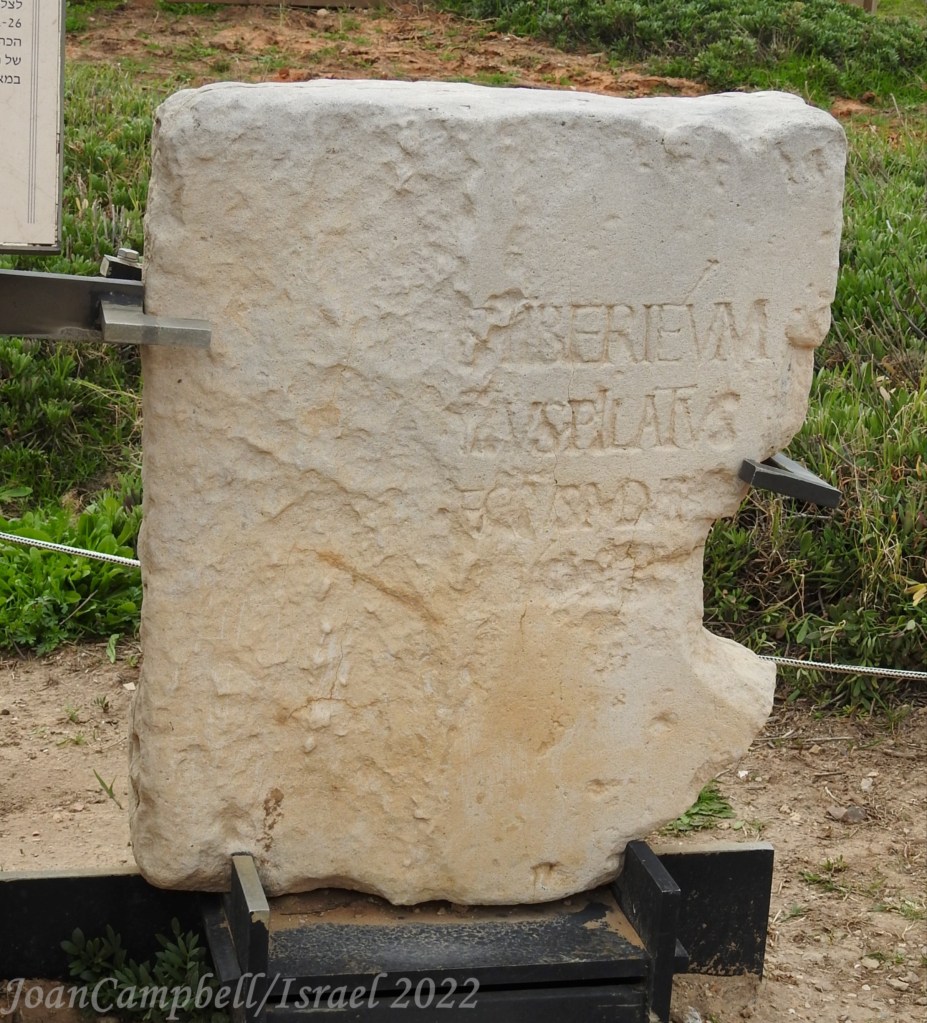
In 6 BC, Caesarea Maritima replaced Jerusalem as the governmental capital of the province. The official residences of the procurator, Antonius Felix, and the prefect, Pontius Pilate, were here. (Herod was off building his personal palaces elsewhere, I expect, but certainly had a home here too.) Pilate was the 5th Governor of the province serving from about 26 AD (or CE) to 37 AD.

I’m sure you recall Pontius Pilate from scripture. Here, at Caesarea, archaeologists uncovered the “Pilate stone”, the only artifact found anywhere that references Pilate making the connection with the New Testament of the Christian Bible. The inscription on the stone reads (per a historical marker in the national park at the site), “(Po)ntius Pilatus, the prefect of Judaea, (erected) a building (dedicated) to (the emperor) Tiberius”.
Which brings us to why two busloads of Christian tourists are spending time at Caesarea Maritima. (I keep saying the whole name so as not to confuse things with Caesarea Philippi which is further north and east…which I will write about later in another blog.)
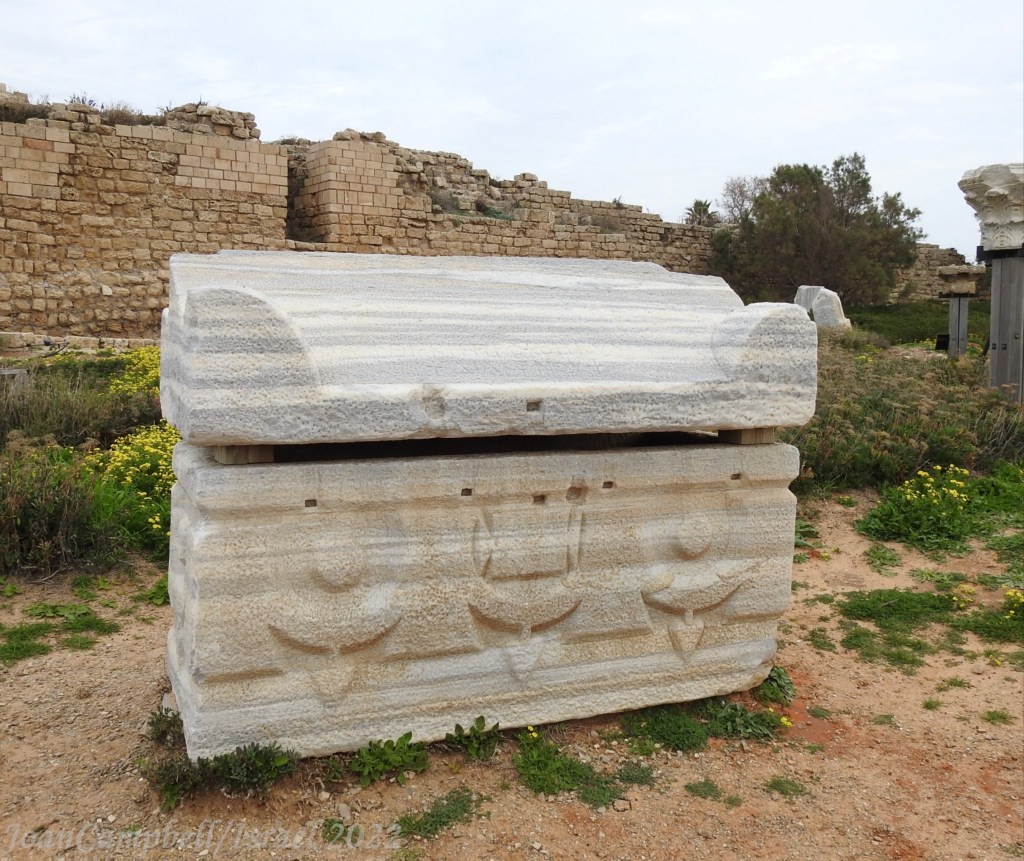
Quite a bit happened at this site that is important to Christians. I’m going to list just a few events from the New Testament with scriptural cites:
After the conversion of the Ethiopian eunuch and his baptism, Philip was carried to Azotus and traveled from there to Caesarea where he continued preaching the gospel. Acts 8:40.
Caesarea was the home of Deacon Philip and his four daughters who were prophetesses. Paul stayed/visited with Philip between missionary journeys. Acts 21:8
Peter traveled to Caesarea “by the sea” to meet with Cornelius the Centurion where Cornelius and his family became some of the first Gentiles converted to Christianity and baptized. Acts 10
Herod Agrippa I (successor to Herod the Great) was searching for Peter after he was released from prison by an angel but could not find him. Herod Agrippa I left Judah at that point and went to Caesarea. He made a speech at his palace where the people said he looked like a god. He was struck down for allowing the people to worship him as a god. Acts 12
After being attacked in Jerusalem, Paul was brought to Caesarea and then sent to his hometown of Tarsus for his safety. Acts 9:29-30
During one of Paul’s stays, the prophet Agabus from Judea, met with Paul, took Paul’s belt and bound his (Agabus’s) hands & feet with it, foretelling Paul’s imprisonment by the Jewish leaders in Jerusalem. Acts 21:11
While Paul was imprisoned at Jerusalem, a plot was revealed that 40 Jewish men were conspiring to kill him. The commander of the centurions had Paul removed from Jerusalem and taken to Caesarea. Acts 23:23 When Paul was taken to Caesarea, he was handed over to Antonius Felix, the Governor. Acts 23:33
Paul was imprisoned at Caesarea for two years awaiting trial until he invoked his Roman citizenship and was shipped to Rome for trial. While at Caesarea, Paul preached to the provincial governor, Agrippa II, who said that if he listened to Paul anymore, he (Agrippa II) might just be converted himself. Acts 24, Acts 25, & Acts 26
Although Caesarea was a port city more associated with commerce than religion, it was a city where many religious things were going on. We know that Herod the Great completed many building projects in Caesarea. According to scriptures, this is the same Herod who ordered the “Massacre of the Innocents” after the birth of Jesus in Bethlehem to prevent a newborn king from growing up to take his kingdom. Matthew 2:1-13

Some 33 years later, the governor, Pontius Pilate, who ruled from Caesarea, traveled to Jerusalem for Passover where he presided over the trial of Jesus ensuring that he would be remembered by Christians all over the world forever….but certainly not in a good way. Luke 23:1-6 We all know how that story ends.
But that was Jerusalem….back to Caesarea. Not so many years later in 135 AD, the last of three Jewish revolts occurred here after the desecration of the Jewish synagogue which ended with the massacre of 20,000 Jews. (The first revolt had occurred in 70 AD and ended with the destruction of Jerusalem and the Temple.)

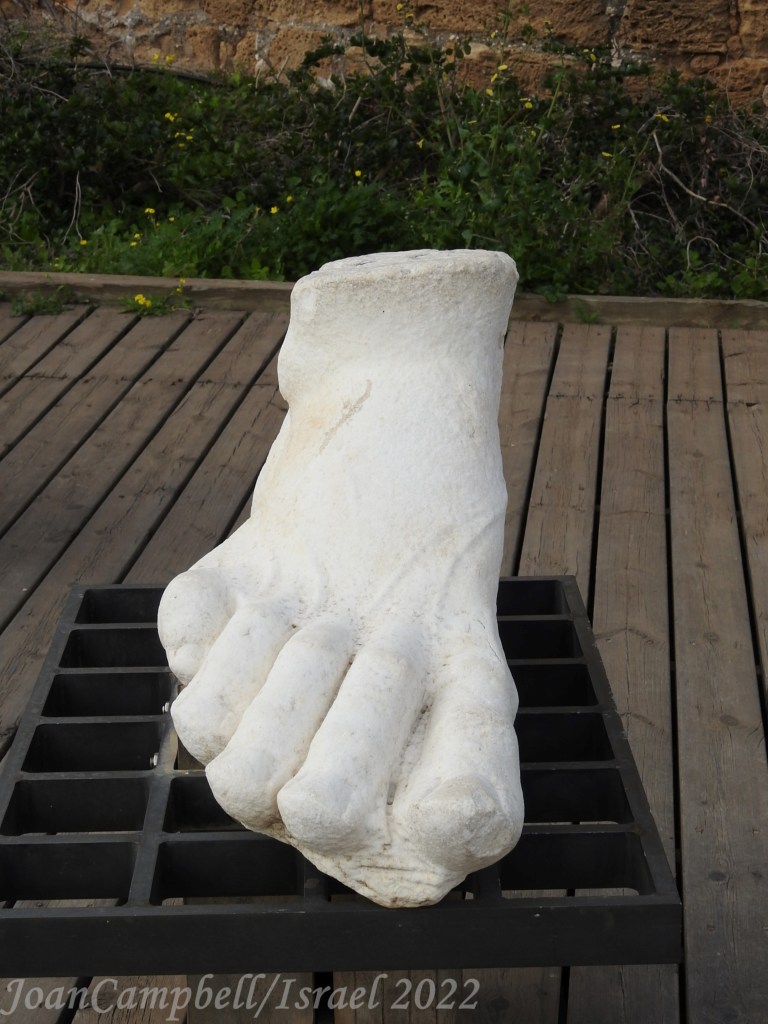

Over the next couple centuries Caesarea became a center for Christianity. The library at Caesarea was said to have included more than thirty (30) thousand manuscripts of scriptures and writings but none of that seems to have survived the conquest by the Muslims in 640 AD. What a shame, I like to think that, just maybe, Paul’s original letters were stored there. How wonderful it would be if we had those documents preserved somewhere today…. not to mention the original manuscripts of the four gospels!
According to Church tradition, the Nicene Creed was written at Caesarea and several early church Bishops served there including Zacchaeus the Publican, followed by Cornelius the Centurion, and then, Theophilus. Also, the Council of 195 AD which determined that Easter would be observed on a Sunday may have been held there.


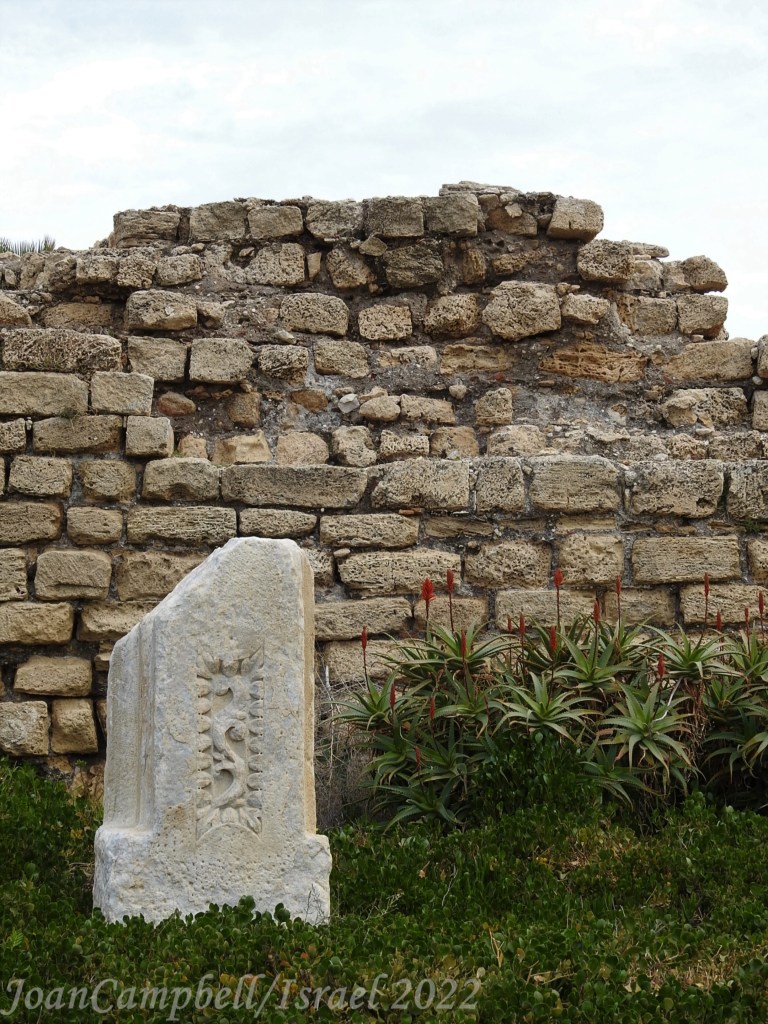
So, what finally happened to Caesarea? Why is it a national park filled with archaeological ruins these days? Well, after that last Jewish revolt, the name was changed to Syria Palaestina. It continued to be inhabited through the 6th Century AD until it was destroyed in the Muslim conquest in 640 AD. By the 9th century, the harbor was said to be no longer used as a port for trading ships. A couple earthquakes and maybe a tsunami may have contributed to the deteriorating condition of the port & harbor over the centuries. During the Byzantine era, the city came to be known as Palaestina Prima.

Not much happened until it was rebuilt by the Muslims in the 11th century. Then it was conquered by the Crusaders who used it as a strategic site because of its harbor. Finally, it was, according to Wikipedia, “slighted” by the Mamluks in 1265 AD. So, I’d never heard “slighted” used in this way, so I clicked again (Wikipedia is the source of endless connections & clicks). Being “slighted” by a conqueror meant that everything was destroyed very deliberately so that nothing remained that could be useful to enemies any longer. The Mamluk Sultanate ruled in the area until the early 16th century. Caesarea as a thriving city was pretty much gone at that point.


While there are only remains of this great city from two thousand plus years ago, there is still a thriving modern community just west of the national park. When we were there, I noticed people sunning on the beach and others fishing off the old breakwaters near the aqueduct much the same as people have been doing for thousands of years. Rulers, Sultans, Emperors, Kings rule & get deposed; cities come and go; then, new cities get built on top of the old ones. The names & the buildings may change but the people go on and on… continuing down through the centuries.
I pray that they always will.
Scriptural Sources:
(See above in the narrative as indicated)
Resources:
(Other than the Biblical parts, my research comes predominantly from Wikipedia1 and See The Holy Land 2 websites. For Biblical references, I used the New American Standard Bible (NASB) at BibleHub.Com5.)
- Wikipedia Caesarea Maritima: Caesarea Maritima – Wikipedia
- SeeTheHolyLand.Net: Caesarea Maritima « See The Holy Land
- For more on AD & BC: Anno Domini – Wikipedia
- For more on Herod the Great: Herod the Great – Wikipedia
- Scriptural References: BibleHub.Com
ICYMI – Previous blogs in the Israel 2022 series:




 Birding Boomers