
 Have you ever gone looking for something and ended up finding another? Started out moving in one direction and ended up going in another? Gone out with one plan in mind only to find out that what you ended up with is so much better?
Well, this is exactly what happened to us recently. Being pretty avid birdwatchers, we are always going out looking for birds. If the birds are not cooperating (as is very normal for the summer months between migration seasons), then we go looking for gardens and flowers – wild or cultivated, it matters not. But mostly we end up roaming around just looking….well, for whatever interests us. This habit has prompted some of our friends to refer to us as being vagabonds….but only on vacations mind you.
So, we headed out on our last trip to southern Virginia with two thoughts in mind – visit a relative and scout out some good birds…which we did. But along the way, we spotted a beautiful old white church and I just had to get a photograph of it. Then there was another and another and another and I had to get pictures of them too.
 And then out of the depths of my brain a new idea was born…a splendiferous idea….an idea so amazing, I am surprised I had not thought of it before….why, I could write some blogs about old churches. After all, I have written about an old church before (Empty Church/January 2015) but this time I thought I’d do something a little different. I’d photograph the churches, find out what I could about them, and share it with everyone. And I could make this project a series of blogs and continue it on future trips…..when I’m looking for birds and blooms, I’d also look for old churches. Heck, I might even end up with a coffee table book filled with pictures of old churches if I do a good enough job of it…..okay, that might be stretching the dream a little bit but it is worth thinking about sometimes.
Right off the bat, I noticed that old churches are, in one respect, more cooperative than birds….they sit still so you can photograph them. On the other hand, it is turning out to be much easier to find out information on the internet about a particular bird than it is to find out the history of a particular church….especially an old one.
The second thing I noticed is that I like old clapboard painted churches more than old brick ones. But then again, there are some brick churches that are old and architecturally beautiful that I really love. So, I think the appeal for me is that the church be (1) old, (2) relatively small, and (3) out in the country rather than in the city. Now, don’t get me wrong, I’ll probably end up taking pictures of churches in cities too and big ones as well as small ones but I’m starting small and then we will see how this goes.
Without further ado – these first five were selected because they were seen and photographed on our recent visit to the middle peninsula of southern Virginia and because the Historical Society of Mathews County (mathewscountyhistoricalsociety.org) did a historical church tour in 2015 and posted information on the internet about the churches on their tour. That is convenient for me since, as I noted above, most of these old churches I’m finding do not have anything on their internet sites…or even seem to have internet sites. My undying gratitude to the Historical Society at any rate.
 Mathews Baptist Church
8284 Buckley Hall Road, Hudgins, VA 23076 http://www.mathewsbaptistchurch.com/
Now, this is the first church photograph I took on this trip to southern Virginia…the one that started it all so to speak. This church was established in 1776 – same as this country. It was established by itinerant preachers and was originally called Kingston. In 1791, it became known as Mathews Baptist Church when the county of Mathews was officially founded. In 1905, the sanctuary was remodeled and the steeple was added. I am not sure whether the First Baptist Church (below) was the first to use the gingerbread décor on the steeple or if Mathews Baptist had a prior steeple and the current one was just updated in 1905. The gingerbread reminds me of Victorian homes and I have never seen it on a church steeple before that I recall. If you look at the bottom front of the church in the photographs, you will see that renovations are still ongoing and, no doubt, new elements are always being added. The church mission is a good one — “To provide the public worship of God; to preach the redeeming love of Christ and lead people to the Savior; to welcome the stranger; to comfort the sorrowing and help the needy; to create the spirit of Christian fellowship; to serve the community; the nation, and the needy world.”


First Baptist Church (Mathews) 
9654 Buckley Hall Road, Mathews, VA 23109
The First Baptist Church in Mathews was founded in 1865. It “came out of” (to quote the Historical Society) the old Baptist church, Mathews Baptist Church. After Emancipation, two hundred and ninety one members of the church requested that their “mission” be changed in status to be a “church”. (Let me take a little break for me to look up some history here. I was a bit confused at the note that the church was founded in 1865 and then “after Emancipation”, a request for a status change was made. I speculate that the congregation had founded a mission prior to the Emancipation Proclamation was passed by executive order on January 1, 1863. But, as we all well know, the American Civil War did not end until 1865 and true emancipation did not come for many slaves until after the war and the Thirteenth Amendment was ratified in 1865. So, after the war, the church was founded when its status was changed. Again, I am speculating because I do not know anything more about this church than I was able to find on the internet.) One thing I love about this church is the lovely steeple with what looks like Victorian gingerbread which is very similar to the steeple at its mother church, Mathews Baptist (above). Also, their mission statement is quite beautiful – “Committed to serving God and his people of all races, encouraging them to make Jesus their choice and acknowledging His as the only way to everlasting life.”
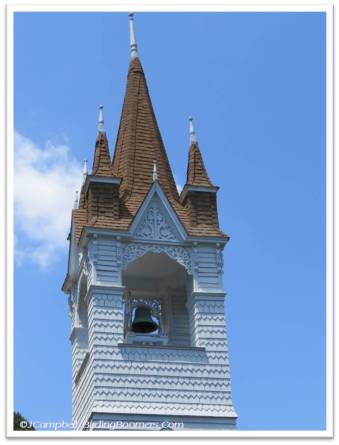

Emmaus Baptist Church
13794 John Clayton Memorial Highway, North, VA
Emmaus Baptist Church was founded in 1867 and established in 1868. (I am learning that there is a world of difference between being founded, established, chartered, built, etc. when it comes to churches.) Prior to the founding of Emmaus Baptist, blacks who wanted to worship in a church with a sanctuary had to do so over at the First Baptist Church. After emancipation, the founding families, some of whom may have been former slaves, would have undoubtedly wanted a church of their own in which to worship. The land for the church was donated by a Mrs. Harriet Jones who also taught school at the church for some years after it was built. The name “Emmaus” was taken from the New Testament in the Gospel of Luke. It refers to an event in the New Testament where Jesus appeared to two of his disciples as they traveled on the road to Emmaus…this was after Jesus’ resurrection but before his ascension into heaven.

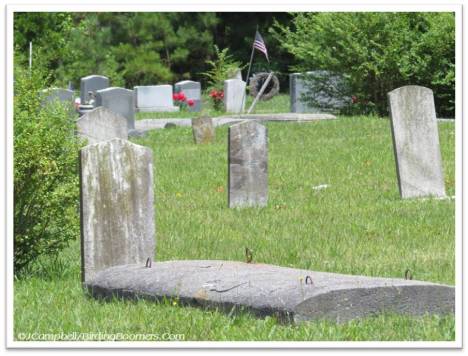
 Ebenezer Baptist Church
3601 Buckley Hall Road, Cobbs Creek, VA
Ebenezer Baptist Church was founded in 1875 by a small group of members from the First Baptist Church. (I am seeing a theme here in members of the congregation breaking away and forming a new church nearby in the county. I believe it is the same today and referred to as “planting” new churches in the community although the reasons for starting a new church may vary.) In the 1890’s, land was purchased and a clapboard structure was built. I was not able to go inside but, per the Historical Society tour notes, there are two Captain’s chairs at the altar that were used throughout the years to support caskets for funerals. The pews are painted wood….men sat on the right (the Hallelujah side) and women sat on the left (the Amen side). Light was provided by oil lamps and chandeliers. In 1908 a cornerstone was laid for the presently existing church and in 1914 a metal ceiling was installed. Of course, now I’m thinking I may need to go back and go inside some of these churches. I recall large wooden chairs behind the pulpit in churches I attended when I was younger but do not recall them being called “Captain’s chairs”. Now I wonder if they were also used to support caskets for funerals before the advent of those metal rolling gurney-like tables provided by funeral homes today.
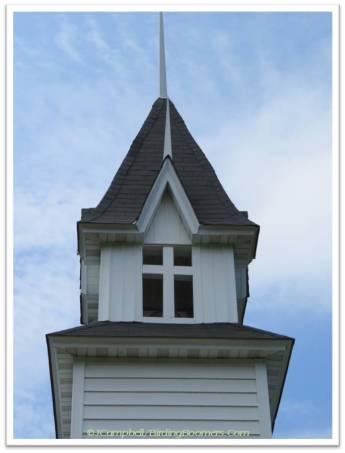

 Gwynn’s Island Baptist Church
2011 Old Ferry Road Gwynn, VA 23066 http://www.gibchurch.com/
Now this church is very cooperative – not only do they have a website, they have a Facebook page! Very up and coming for a church that was started way back in July 1874. But, once again, we find that the original congregants, thirty five of them, came over from Mathews Baptist Church. They acquired ¼ acre of land for $25 in February 1875 and built their church. The first pastor was Charles A. Raymond. By 1889, they had organized a Sunday School….or at least that was the first mention of Sunday School in their historical documents online. The longest pastor to serve the congregation was I.E. Belch who was pastor for twenty-six years. Their mission is “Serving the Lord by Serving Others”.

Again, most of the information on these churches in Mathews County comes from the Mathews County Historical Society. However, I would love to hear more about these churches if you happen to know anyone who has or still attends these churches and have more information to share. And, if you like this idea, please comment and let me know……I’m finding lots of churches to photograph so would like to share more of them in future blogs.
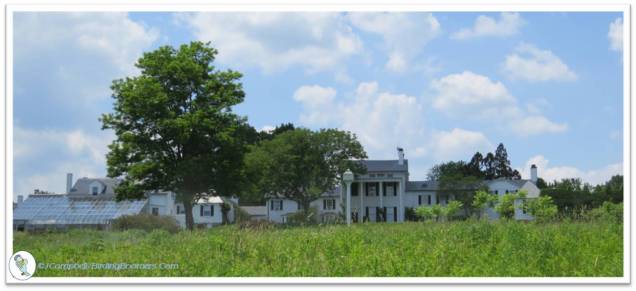


 As a child, Harvey was educated by private tutor at home and spent some years learning to draw from the curators at the Metropolitan Museum of Art. He didn’t really have any formal schooling and didn’t attend college at all, let alone an Ivy League College….although it seems that he ran with an Ivy League crowd. As such, Harvey was home-schooled and/or self-taught…not unusual at the time.




 Birding Boomers