Martha and Mary (in me)

It’s Christmas and time to share one of my favorite Christmas stories from the Bible at Luke 10:38-42. You know the one about the two sisters, Mary and Martha. Jesus came to dinner and Martha was stressed because she was doing all the work and Mary was sitting by Jesus listening to him as he spoke to the disciples and that made Martha even more stressed? Right?

Not a Christmas story, you say? Well, let’s call my story an application rather than a strict interpretation.

So, Martha is stressed, and she goes to Jesus to “woe-is-me” a little bit and she asks that he intervene and give Mary a good talking to. After all, wouldn’t he agree that Mary should be helping?

Now, when I was young and mama said my name twice in a row like that, it either meant that I had done something wrong for which I was about to be punished, or maybe I looked too forlorn for words, and she was just gonna give me a big hug. I think that’s what Jesus was gonna do – give Martha a great big hug to help her settle down a bit and remember that she was talking to someone who loved her dearly but who wasn’t going to be there with her forever. I’m not sure that’s what Martha was expecting him to do though.

I can certainly understand all her stress. After all, it is Christmas, and there is so much to do. Why, if there’s to be any kind of joy when Christmas Day gets here, someone has got to get cracking and get things done. There are plans to be made, presents to buy, cakes and cookies to bake, and at some point, someone is going to have to get that tree up and decorated. Why, if I had started all this back in October when the Walmart starts putting out their Christmas decorations, I’d still not have time to get everything done. My “inner” Martha is totally rolling now and I am pretty anxious, but I can do this. I just need some lists (I’m big on making lists) – task lists, budgets, grocery lists, present lists – why just for cookies & cakes alone, we need flour, sugar – regular and powdered, cinnamon, nutmeg, cloves, ginger….lots of spices. And there’s presents. What do the children want this year? I just don’t have a clue – I’m not sure socks and hats are going to be at the top of their lists although these things would always be needed and appreciated, I’m sure. The lists are endless and money shorely doesn’t grow on trees, now does it? How will I ever get it all done? And, where’s that Mary when I need her?

Only one thing? The good portion? The love and joy part? The family part? The salvation part? The part that cannot be taken away from me? Let me think about this.

About those decorations that need to go up. Come to think of it, how pretty the tree looks this year even without all the ornaments. I remember when we made those little four-pointed stars out of Q-Tip’s and yarn? The babies’ hands were so small, and they had so much trouble getting those Q-Tips to stay together long enough to start winding the yarn all around. I had to hot glue the Q-Tips together so the yarn could even begin to go on. And there’s this wooden cross made of olive wood that we bought in that little wood-working shop over in Bethlehem right down the street from the Church of the Nativity where Jesus was born. Oh, there’s that one ornament left over from the year I decided the balls were boring so I’d bling them up with some glue and glitter – we made such a mess, had glitter all over the place – three months later, I was still sweeping that stuff out of the cracks and crevices in the kitchen. Those ornaments are all broken now except for this last one. That must have been forty or more years ago. My baby girl is all grown up now – no more help with blinging out the ornaments.

Hey, here comes the neighborhood Christmas parade…..”Merry Christmas”, “Merry Christmas”, they all call out as they pass me standing there by the side of the road. Oh my! How did they ever get all those packages up on top of that golf cart like that? And the twinkling lights! And there’s the old grinch bringing up the rear throwing out candy to the kids trailing along behind. What fun! “Goodbye…Merry Christmas!”

It’s so cold out here tonight but the sky is so clear, and the stars are coming out. One of those stars would be the very one that the Wise Men followed to see the new king. There are so many out tonight, which star could it be? In all creation, in all those millions of stars out there, there was just one that led them to the Lord…..just one child born that night to save us all.

The good portion……Mary chose the good portion……and it’s Christmas.

I let the joy and peace wrap around me like mama’s hug so many years ago. I remember….our children won’t always be children, our memories won’t always be sure, the music won’t always be playing in the background, our friends won’t always be close by, our parents won’t always be here with us……time will not wait for us to get it all done before we find a moment to stop and feel the wonder of it all….to consider the “good portion”.

Martha and Mary. A time for Martha. A time for Mary.

O Little Town – A Little History (Part 1)

Series: Israel 2022

O Little Town of Bethlehem6.

This song has been rolling through my mind regularly since the start of the Christmas season. That and a good dozen other Christmas carols that speak (sing?) to the birth of Christ. So, it’s Christmas and I figure I just about have to write about visiting Bethlehem and seeing The Church of the Nativity, the place where it is said that Jesus was born.

But what comes to mind when I sing these carols is not the Bethlehem we visited, but something out of a Currier & Ives inspired event depicting a quaint and very small foreign village with lots of snow, twinkling stars, and an old wooden open-fronted shed with Mary, Joseph, 3 (exactly 3) wise men, maybe 4 shepherds, an angel hovering overhead underneath a big star, and a variety of farm animals. Everyone (and every animal) is standing around reverently adoring the wee baby Jesus wrapped up and asleep in a feeding trough (aka manger) with bits of hay sticking out the sides. Just so you know how important the baby is, there is sometimes a halo encircling his head or a bright light beam shining down directly on him from that giant star outside. A good and proper portrayal of the birth scene for Christians everywhere.

But the new world images of the Holy Land are maybe just a little skewed towards our culture and not that of the middle east.  Nativity scenes that I see at Christmas time certainly do not bring to mind the Bethlehem that we visited in the Judean Mountains just south of Jerusalem (maybe 5 miles). The Bethlehem that gets chilly in winter (if indeed Jesus was born in the winter season) but not really snowy although I’ve read that it can snow and does sometimes. It certainly didn’t snow when we were there in February.  In fact, it was rather hot, and Bethlehem isn’t a little village, it’s a good-sized city; and there was neither hide nor hair of a stable anywhere that I could see.

So, what is true about Bethlehem? Today it is located in the West Bank in the Palestinian Governorate of the State of Palestine. It is Israel but not really.  If you visit, you have to enter through checkpoints, and you have to show a valid passport just like any other border crossing anywhere in the world. (Fortunately, being on a bus as part of a tour, we were allowed to pass through without any serious issues or delays.) Today, Bethlehem’s economy is primarily tourist driven and right at the center of the city is The Church of the Nativity, a site now deemed sacred for Christians throughout the world which attracts thousands of Christian tourists every year.

How can you go wrong with Gospel Travel?

Like many middle eastern cities, Bethlehem is a city within a city. There are the ancient portions and then there are the 21st century modern parts. The “old city” in Bethlehem includes about 8 quarters (sections) with a “mosaic style” layout with Manger Square being at the core.  To the Arabs, the city was Beyt Lahm or “house of meat”; to the Hebrews, it was Bet Lehem or “house of bread”; to the ancient Greeks, it was Bethleem. But even older still is the Canaanite name, Beit Lahmi, which refers to the House of Lahmi, a Canaanite god of fertility worshipped by the Canaanites.5

The city is indeed ancient with some archaeological dates going back to the 14th century BC/E where it was mentioned in the Amarna Letters as a Canaanite city.5&10 But, our visit was primarily focused on Manger Square and the Church of the Nativity and events related to the birth of the Christ (Messiah) somewhere around 1BC give or take a couple years.

Bethlehem…. the place where Jesus was born…. the place that was prophesied in the Old Testament (Christian Bible) in the Book of Micah (5:2):

“But you, Bethlehem Ephrathah, 

Though you are little

among the thousands of Judah, 

Yet out of you shall come forth to Me

The One to be Ruler in Israel,

Whose goings forth are from of old,

From everlasting.”8

This little town – little among thousands. While no one really knows where Jesus was born and laid in a manger by Mary, his mother, there is a long tradition that associates the event with caves in the city at the site of The Church of the Nativity.

But, let me back up a minute. Bethlehem is also known as the “City of David” …. for good reason. David, the second and some would say greatest King of Israel, was from Bethlehem. David, the son of Jesse of the tribe of Judah who was anointed by Samuel to be king when he was but a young shepherd boy (1 Samuel 16:13).  David, the ancestor of Joseph, who was betrothed to Mary, the mother of Jesus. David, who was promised by God (2 Samuel 7:16) that the Messiah would be born of his lineage.

David’s line. You know the basic nativity story, right? If not, it is all laid out in the New Testament in the Christian Bible in Luke Chapter 2.  The Roman emperor, Caesar Augustus, called for a census, and everyone in Palestine had to travel back to the home of their ancestors. Since Joseph was of the “line of David”, he had to go to Bethlehem to be counted. And, so he did, taking a very pregnant Mary, his betrothed, with him.  (I’m leaving out quite a bit of the whole story so a little review by reading Luke Chapter 2 and Matthew Chapter 1 might be helpful to you.)

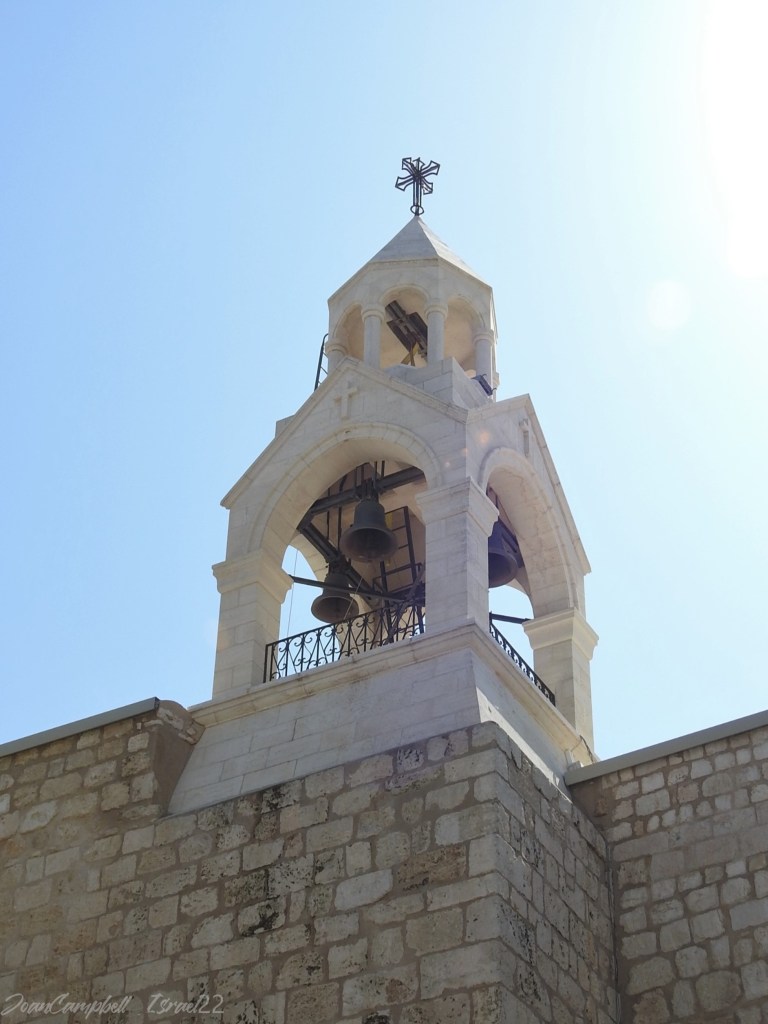
Bell Tower at the Church of the Nativity overlooking Manger Square

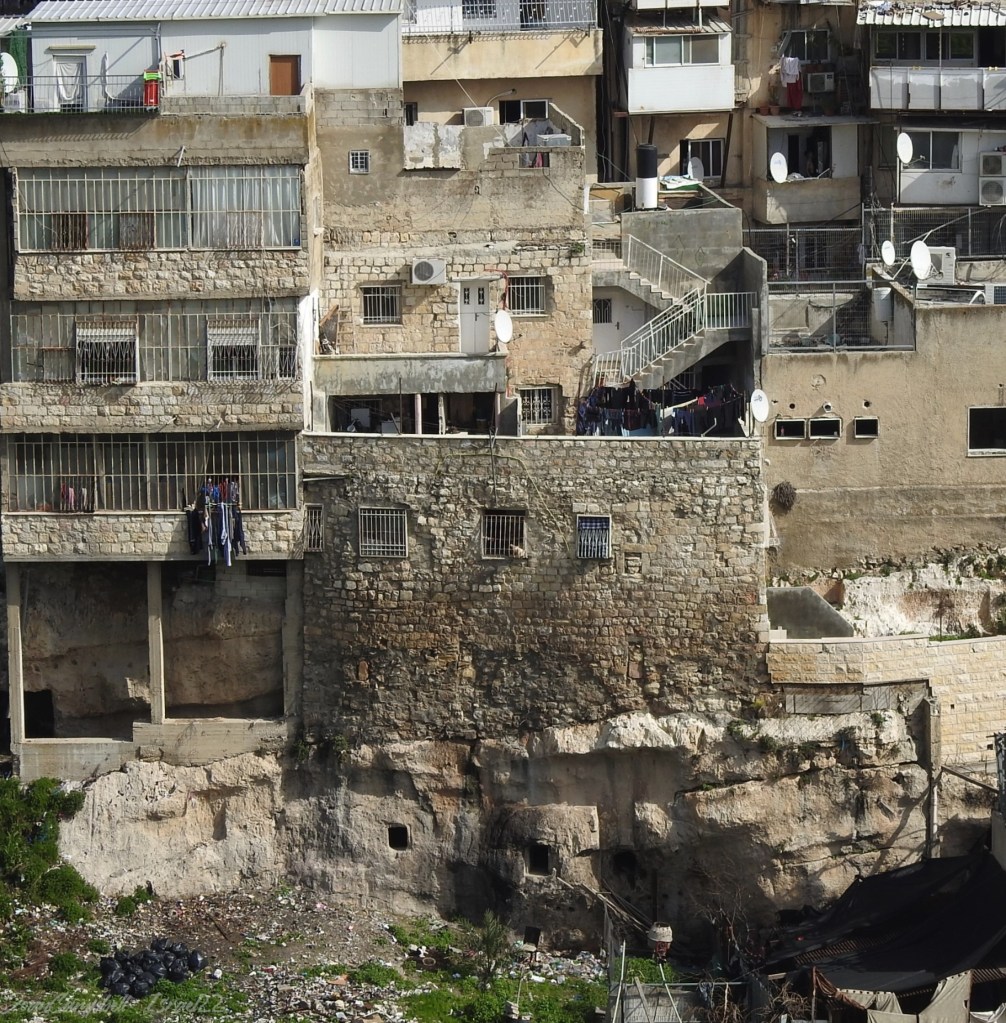
Now, back to the Church of the Nativity and those caves. As noted above, Bethlehem is in the hills of Judea and those hills include many limestone caves and the people built their houses over the caves. I suppose it is possible that, in even more ancient times, they originally lived in those caves and building their homes over them was a natural evolution. We know that young David took refuge in caves when he was hiding from King Saul (the first king of Judah, and that, in more modern times, the Dead Sea Scrolls were found stored in caves near the Dead Sea. Suffice to say, there are lots of caves in Israel and they were used for various purposes by the people living there. Even today, you can see houses built over caves in Israel. According to our Israeli tour guide, today the caves are used primarily for storage but have been used in the past for graves and, yes, as stables for sheltering their farm animals.

Old Houses built over caves in Jerusalem near Kidron Valley

The Church of the Nativity was built over a series of caves where tradition says that Jesus was born because there were no more rooms available in the house. Yes, the King James Version Bible says “inn”, but the koine Greek (New Testament language) word refers to a house or abode. The translation issue is not something I’m going to delve into with this blog. Suffice to say, some sort of building was built over the caves which, it seems, were being used as a stable with a manger available. Again, there is no recorded history – no neighborhood maps from 1BC, no birth certificate showing the date, time, & place of the birth of Jesus – only oral tradition that provided the basis for the location of the church.

Now a little info on the building of the church – very short version: Early Christians had identified these particular caves (or grottoes) as the site of Christ’s birth as early as the 2d century AD/CE. Yes, that’s over 100 years after the birth but it’s not known how long the early Christians had been going to the site. The Roman emperor Hadrian had gotten a little concerned about Christians gathering here. He didn’t like it since he wanted everyone to worship Roman gods so, in 135 AD/CE took over the site and had a pagan sanctuary to Adonis built over the caves.1&5 Interestingly enough (and ironically), Hadrian’s decision actually preserved the site which would later come to the attention of Helena (mother of Emperor Constantine) in 330 AD/CE or thereabouts when she came to the Holy Land seeking out sites associated with Jesus.  She found (?) and identified this site as the birthplace and the first Christian Basilica was built at the site over the caves in 339 AD/CE.1&2

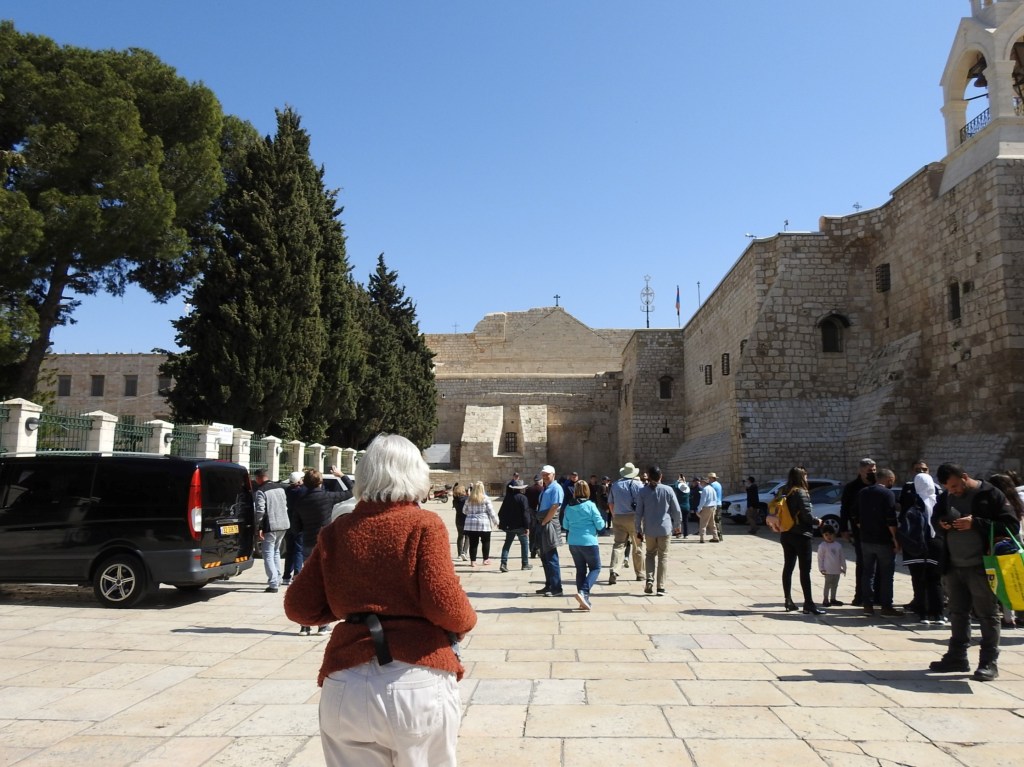
Manger Square at the Church of the Nativity

Fast forward. The original church was one of those octagonal ones (remember the one built over Peter’s house in Capernaum – read about our visit there here). Octagonal shapes were customary for use in basilicas at the time. The original basilica was destroyed by fire in the Samaritan revolts in 529 AD/CE2 and replaced in 539 AD/CE by order of Emperor Justinian with a more modern (for that time) church in the cruciform transept style – shape of a basic Greek cross, 4 apses, 44 Corinthian columns, 5 aisles – basically the footprint the church has today.2  I could go on and on with this history – that church (like the city and the country) has been through a lot since Jesus was born…held by the Romans, conquered by Persians, conquered by the Crusaders twice, back to Muslims, and then the Ottomans, then much, much later, after World War I, the British, and so on and so on. The history of Bethlehem is pretty much also the history of the Church of the Nativity itself. Sometimes the Church of the Nativity was under the management of the Roman/Catholic church, sometimes the Greek Orthodox, sometimes used by the Muslims, sometimes nobody really taking care of things – back & forth it went for the past two thousand years.

Today, as noted above, Bethlehem is a part of Palestine in the West Bank. The Church of the Nativity is managed in joint by a series of documents and understandings called the “Status Quo”.2 Major ownership is divided between the Greek Orthodox, the Armenian Apostolic, and the Roman Catholics (St. Catherine’s next door is connected to the Church of the Nativity and also built over the system of caves); minor rights are also given to the Coptic Orthodox (Egypt) and the Syriac Orthodox (the Church at Antioch) denominations. The city of Bethlehem was once predominantly Christian but today is primarily Muslim or secular with a very small minority being Christian. (In 1947, the population was 85% Christian; in 2016, 16%.5)

Bethlehem

So what did I see there? Tune in Tomorrow for Part 2 – Our Visit

Sources for Information:

  1. The Holy Land for Christian Travelers, John A. Beck, 2017, Baker Books, Baker Publishing Group, Grand Rapids, MI, www.bakerbooks.com , USA, Bethlehem and Shepherds’ Fields, pages 87-91
  2. Church of the Nativity – Wikipedia
  3. Mosque of Omar (Bethlehem) – Wikipedia 
  4. O Little Town of Bethlehem – Wikipedia
  5. Bethlehem – Wikipedia
  6. O Little Town of Bethlehem > Lyrics | Phillips Brooks (timelesstruths.org)
  7. Rachel’s Tomb – Wikipedia
  8. Micah 5 (biblehub.com)
  9. Philippians 4:4
  10. Biblical Israel: Bethlehem – CBN Israel
  11. Currier and Ives – Wikipedia
  12. Church of Saint Catherine, Bethlehem – Wikipedia