Blessings in a Garden

Series: Israel 2022 – Mount of Beatitudes

I come to the garden alone

While the dew is still on the roses

And the voice I hear

Falling on my ear,

The Son of God discloses….6

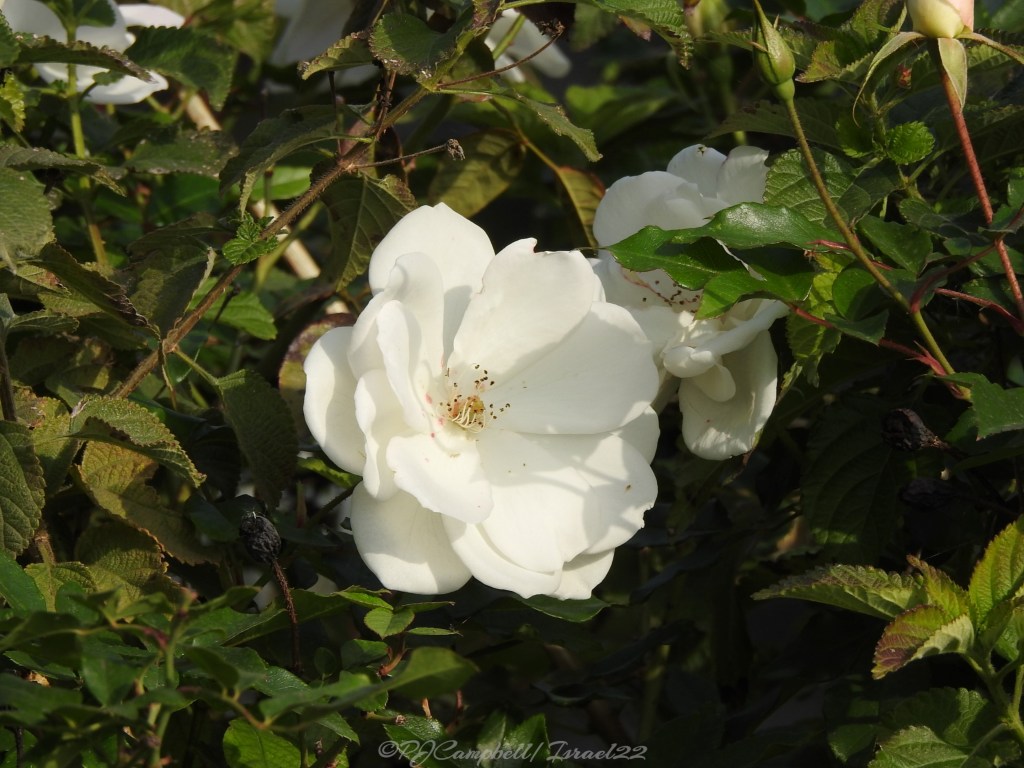
We have entered a beautiful garden on a hillside on the Korazim Plateau overlooking the Sea of Galilee. There are roses blooming along the walkway, birds flitting among the trees chirping and singing, bees and other pollinators buzzing among the blossoms adding a quiet hum to the peacefulness of the site. Even though it is February, the middle of winter, and there is snow on Mount Hermon to the north, here it feels like spring.
This “mount” we’ve come to is Mount Eremos and Har Ha Osher in Hebrew.1  I suppose it could hardly be called a mountain at all. This “mount” has a negative altitude. It is 200 meters above the Sea of Galilee but still 25 meters below sea level.  Mount Eremos is one of the lowest summits in the world.

The Franciscan chapel that dominates the garden was built in 1937-38 over the ruins of a Byzantine chapel at the site that was used from the 4th through the 7th century.  It was the practice of the early Christian church to build chapels at sites in Israel associated with Jesus and His ministry. Only a few traces of the ancient monastery and cistern remain at the site.1
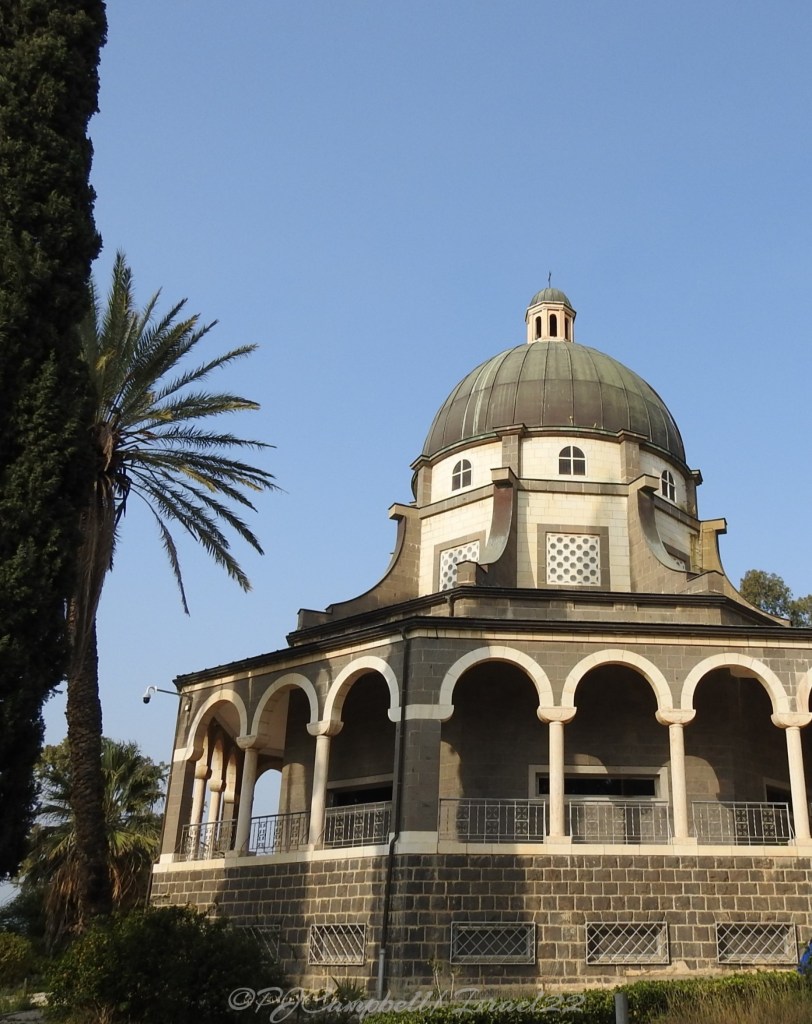
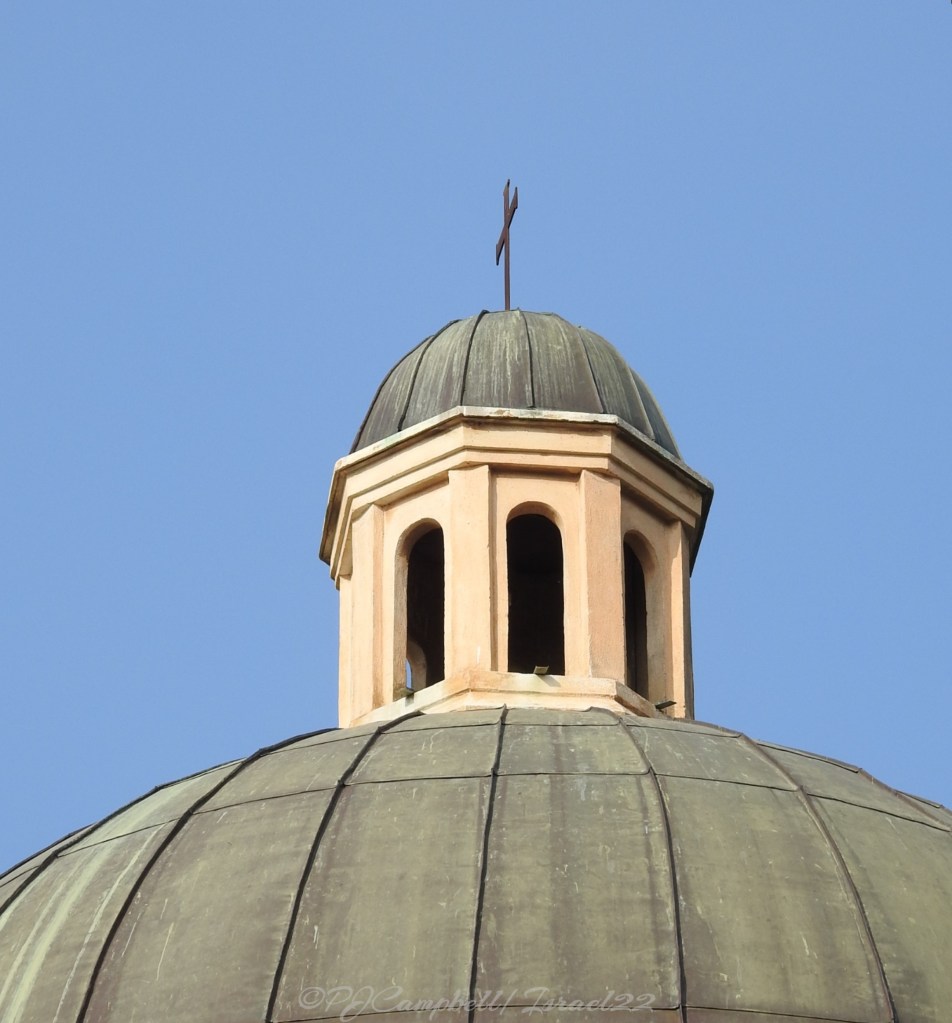
The Franciscan Chapel on the Mount of Beatitudes

The “new” chapel was designed by an Italian named Antonio Barluzzi commissioned by the Italian Mission Society…. with funding from Benito Mussolini…. yes, that Mussolini.2

It is a lovely chapel built with 8 sides in a Neo-Byzantine style. It has marble veneer casing the lower interior walls and includes gold mosaic in the dome over the altar.
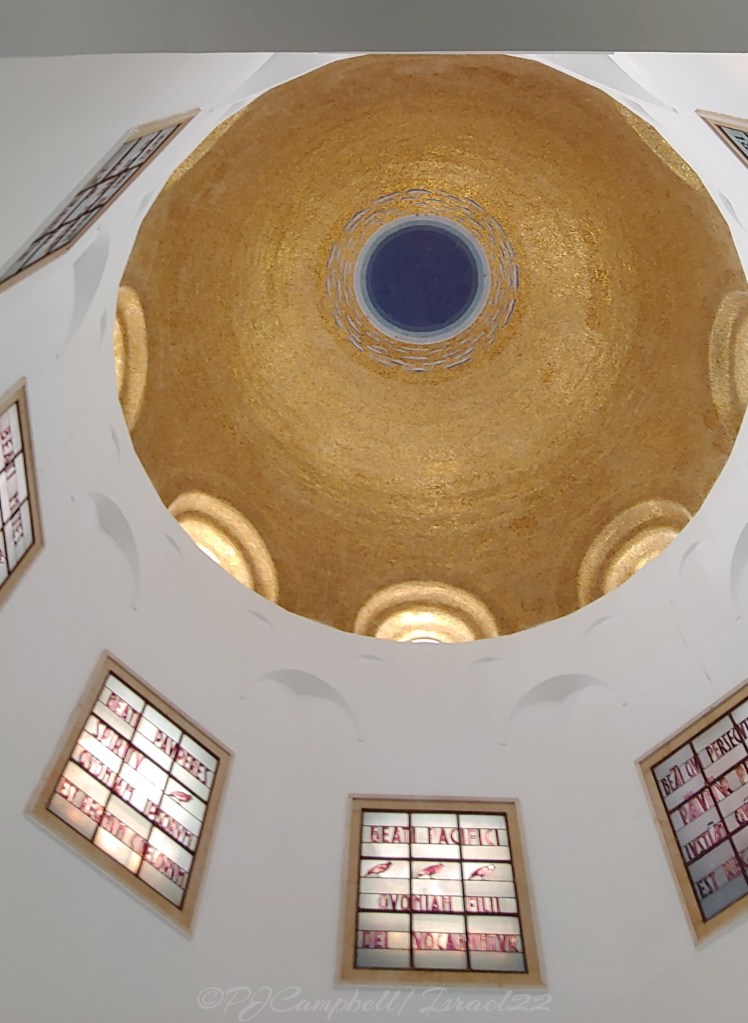
The golden dome inside the chapel.

The floor inside is circular around a central altar and includes mosaics for 7 virtues. Each stained-glass window is dedicated to and shows a single Beatitude written in Latin.2

For this is the Mount of the Beatitudes. While there is a 20th century chapel and garden with views all the way down to the Sea of Galilee, there is very little to identify this hillside as the one where Jesus sat and spoke to his disciples and a multitude of followers some two thousand years ago…nothing at all from the first century to commemorate what is today called “the Sermon on the Mount”.  

The floor mosaics around the altar show 7 virtues
and this one which says, “We adore you, Christ”.

The Sermon on the Mount is detailed in the Gospels, Matthew 5, 6, & 7 and Luke 6. It is the longest single discourse by Jesus memorialized in the Christian Bible. It is probably the most famous and most quoted of all the sermons recorded in the Bible or anywhere else for that matter. These three chapters in Matthew and corresponding chapters in Luke also include the “Lord’s Prayer” which absolutely has to be known by every Christian in the world today. (Okay, maybe the 23rd Psalm would be in the running for most famous and memorized passage, but I think it holds a distant second at best to the Lord’s Prayer.)8

Gateway overlooking the hillside of Mount Eremos

It may also be one of the most mis-quoted and maybe misunderstood passages in scripture. While reading and researching the Beatitudes (in both Matthew and in Luke where some call it the Sermon on the Plain4), I was amazed at how many different interpretations and applications I found. After two thousand years, theologians are still trying to understand what Jesus was saying that day on the hillside where He sat and taught those who followed Him.

At first read, it seems so simple…as is the way with most deeply complicated things. The Beatitudes include 9 blessings that focus on justice, faith, fortitude, hope, temperance, humility, compassion, meekness, charity, peace, and love… of course, love. Did Jesus not always preach love?

Mural inside the chapel showing Jesus teaching His followers.

I have read several translations but the pure poetry of the “blessed” verses in the King James Version (KJV) is what I grew up with and what I tend to remember.

3“Blessed are the poor in spirit,

for theirs is the kingdom of heaven.

4Blessed are those who mourn,

for they will be comforted.

5Blessed are the meek,

for they will inherit the earth.

6Blessed are those who hunger

and thirst for righteousness,

for they will be filled.

7Blessed are the merciful,

for they will be shown mercy.

8Blessed are the pure in heart,

for they will see God.

9Blessed are the peacemakers,

for they will be called sons of God.

10Blessed are those who are persecuted

because of righteousness,

for theirs is the kingdom of heaven.

11Blessed are you when people insult you,

 persecute you, and falsely say all kinds of evil

against you because of Me.

12Rejoice and be glad,

 because great is your reward in heaven;

for in the same way

they persecuted the prophets before you.

Matthew 5

The koine Greek word “makarios” used for Blessed can also mean “happy” or “fulfilled”.7 Some see the Beatitudes as a guide for living for Christians under the New Covenant.  Would that I could follow these tenets and be perfectly happy and fulfilled – perfectly righteous – all on my own! But, alas, I cannot. No one can. That was the point for the Jews in the first century and it is still relevant for all Christians today. You cannot do it on your own – the standard is too high — you need help – you need a Savior.

I walked there, in the garden on the hillside where Jesus (our Savior) might actually have come and sat down to teach this lesson. Scattered throughout the garden amongst the flowers were large plaques showing the Beatitudes in different languages of the world. 

There are other engraved stones about that have a single Beatitude inviting contemplation of just one “blessing” at a time.
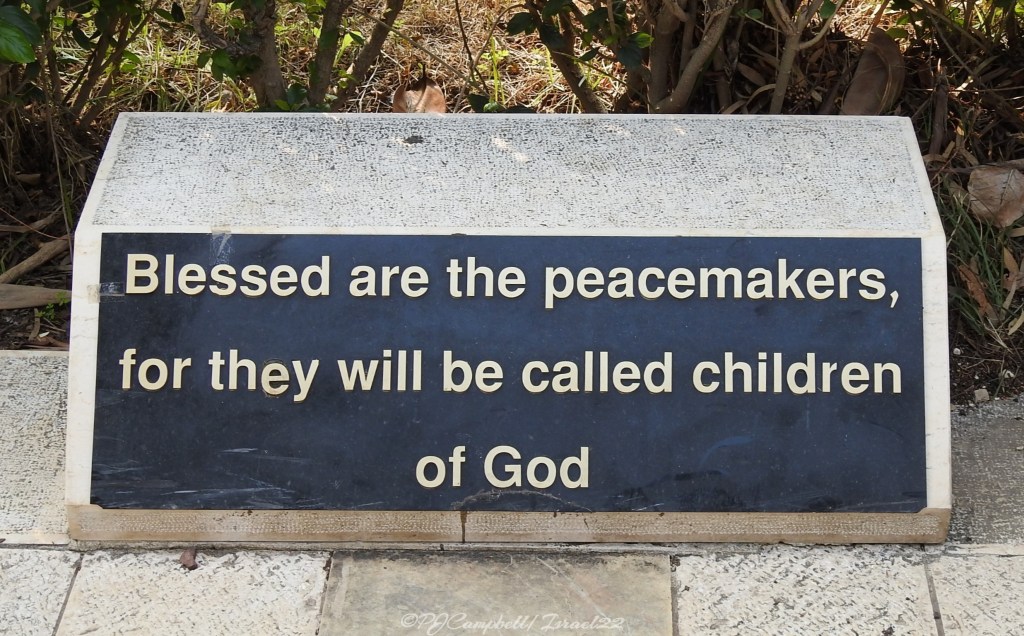
It is a place for meditation, a place to consider those “blessed” words. A place to pray and to talk to God and to listen for that still small voice as God responds.

“And He walks with me, and He talks with me,

And He tells me I am His own,

And the joy we share as we tarry there,

None other, has ever, known!” 5&6

Dr. Bremer from Dallas Theological Seminary (DTS) teaches at the Mount of the Beatitudes.

Scriptural Sources:

  1. Matthew 5:3-12
  2. Luke 6:20-23

Sources and References:

  1. Mount of Beatitudes – Wikipedia
  2. Church of the Beatitudes – Wikipedia
  3. New Testament places associated with Jesus – Wikipedia
  4. Ministry of Jesus – Wikipedia
  5. In The Garden – Lyrics, Hymn Meaning and Story (godtube.com)
  6. In the Garden, C Austin Miles, 1912 (Public Domain)
  7. Strong’s Concordance 3107, Interlinear Bible, Greek – “makarios”, Helps Word Studies 3107
  8. Sermon on the Mount – Wikipedia
  9. The Holy Land for Christian Travelers, John A. Beck, 2017, Baker Books, Baker Publishing Group, Grand Rapids, MI, www.bakerbooks.com , USA, Mount of the Beatitudes, p218 (This book can be purchased on Amazon.com)

ICYMI (In case you missed it) – Previous blogs in the Israel 2022 series:

Israel 2022: Pinch Yourself – April 4, 2022

Israel 2022: Caesarea Maritima – April 11, 2022

Israel 2022: Contested on Mount Carmel – April 20, 2022

Israel 2022: In This Valley – April 30, 2022

Israel 2022: Sea of Galilee – May 9, 2022

Israel 2022: A Very Old Boat – May 31, 2022

Israel 2022: A Blessing & A Curse – Capernaum – June 20, 2022

Israel 2022: One Little Boy Named David – July 5, 2022

Israel 2022: The Gates of Hell – July 23, 2022

One Little Boy Named David

Series: Israel 2022 – Valley of Elah

He’s singing to us.

We are standing at the edge a field of what looks to me like winter wheat. The bus had pulled off the highway and we’d all walked down the edge of the road and into the field. I was hoping that the farmer who owned the field did not come driving by and stop to run us out of his field lest we trample the crop. He didn’t and we didn’t – we stayed on the very edge and did no damage.2

And Dr. Yarbrough4 is singing to us – not what I’d expected at all. Since when do doctors sing to you? (I think I’ve been going on the wrong tours. I kind of like this singing thing.)

“Only a boy named David
Only a little brook
Only a boy named David
But five little stones he took.
Only a boy named David
Only a little sling
Only a boy named David
But he could pray and sing

And one little stone went in the sling
And the sling went round and round
And one little stone went in the sling
And the sling went round and round
And round and round
And round and round
And round and round and round
And one little stone went up in the air
And the giant came tumbling down.”
1

No sooner than he started singing that song than I was taken back maybe sixty years. I know that song! I cannot remember where I learned it (Sunday School?) but, in my head, I was singing right along with him. I imagined that everyone in this group was probably singing along too. Even if they did not know the song exactly, doesn’t everyone everywhere know the story of David & Goliath from the Bible? The song pretty much says it all.

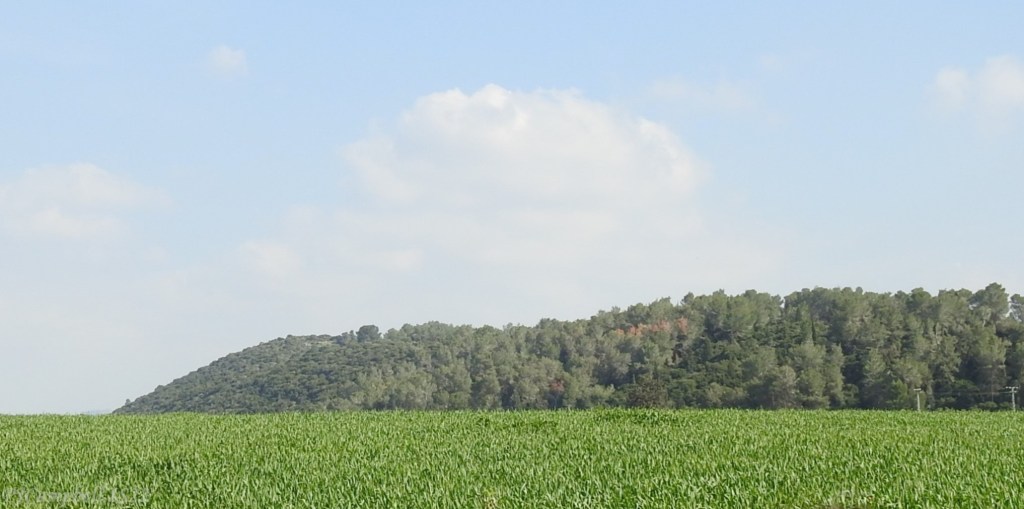
We were in the Valley of Elah, named for the terebinth trees that grow there. And, like the Sea of Galilee, it doesn’t seem to have changed much over the past several thousand years….at least from where we were standing. It’s a long shallow relatively flat valley that lies between the low hills of Judah. In ancient times, this valley was significant in that the main road from the coastal cities and those in the interior of Judah – Bethlehem, Jerusalem, and Hebron – ran right through the valley.

The Philistines controlled most of the valley leaving the Israelites with only a small portion at the northeast corner. Should the Philistines push through and conquer that small corner, then all of the interior of Judah would be open to them. King Saul and his men were all that stood between the Philistines and Judah.

Looking over to the side of the valley where the Philistines were encamped.

They met in this valley. On one hillside, the Philistines, and on the other, the Israelites.

This was created using Google Maps (Note 6) with my annotations to give you an overview of the battle.

For us, the Valley of Elah was a short stop on the way to Jerusalem.  We were driving up the highway heading towards Jerusalem and the bus pulls over. We all got off and walked down the side of the highway through a lovely area with quite a few pretty flowers – almost a garden by the side of the road.

Poppies growing in the Valley of Elah

At that point, I wasn’t quite sure where we were or why we had stopped there. But I figured it was something special…and I was right. We were led away from the roadway to a spot just at the edge of the field. And, as a gentle breeze rustled through the winter wheat, we listened to the story of the battle of the two fierce champions who engaged in a battle to the death.

Dr. Yarbrough took us through 1 Samuel 17 and the battle between the Israelites under King Saul and the Philistines with their champion, Goliath. Goliath, a giant from Gath who was well-versed in fighting and combat would take on a small untrained shepherd boy armed only with his trust in God, a leather sling, and five small stones he had taken from the nearby brook.

Somewhere down there is the Brook Elah. It is dry much of the year now.

Goliath was, indeed, a giant of a man. Standing somewhere between 6’9” (206cm) and 9’9” (297cm) depending on your source (Masoretic or Dead Sea Scrolls/Josephus/Septuagint), he wore armor of bronze with a bronze helmet weighing more than 5000 shekels (125.6 lbs./57kg). He had a javelin of bronze slung across his shoulders and carried a spear whose shaft was as large as a weaver’s beam (ok, big) and a point weighing in at 600 shekels (15.1 lbs./6.8 kg).3 No matter how you look at it, he was a BIG man, and a 15-pound spear point could do some serious damage. It was no wonder everyone was so frightened.

David? Not so much. He is described as a young shepherd boy, ruddy and handsome…but a boy, nonetheless… with not a lick of fear, it seems. He volunteered when no one else would. When he tried on King Saul’s armor, it was way too heavy for him such that he said he couldn’t walk in it and refused to wear it. So, he left the tools of a warrior behind and took only the tools of a shepherd, his staff, his pouch with the five stones he gathered from the stream, his sling….and, his trust in the Lord.

For 40 days, Goliath had challenged the Israelites to send their champion to fight him. Until David, there were no volunteers. David wanted to know, Just who is this uncircumcised Philistine, that he should defy the armies of the living God?3

Goliath was not amused when David came out to fight. Am I a dog,” he said to David, that you come at me with sticks?” “Come here, he called to David, and I will give your flesh to the birds of the air and the beasts of the field!3 Big words from a big man.

David’s response: You come against me with sword and spear and javelin, but I come against you in the name of the LORD of Hosts, the God of the armies of Israel, whom you have defied. This day the LORD will deliver you into my hand. This day I will strike you down, cut off your head, and give the carcasses of the Philistines to the birds of the air and the creatures of the earth. Then the whole world will know that there is a God in Israel.  And all those assembled here will know that it is not by sword or spear that the LORD saves; for the battle is the LORD’s, and He will give all of you into our hands.3

Of course, you know the rest. David put the stone in the sling, slung it round and round (just like in the song), and the stone hit Goliath on the forehead and sunk in. Goliath came tumbling down…. or, as Dr. Yarbrough would sing, “went splat”.  The Philistines ran away, and the Israelites won the battle.

For Saul, it was the beginning of the end. For David, it was just the beginning.

For us, it was another opportunity to see a Biblical story through new eyes…now having seen the hills and the battlefield and the little brook where the stones came from, we will always remember the place and how it felt to be there and how peaceful it is in the valley today.

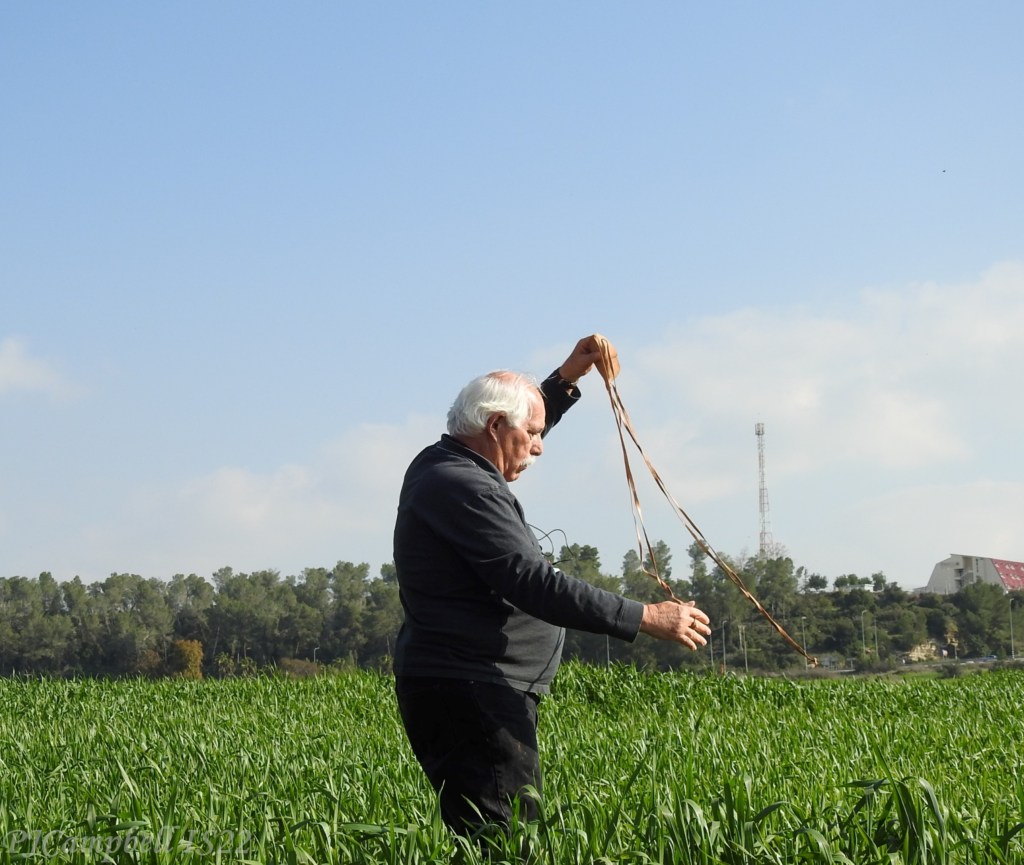
One of our guides from Sar-El Tours gives us a demonstration on how to use a sling.

The combat between David and Goliath way back in 1010 BC has come to mean any contest where the odds are greatly skewed against one opponent, the obvious underdog… in this case, Israel and its champion, David.  But I am reminded and, once again, quote Dr. Bremer5 who told us, where God is concerned,

“Numbers don’t count, and the odds don’t matter.

When you go into battle, as Paul said in Ephesians 6:14, you should gird up your loins and trust in the Almighty God of the universe.

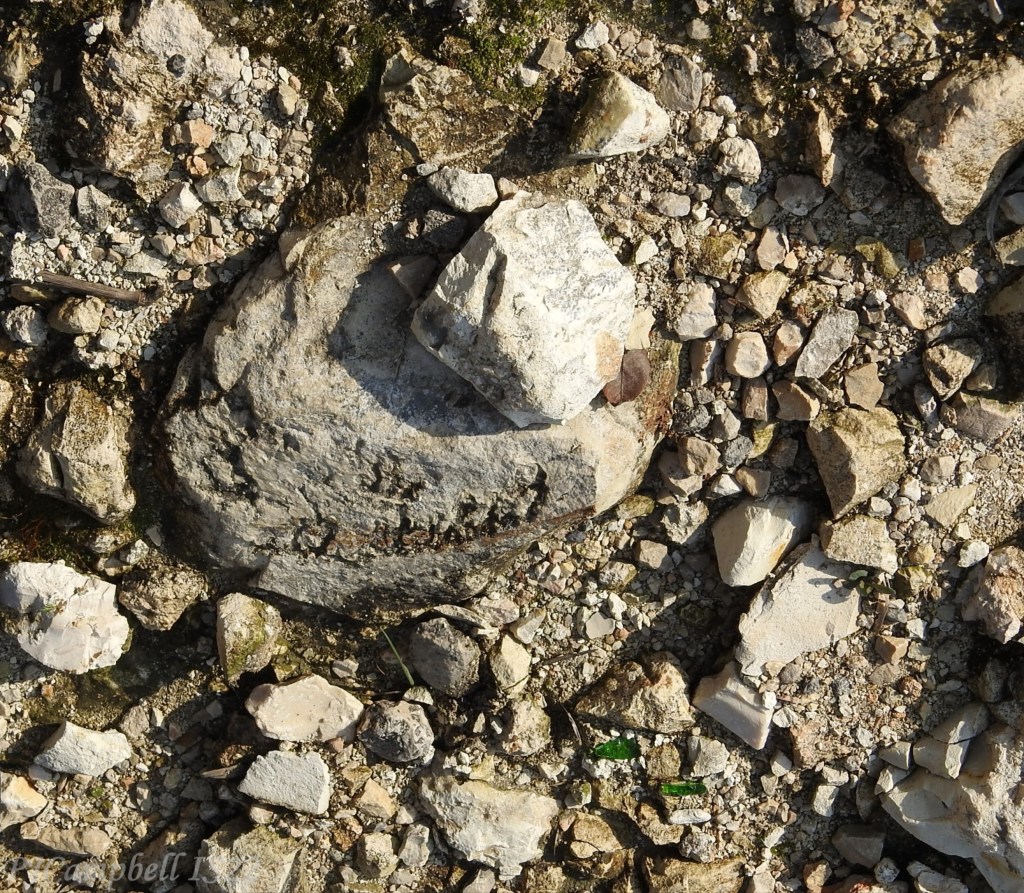
As we left the valley, I collected a stone….a tiny memory of the valley where David & Goliath fought.

Scriptural Sources:

  1. 1 Samuel 17

Notes & Sources for Additional Information:

  1. https://www.songlyrics.com/gaither-vocal-band/only-a-boy-named-david-lyrics/ These are the lyrics that came closer to those I remember from my childhood and the song that Dr. Yarbrough sang that day in the Valley of Elah. I imagine there are many versions of the children’s song or, perhaps, our Sunday School teachers took a few liberties in teaching us back before the internet started documenting everything.  Or maybe, I just remembered incorrectly. In my memory, it is a “babbling brook” and the “play and sing” was not included. Also, in Dr. Yarbrough’s version, the giant “went splat” rather than “came tumbling down” which I like much better and I’m sure as kids, it was much more fun for the giant to go splat.
  2. Wikipedia (#14 below), since July 2019, the Israel Nature & Parks Authority has stepped up to ensure that treats from development and possible shale oil extraction would be alleviated and the valley preserved.
  3. 1 Samuel 17, BibleHub.Com
  4. Dr. Mark Yarbrough – Dallas Theological Seminary
  5. Dr. Stephen J. Bramer – Dallas Theological Seminary.
  6. Valley of Elah from Google Maps
  7. Valley of Elah – Wikipedia

Want More?

ICYMI (In case you missed it) – Previous blogs in the Israel 2022 series:

Israel 2022: Pinch Yourself – April 4, 2022

Israel 2022: Caesarea Maritima – April 11, 2022

Israel 2022: Contested on Mount Carmel – April 20, 2022

Israel 2022: In This Valley – April 30, 2022

Israel 2022: Sea of Galilee – May 9, 2022

Israel 2022: A Very Old Boat – May 31, 2022

Israel 2022: A Blessing & A Curse – Capernaum – June 20, 2022