
I visited a garden this week. It was a garden with few flowers although the trees and grass are quite beautiful in the dappled sunlight. It has been called a garden of stones…..gravestones. The garden is officially closed right now because it belongs to the Federal Government and is closed now as Congress and the Executive Branch disagree over the nation’s budget and funding. But the garden is not really closed…at least one veteran will be admitted today.
 This is Arlington National Cemetery and I am here for the funeral of a friend – a West Point graduate, Vietnam War veteran, career military man. He died several months ago and now we’ve come to honor him and pay last respects at Arlington. I wait with everyone else in the parking lot in front of The Old Chapel. Funerals for war casualties and veterans have been conducted in this chapel since it was built in the 1930’s. I find myself pondering all the military men and women buried here at Arlington – how many funerals have been held here and how many different wars are represented by this place. I look across the hills and I am struck by the rows of markers….
There are just so many of them.
 Arlington National Cemetery covers about 624 acres and has been used as a cemetery for war casualties, veterans, and their families since the American Civil War. It is located on the site that was originally the home, Arlington Hall, and estate of Mary Anna Custis Lee – great granddaughter of Martha Washington and wife of Confederate General Robert E. Lee. But every school child in America knows that Robert E. Lee wasn’t always a Confederate general. Originally he was also a graduate of West Point Military Academy and an officer in the United States Army before the United States split into two and the Civil War began. He was offered the post of commander of the Armies of the Potomac at the start of the Civil War but, conflicted within himself about the war and loyal to his home, Lee wrote to his wife that he could not fight against the Commonwealth of Virginia. He resigned his commission on April 20, 1861 and became the commander of the Army of Northern Virginia and, ultimately, the commander of all the Confederate military forces.
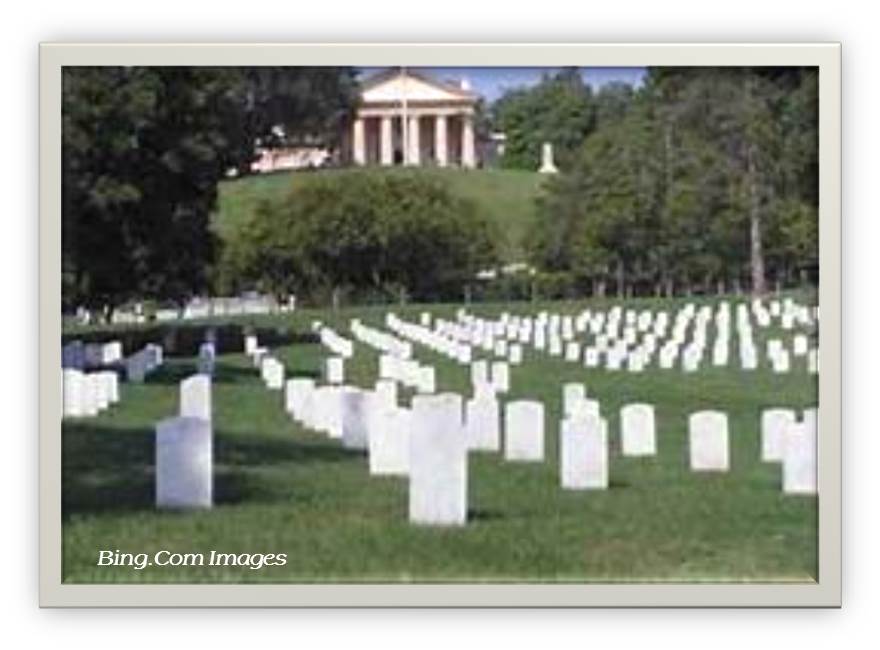 War brings strong emotions to the surface and, once he left to join the Confederacy, Lee would never be able to go home to Arlington Hall again. Fearing for her life, Mary Anna Custis Lee followed her husband’s advice and fled from her home. The Union Army soon took over the property and used it as an Army headquarters. Its position overlooking the Potomac River and Washington, DC made it a strategic military position that could not remain in the hands of Confederate sympathizers. Later, in 1864, when most of the local cemeteries had become filled with war dead, the Army’s Quartermaster General saw the political advantage of using General Lee’s home as a cemetery making it forever “uninhabitable” and ensuring that the Lees would always remember the cost of war. The land was formally taken from Mrs. Lee for back taxes. She had sent a friend to pay the taxes but he was turned away and the tax payment was rejected because the owner had not come in person – an obvious ruse by the Government to take the land and punish the General and his family. Mrs. Lee was able to return to her childhood home one last time before her death in 1873. After the war, Mary Anna Custis Lee’s son, who was her heir and would have inherited the estate, sued the Government successfully and the estate was returned to the family but it was too late…it was by this time filled with the graves of soldiers from both sides of the conflict. The estate was sold back to the Government for $150,000 (about $3.1M in today’s dollars). The first war casualty buried at Arlington was William Henry Christman on May 13, 1864.
Since then, there have been so many more…..
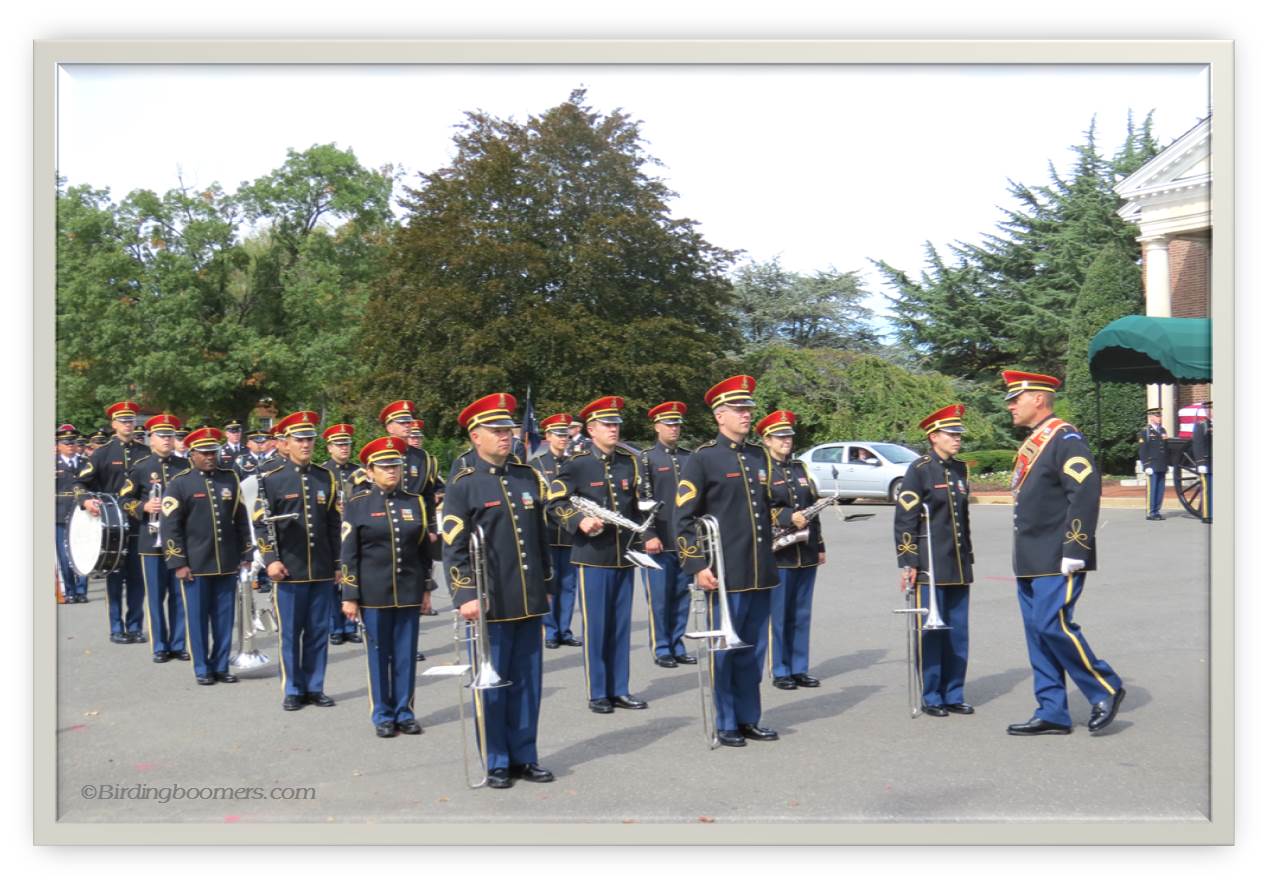
 This is the second military funeral I have attended at Arlington. The funerals are conducted with great honor and respect by the Army’s 3rd Infantry Regiment. The 3rd Infantry is a fully functioning fighting unit but most people are more familiar with the Regiment’s mission to “honor our fallen comrades”. As I stand in the parking lot, the horse-drawn caisson arrives along with the honor guard. Although our friend was cremated and will be buried in the columbarium at Arlington, a coffin is placed on the caisson’s wagon and the American flag is carefully and slowly draped over the coffin. At this point, even before the actual funeral service begins, every action by the members of the funeral detachment is handled with solemnity and respect for the veteran being laid to rest this day. Every step and every action is calculated and filled with tradition and symbolism. After the service in the chapel, the funeral procession led by the caisson, the color guard, the 3rd Infantry band, and the honor guard will move slowly through the cemetery to the final resting place for our friend.
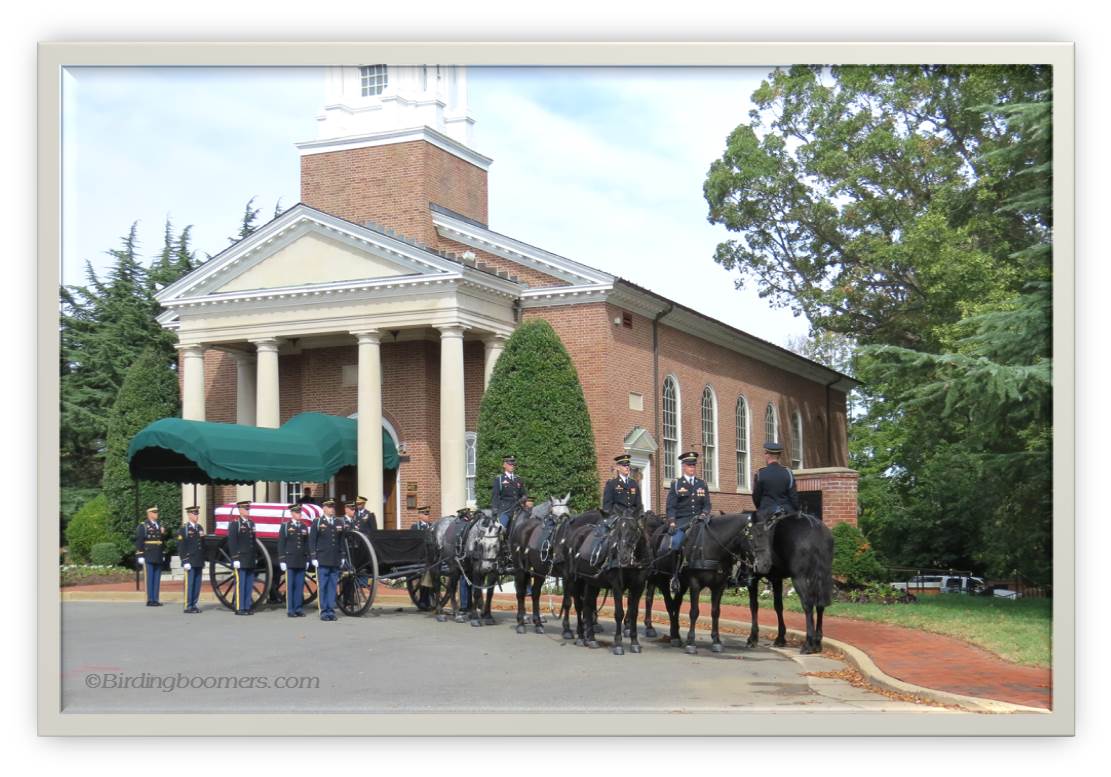 Years ago when I attended the first funeral here, we elected to walk with other friends and family members in the processional. It is a very moving experience to walk slowly down through the rows and rows of war dead thinking about all the other people who have walked behind other caissons through
  the last one hundred and fifty years. On our return, we decided not to stick to the roadway to get back to our car at the Chapel; we thought maybe we would walk up through the cemetery. It seemed like a simple shortcut to cut straight up over the hillside. Within ten minutes or so, we were hopelessly lost. In every direction there were white markers – all the same – row upon row – seemingly going on forever. We
  walked this way and that slowing down to read the names on the stones, noting the different religions represented and, more sadly, the ages of the young men and women who had lost their lives in battles. The cemetery has 70 sections representing all aspects of war and the “brothers in arms”. Section 21 holds military nurses and, more recently, there is a section just for casualties for the “Global War on Terror”. Incredibly (to me), there is a section with Confederate
  soldiers and a section with former slaves – war may be fought over political and cultural differences but death knows no such boundaries. There are the usual sections for different military services and different wars and different occupations. In all, there are about 400,000 souls that have been laid to rest at Arlington and the funerals continue five days a week, about 6,900 per year. There is a three month backlog. The Government may shut-down but the funerals continue here.
And there are just so many of them….
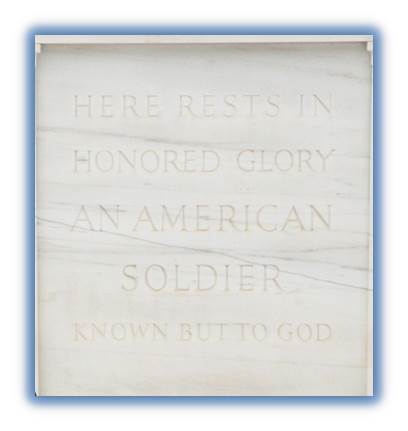 Ultimately, we found our way up to the Tomb of the Unknown Soldier and decide to stay a little longer to see the changing of the guard. This tomb is guarded day and night, rain or shine, winter and summer. There is always a guard from the 3rd Infantry marching back and forth, 21 steps right, turn and then 21 steps left….silently and steadily day after day. There are actually four service men buried in the tomb, one from each of four major conflicts of the past hundred years – World War I, World War II, Korean Conflict, and the Vietnam War. The inscription on the tomb reads “Here rests in honored glory an American soldier known but to God.” I suppose medical procedures and advances in DNA technology in the past decade make it possible that there will never be another “unknown” soldier but somehow I doubt it and wonder how many more will die. It is sad to think that these young men were lost forever to their families and friends.
Changing of the Guard a the Tomb of the Unknown Soldier
But today, we do not walk. There is final short service at the grave-site ending with the honor guard’s 21 gun salute – the sound reverberating throughout the still quietness of the place. Finally taps is played. Once you hear it, you never really forget the haunting beauty of that lone bugle and the thought of a single soul winging its way up to the heavens.
Day is done, gone the sun
From the lakes, from the hills, from the sky
All is well, safely rest
God is nigh.
Fading light dims the sight
And a star gems the sky, gleaming bright
From afar, drawing near
Falls the night.
Thanks and praise for our days
Neath the sun, neath the stars, neath the sky
As we go, this we know
God is nigh.
A single soul is honored today.
As we leave this garden, I take one look back and say 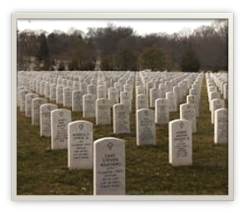 one last goodbye to our friend and thank him silently for his service. My glance turns into a long last look through the gates and down the hill at the rows upon rows of white marble markers. At once, I am filled with an overwhelming sadness and new tears come to my eyes. I read recently an anonymous quote – “Our flag does not fly because the wind moves it, it flies with the last breath of each soldier who died protecting it.” Every last breath…..
And there are just so many of them…..
Sources and for additional information on Arlington National Cemetery:
Arlington National Cemetery: http://www.arlingtoncemetery.mil/
Wikipedia: http://en.wikipedia.org/wiki/Arlington_Cemetery
The Old Guard (Wikipedia) http://en.wikipedia.org/wiki/3rd_United_States_Infantry_Regiment_(TOG)
The Old Guard (Official): http://www.army.mil/info/organization/unitsandcommands/commandstructure/theoldguard/
Arlington House (Wikipedia) http://en.wikipedia.org/wiki/Arlington_House,_The_Robert_E._Lee_Memorial
Arlington Cemetery Unofficial Site: http://arlingtoncemetery.net/
Visitor’s Guide: http://dc.about.com/od/monuments/p/ArlingCemetery.htm
Tomb of the Unknown Soldier: https://tombguard.org/
Taps Lyrics, Wikipedia: http://en.wikipedia.org/wiki/Taps
Video – Changing of the Guard at the Tomb of the Unknown Soldier: http://www.youtube.com/watch?v=DLVzKTyXI_E
Taps Video: http://www.youtube.com/watch?v=Wn_iz8z2AGw





 Birding Boomers