Mama Prayed Here – The Ridge Church

I love old churches. They remind me of old hymns – Amazing Grace2, Be Still My Soul3, Victory in Jesus3 – all the old ones we carry around in our hearts and sing when we are in the most need of a good blessing. When I think of The Ridge Church, it’s The Church in the Wildwood1.

Although The Ridge Church is little, it is not “brown”, but I think of this song when I remember the church itself. Something about the lyrics and the melody just brings this church to my mind.
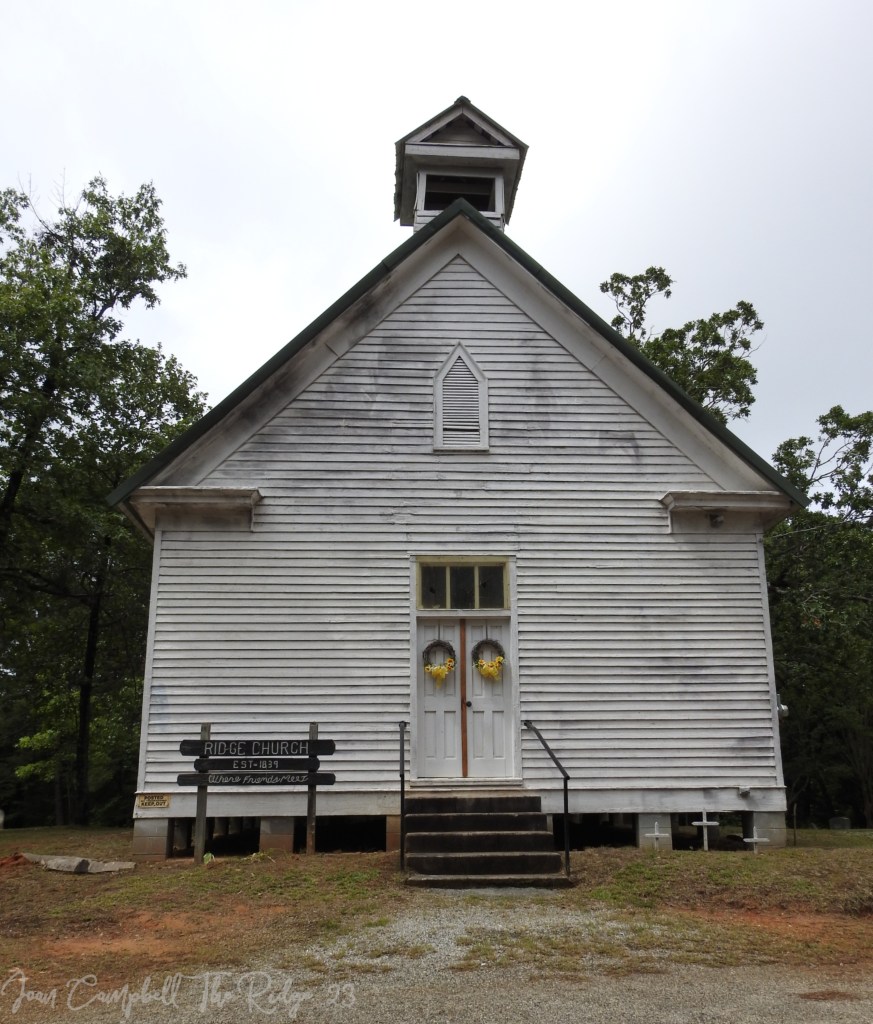
The Ridge – a little church in the “wildwoods” out there in the middle of nowhere in South Carolina. I should know more about this church – you’d think I would have more memories of it. Rarely have I been there – only a handful of times when I went to family reunions all as an adult. But it is nonetheless a part of me, and I think of it as Mama’s church.
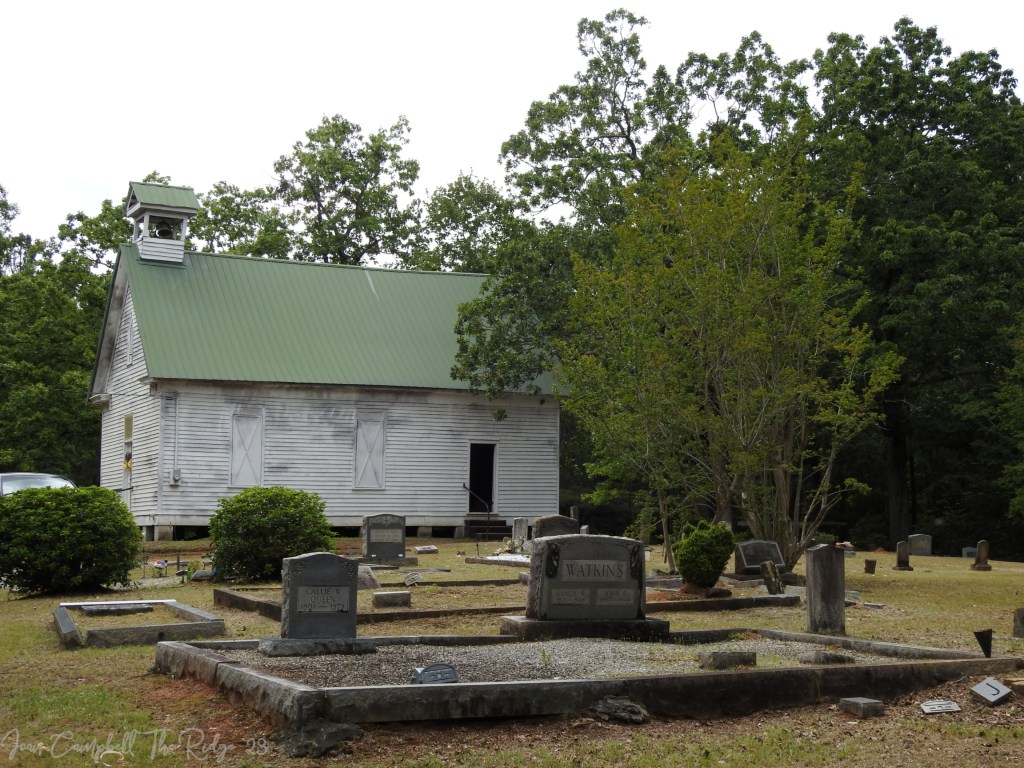
Now, having said all that, I do not know how much Mama went to church there when she was a child or if she went to church there at all. So, why write about the church and indicate it was the church where mama prayed? Well, because it’s in Lowndesville and that is where she was born and where she grew up; Lowndesville is where she came from; and The Ridge is where her ancestors probably would have worshipped, where many of them are now laid to rest. The cemetery by the church is filled with Mama’s ancestors. My grandparents are buried there along with a good number of aunts, uncles and cousins. The names on the tombstones attest to their lives in Lowndesville and Iva and Abbeville…..all remind me that they are my Mama’s people; and, yes, they are my people too resting in peace there giving me a sense of the familiar, of home…and of Mama.

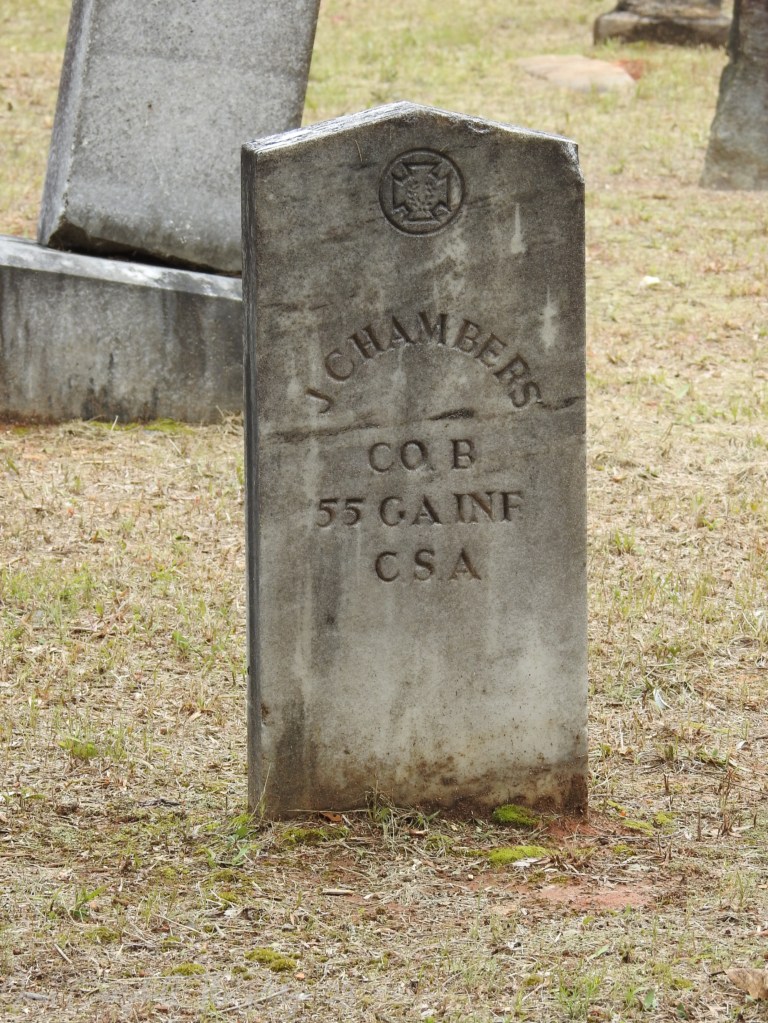
When you search online you can find a good bit about Lowndesville and the surrounding area but very little about The Ridge Church itself. Like many small churches that are no longer active, very little of the church history seems to have been written down or memorialized. Lowndesville itself is a “small” town. When I say that, I mean it is way smaller than any one-horse town you’ve heard of. As far as I know, Mama’s daddy was a sharecropper at the turn of the century, at a time when things were going well for farmers in the south and cotton was still king…..right up until the Great Depression. Prior to the depression, the town seems to have been a relatively prosperous railroad town….prosperous enough that the Southern Railway could pay for a belfry with a brass bell for a little church out in the woods a few miles outside of town.

The congregation was established in 1839 and first met under a brush arbor. For those who’ve never heard of a brush arbor, it is an outdoor meeting place – open sided – made of wooden poles with tree limbs (brush) across the top, where people met to worship God and have church meetings…think tent revivals but much earlier and more rustic. In 1840, a log house was constructed with pews of hewn logs with wooden pegs5. It was known then as the Ridge Meeting House and in 1890 the present church was built. This would be the church that I have come to know and the one that Mama would have known.

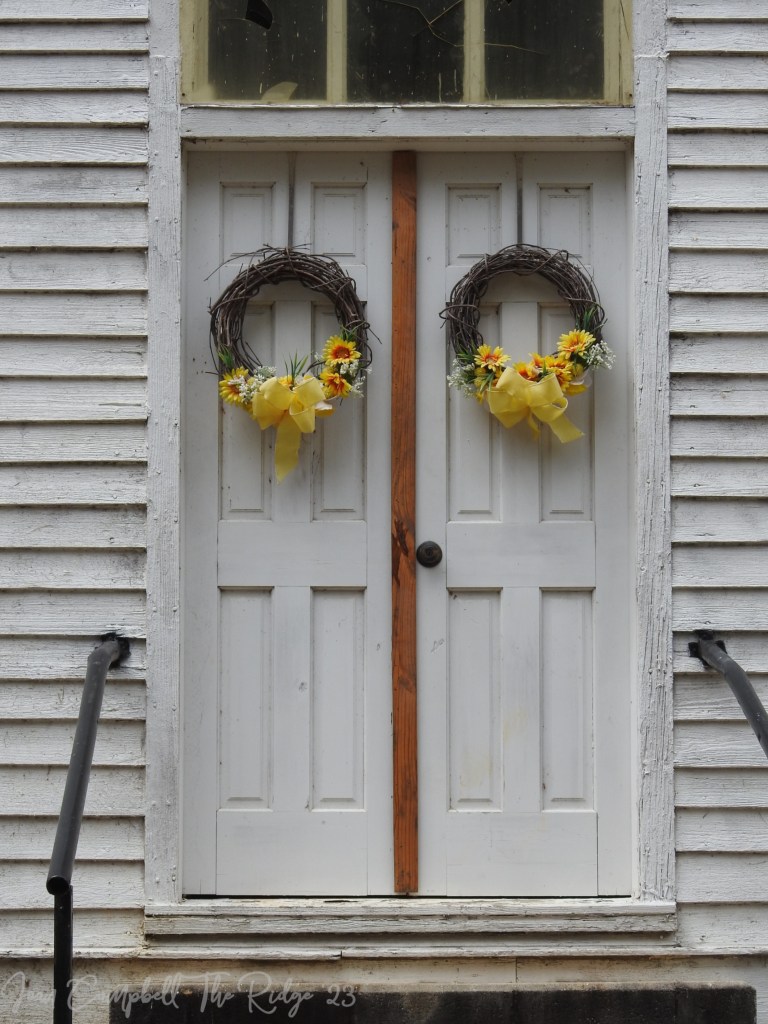
Sad to say, the church itself has become somewhat easier to find nowadays because it has been desecrated by vandals and some errant bloggers have made it a bit famous by telling the world online that the church is haunted so every year around Halloween, miscreants try to find it to desecrate it some more. Fortunately, The Ridge is now owned and managed by the Smyrna Methodist Church in town, and a locked gate on the roadway going up to the church has made it more difficult to get to the old church. Additionally, the doors are now kept locked and the windows have all been boarded up. The congregation at Smyrna provides for the ongoing upkeep of the church and the cemetery – sadly that includes painting over the smut left by vandals. Smyrna Methodist also holds special services at The Ridge several times a year including a candlelight service at Christmas.
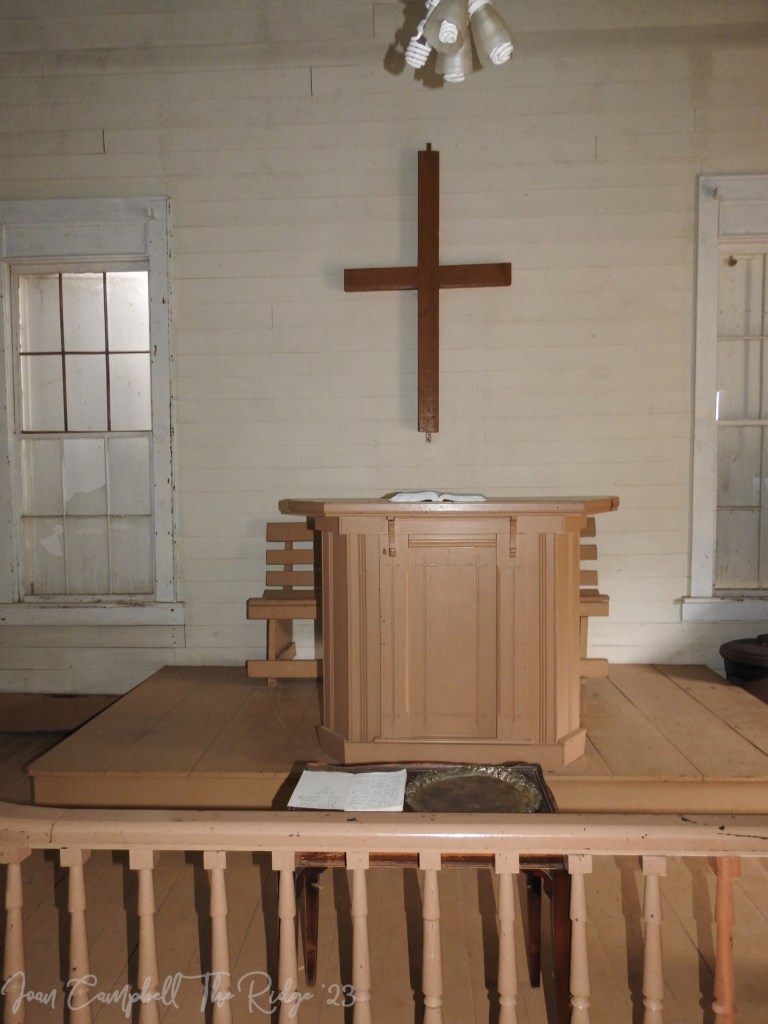
My personal memories of Lowndesville and The Ridge Church are much more recent. When we have attended family reunions in the past, we always go over to the Ridge Church after dinner on Sunday….and it is always a good visit. The church is quiet and peaceful and beautiful in its simplicity – just an old wooden church sitting in the trees back off a dirt road in the middle of nowhere.
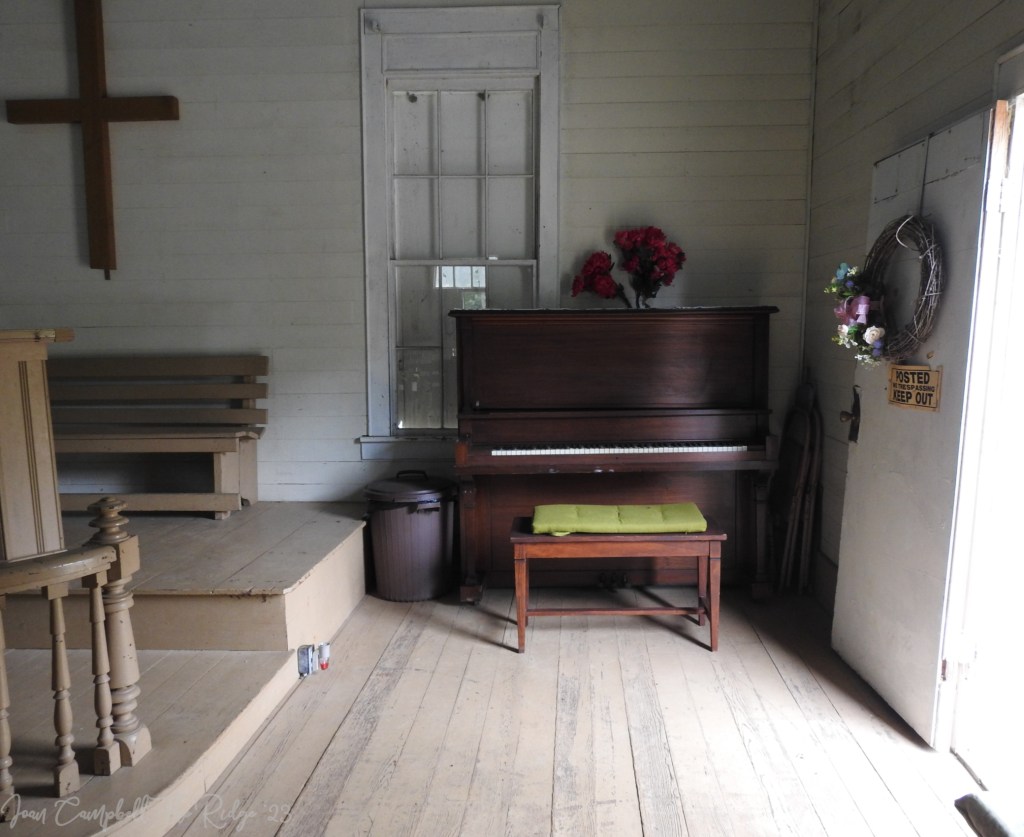
When I think of it now, I think of my cousin playing the piano while we gather around to sing a few old hymns. I remember my sister standing right there by him singing away while pointing her cane sternly at any of her grandkids who might have even a single thought to misbehave. Before we leave the church, we gather around the pulpit to pray for blessings and safe travels for all the cousins as we head back home later in the evening. Perhaps we prayed standing very near the spot where Mama would have sat with her sisters as a young girl, prayed for her family and maybe prayed for her future and the children she might have….perhaps she prayed that they might someday make their way back to her home in Lowndesville and to The Ridge Church “Where Friends Meet”.

Notes:

  1. THE BROWNS – THE CHURCH IN THE WILDWOOD LYRICS
    1. The Church in the Wildwood – Wikipedia
  2. Amazing Grace > Lyrics | John Newton
  3. Be Still, My Soul > Lyrics | Katharina A. von Schlegel
  4. Victory in Jesus > Lyrics | Eugene M. Bartlett
  5. I did find a blog written by a lady (Donna Bratcher) who lives down in South Carolina and writes about old buildings and churches there. Her blog is called Faded and Forgotten History. She was kind enough to send me an article from an old newspaper that she had used as a source for her blog, so I do have that bit of information. (If you’d like to read her blog about The Ridge Church, you can find it here.)
The Gates of Hell

Series: Israel 2022 – Caesarea Philippi

 “Who do you say that I am?”

Jesus asked the question of his apostles – those closest to him during His ministry on this earth – as they traveled thru the towns around Caesarea Philippi in northern Israel. (Mark 8:27-30; Matthew 16:13-20; Luke 9:18-21)

Caesarea Philippi. This was not a Jewish town or religious center. I’m not even sure that there was a synagogue in the area at that time. (There are old ruins of a synagogue nearby but I was not able to find a date for the ruins.) This was not a place you’d expect the Messiah or even a prophet to visit. It was known throughout the region as a pagan worship center of the Gentiles in Hellenistic times called Paneas. It was a “high place” set aside for worship of the god, Pan. (In Arabic, the name is Banias; hence, the name of the park today.)

Caesarea Philippi is a beautiful park today in Israel’s Golan Heights at the foot of Mount Hermon. It is set aside as an archaeological site and nature preserve. 

When we arrived, we took a walk through a wooded area to the Lebanese Restaurant for lunch. It was a lovely sunny day, and the park was filled with families enjoying the afternoon. Lunch was excellent, by the way. If you ever visit Banias, do try to have a meal at the restaurant. The setting along the stream is lovely and the food was very good.

Lebanese Restaurant in Hermon Stream Nature Reserve
(Photo from Google Maps)

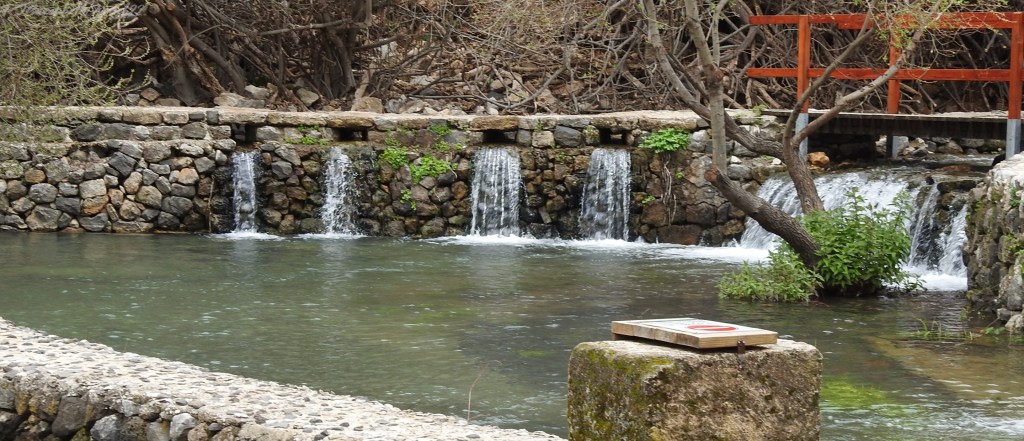
After lunch, we headed up to the old sanctuary walking along the stream, Nahal Hermon in Hebrew and Banias River in Arabic.3 It was so unexpectedly peaceful that I fell in love with this place and hoped we’d stay so I could just wander around for the rest of the day. (Alas, we did not.)

Nahal Hermon/Banias River

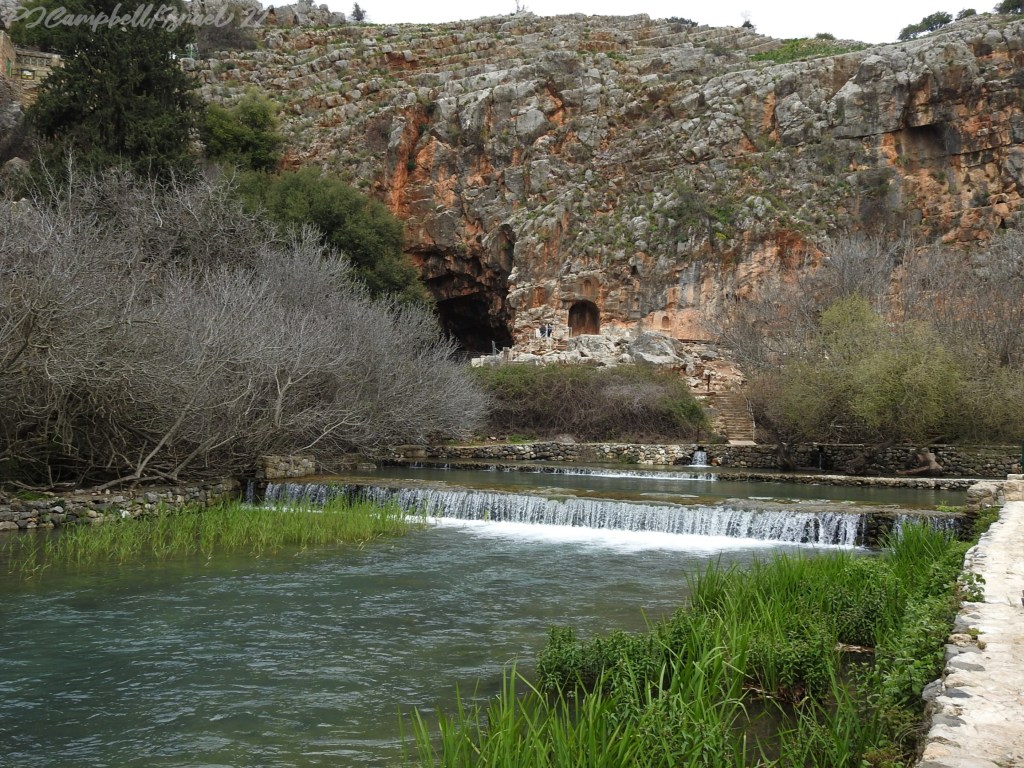
We arrived at Paneas at the headwaters of the spring that fed the stream and is also one of three tributaries that feeds into the Jordan River. I was just amazed at the sight.

Paneas at Caesarea Philippi – First Look

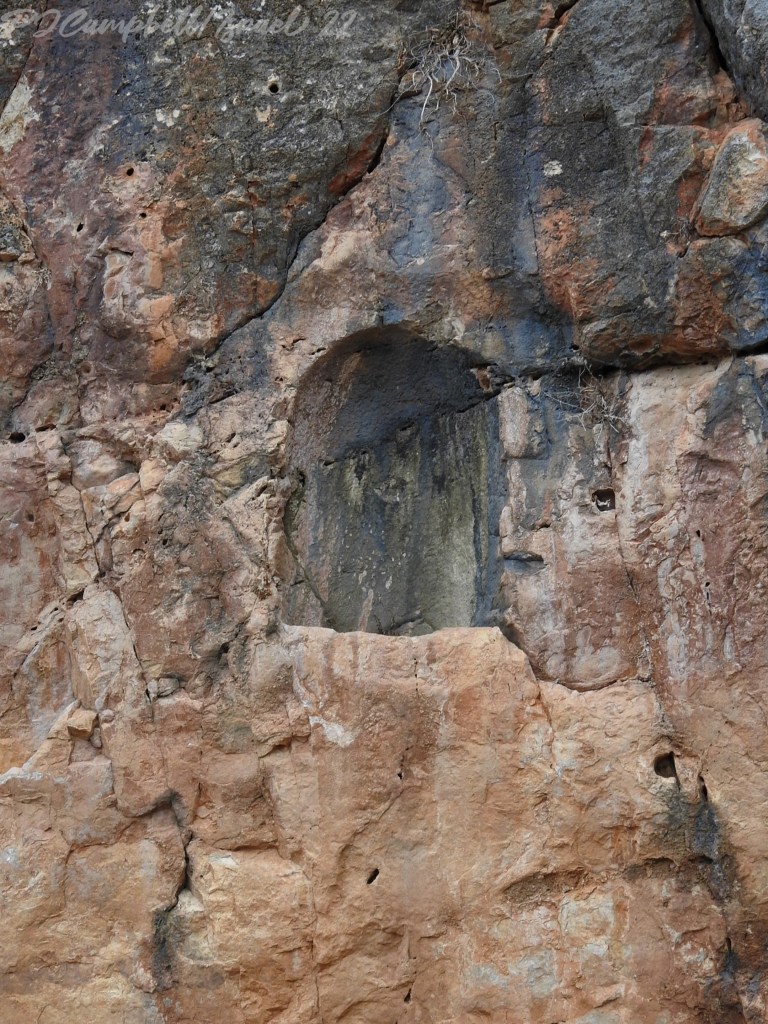
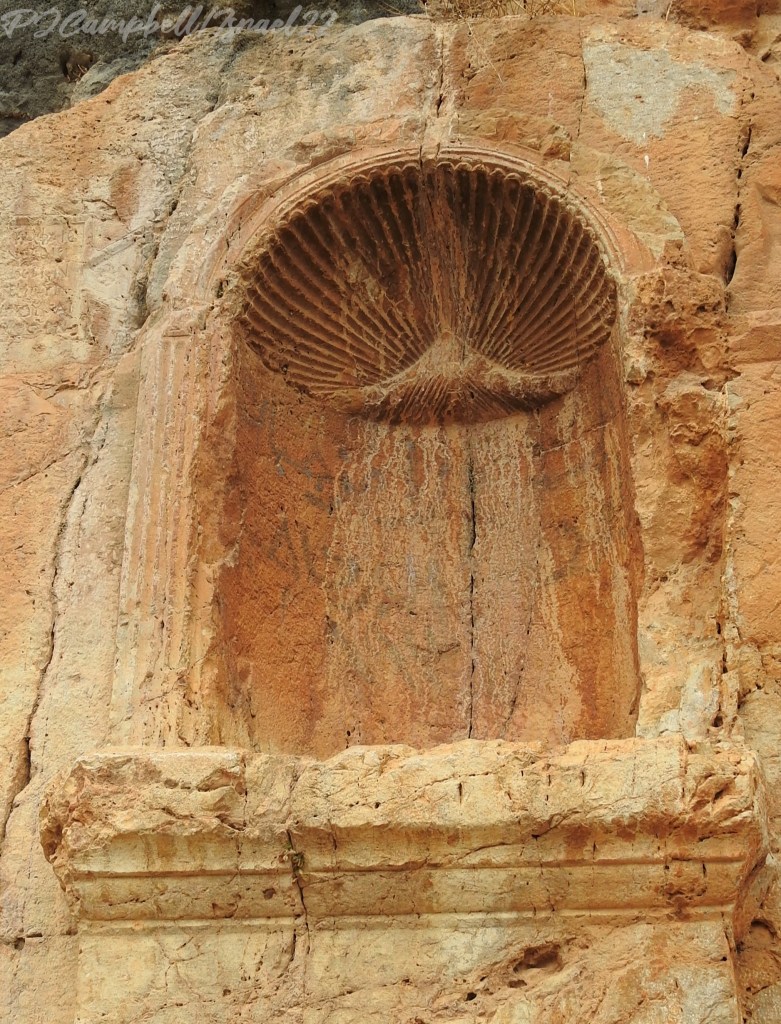
In front of us, the ancient Bamah or, “high place”, worship site.8 This had been a cultic sanctuary since the beginning of time, I suppose.  There was a red and tan and black colored cliff right in front of us that is 230’ (70m) long by 131’ (40m) tall. On one side is a large cave that is 66’ (20m) wide by 49’ (15m) tall. Along the front of the cliff is an elevated terrace about 263’ (80m) long on which were built temples and altars for worship of the gods. The cliffside was carved with niches that had once held statues and idols.

In front of the cave was the rushing waters of the spring. In the past, that spring had gushed forth from the mouth of the cave which may have been much larger and even more impressive than it is today.

According to Josephus, the Jewish historian from Roman times:

“… the place is called Panium, where is a top of a mountain that is raised to an immense height, and at its side, beneath, or at its bottom, a dark cave opens itself; within which there is a horrible precipice, that descends abruptly to a vast depth; it contains a mighty quantity of water, which is immovable; and when any body lets down any thing to measure the depth of the earth beneath the water, no length of cord is sufficient to reach it …7

During the time of Christ, it was a site dedicated to the Greek god Pan. Paneas had been established by the Greeks sometime after Alexander the Great had conquered the area in the 3rd century BC .1 But the Hebrews had also worshipped Baal Gad (“Master Luck” or god of good fortune) at the site in the past.1 Joshua 11:17, 12:7, and 13:5 references a high place in the valley of Lebanon below Mount Hermon.

The Court of Pan & the Nymphs –
The carved niches would have held statues of the pagan gods.

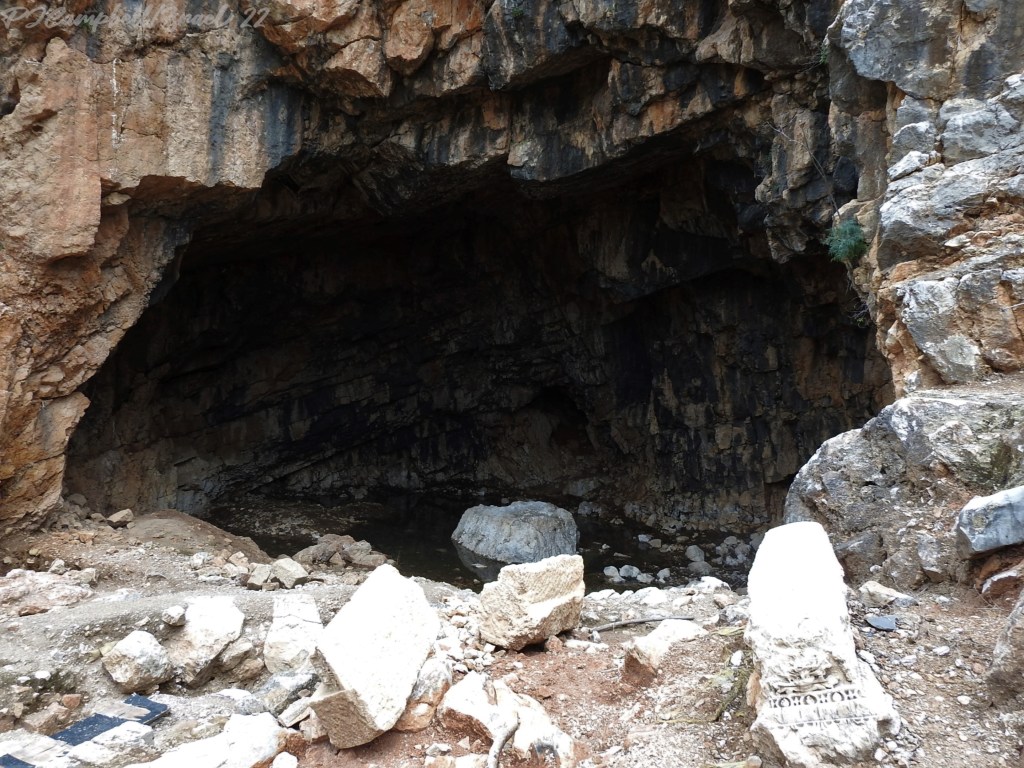
The place must have been quite ominous in ancient times. To the first Greeks who came here, the site resembled the legendary River Styx, the boundary between the earth and the underworld. They thought this must be a place of death and it came to be thought of as the “Gates of Hades” or, “Hell”.10 In the 3rd century BC, the Ptolemaic kings built a cultic center here and as noted, the Hellenists replaced all the local deities with Pan and the cave itself was dedicated to him.

The Grotto of Pan During Biblical times, the cave was much bigger and the spring waters would have gushed out of the mouth of the cave. The ancient Greeks in the area saw this as the entrance to the underworld, Hades.
A closer view of the large rock inside the Grotto of Pan that was possibly used for sacrifices of goats to the god.

You may remember studying Pan during those mostly boring classes in high school on Greek mythology and culture. There were so many that I got them all confused but I thought Pan was the funny one – you know he was the half-human, half-goat that played a flute and hung around with nymphs, one in particular called Echo. He was a god of wild places much revered by shepherds (well, he was part goat after all). I always think of Pan drinking lots of wine and carousing around. But I read he was a troublemaker and our word, pandemonium, comes from Pan’s name.4

Statue of Pan – This photo was taken in Maryland (USA) at Ladew Topiary Gardens

That’s pretty much all that was happening here for a few centuries – lots of pilgrimages being made to the cave and lots of goats being sacrificed. Greek empires faded and, ultimately, the Roman empire came on strong.

During the time of Christ, the area had been placed under Herod the Great’s rule. When Herod the Great died in 4 BC, his “kingdom” was divided into a tetrarch and split between his three sons. One son, Philip II, inherited governance of the northern areas and founded the city called Caesarea Philippi. After Philip II died in 34 AD, his nephew Herod Agrippa I assumed rule over Caesarea Philippi. Enough history.1

A view of what the site would have looked like at the time that Jesus visited.

I keep asking myself why Jesus would come here?  Why travel this far north from Galilee where there were not too many Jewish communities? There are ruins of an old synagogue nearby but I’m not sure it was there during the 1st century AD. According to Google Maps, the distance from Capernaum on the Galilee to Caesarea Philippi is about 54 kilometers (33.55 miles) and would take about 12 hours straight-up walking…. maybe 2-3 days if you’re eating and sleeping along the way. That’s quite a distance. Scripture tells us that Jesus made one trip to Caesarea Philippi, and it was from here that He began His last trip to Jerusalem (which is another 180 kilometers/111.84 miles to the south).10

Screenshot from Google – Galilee to Caesarea Philippi

Was He here just to see this place famous for pagan worship?

Many Gentiles came here to worship and make offerings to Pan but why would a Jewish teacher come here? He spent very little time in Gentile cities overall. So, why here? If you’re looking for an answer, I do not have one. It puzzles me. But it was against this backdrop that Jesus posed that question to Peter.

Who do you say that I am?” (Matthew 6:15)

Peter answered,

You are the Christ, the son of the living God.” (Matthew 16:16)

Standing there looking at the cliff with all the niches carved out to hold pagan idols, I wondered what Peter and the other apostles thought about knowing they were standing right there in the presence of God… the real one.  No silly half-goats or wood nymphs playing flutes and causing trouble…. but the actual Messiah, the one who came to heal and to save all of mankind was there with them. For three years, He had traveled around teaching, healing the sick, calming storms, and even raising the dead. And now He was nearing the end of His ministry. Why had He come here?

Scripture tells us that Jesus held these conversations with the apostles in/around Caesarea Philippi. (Matthew 16:13) I do not know exactly where He stood when He called Peter “the stone” and told his followers that He would build His church on “the rock”. (Matthew 16:18) But, right where we stood looking at that awesome cliffside where the pagans made sacrifices to save their souls thinking that the cave was indeed the entrance to the underworld…to Hades, I can imagine Jesus telling the apostles that the “Gates of Hell” would not prevail against His church…the Church that He would build on the foundation of His own broken body.

The temples and altars at Caesarea Philippi are all gone. The spring no longer gushes out of the mouth of the cave but flows out further down the hill. The niches no longer hold idols. No more offerings are made to false gods. No one anywhere thinks of Pan as anything but a little made-up creature from the Greek myths they studied in high school.

But the church that Christ raised up…the church that He built…that church remains strong and continues to grow even today. Indeed! It will prevail for it is built upon the rock that is Jesus Christ himself and will continue forever and ever.

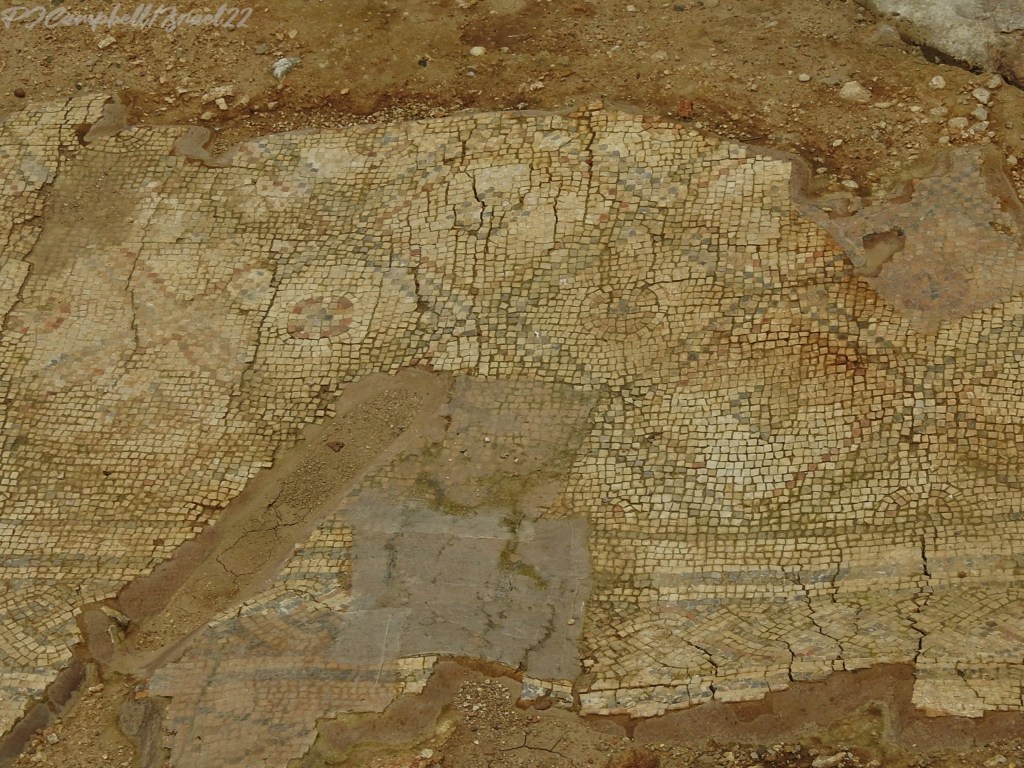
In the 3rd century AD, a Byzantine Church was built over the Temple of Augustus in front of the Cave. This photo is a detail of the floor mosaics from the church. Note the crosses in the circles in the mosaic design.

Sources for Historical Information About Caesarea Philippi:

  1. Caesarea Philippi – Wikipedia
  2. Baal – Wikipedia
  3. Banias River – Wikipedia
  4. Banyas – Archaeology in Israel (jewishmag.co.il)
  5. Banias – Wikipedia
  6. Altar Dedicated to Pan Unearthed in Golan Heights – Archaeology Magazine
  7. Banias Temples – Sanctuary of Pan – BibleWalks 500+ sites
  8. High Places, Altars and the Bamah – Biblical Archaeology Society
  9. Banias Springs – Israel Travel Centre
  10. The Holy Land for Christian Travelers, John A. Beck, 2017, Baker Books, Baker Publishing Group, Grand Rapids, MI, www.bakerbooks.com , USA, Caesarea Philippi, pages 179-181(This book can be purchased on Amazon.com)

ICYMI (In case you missed it) – Previous blogs in the Israel 2022 series:

Israel 2022: Pinch Yourself – April 4, 2022

Israel 2022: Caesarea Maritima – April 11, 2022

Israel 2022: Contested on Mount Carmel – April 20, 2022

Israel 2022: In This Valley – April 30, 2022

Israel 2022: Sea of Galilee – May 9, 2022

Israel 2022: A Very Old Boat – May 31, 2022

Israel 2022: A Blessing & A Curse – Capernaum – June 20, 2022

Israel 2022: One Little Boy Named David – July 5, 2022