Blessings in a Garden

Series: Israel 2022 – Mount of Beatitudes

I come to the garden alone

While the dew is still on the roses

And the voice I hear

Falling on my ear,

The Son of God discloses….6

We have entered a beautiful garden on a hillside on the Korazim Plateau overlooking the Sea of Galilee. There are roses blooming along the walkway, birds flitting among the trees chirping and singing, bees and other pollinators buzzing among the blossoms adding a quiet hum to the peacefulness of the site. Even though it is February, the middle of winter, and there is snow on Mount Hermon to the north, here it feels like spring.
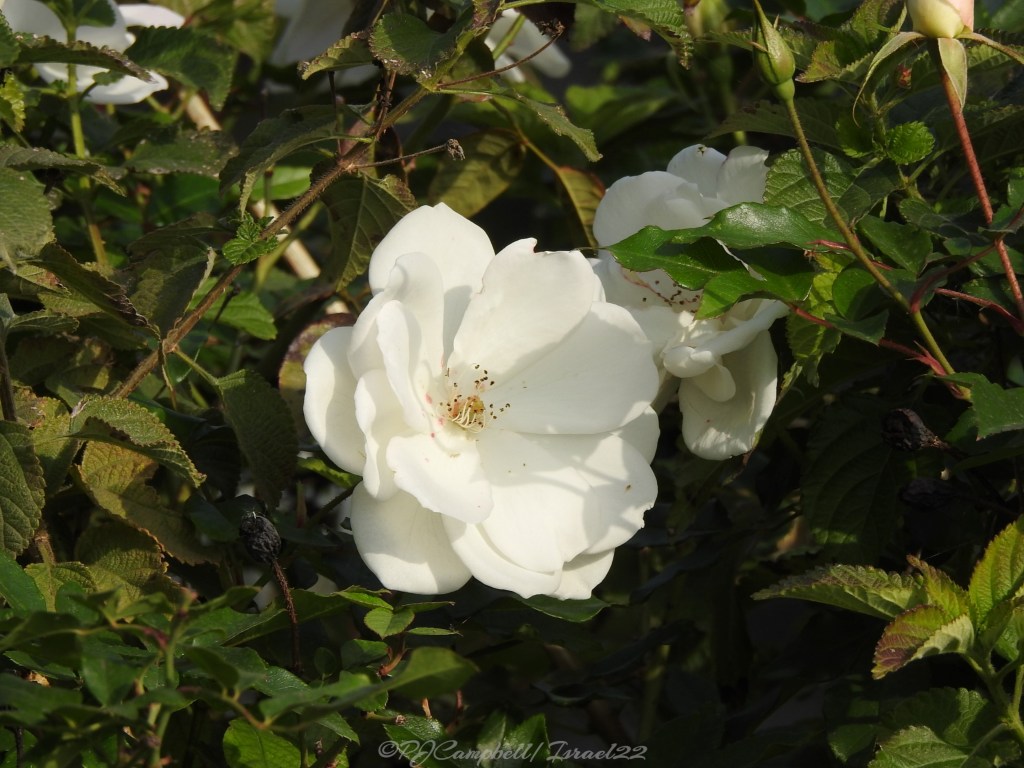
This “mount” we’ve come to is Mount Eremos and Har Ha Osher in Hebrew.1  I suppose it could hardly be called a mountain at all. This “mount” has a negative altitude. It is 200 meters above the Sea of Galilee but still 25 meters below sea level.  Mount Eremos is one of the lowest summits in the world.

The Franciscan chapel that dominates the garden was built in 1937-38 over the ruins of a Byzantine chapel at the site that was used from the 4th through the 7th century.  It was the practice of the early Christian church to build chapels at sites in Israel associated with Jesus and His ministry. Only a few traces of the ancient monastery and cistern remain at the site.1
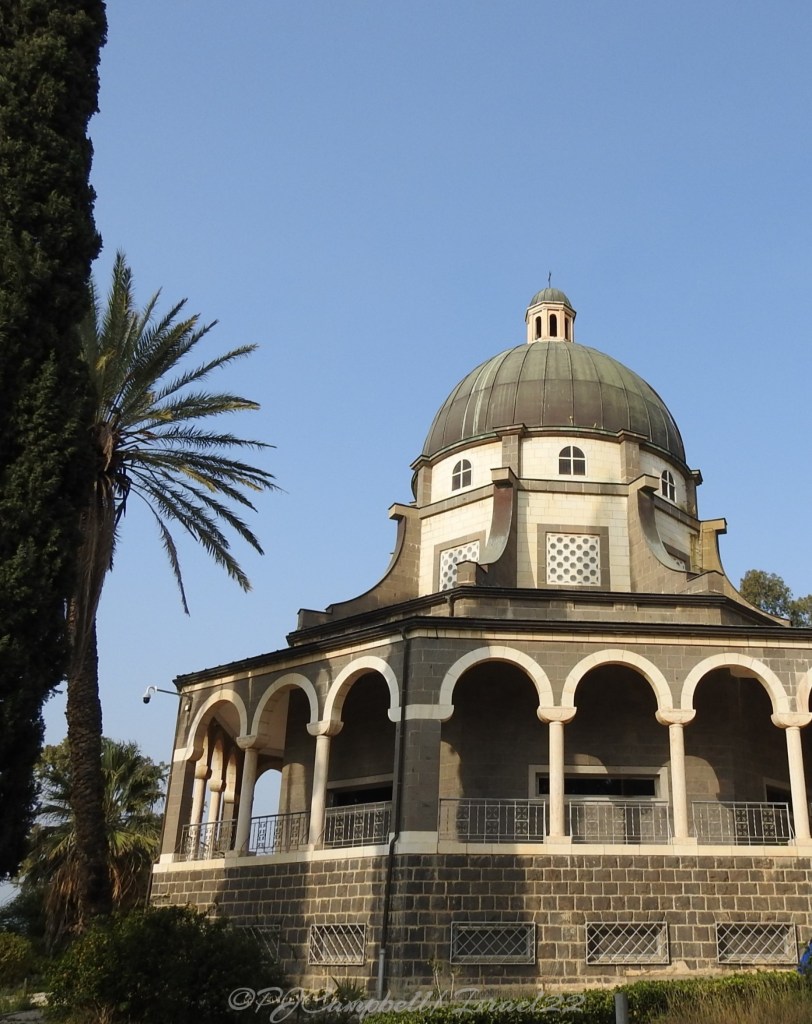
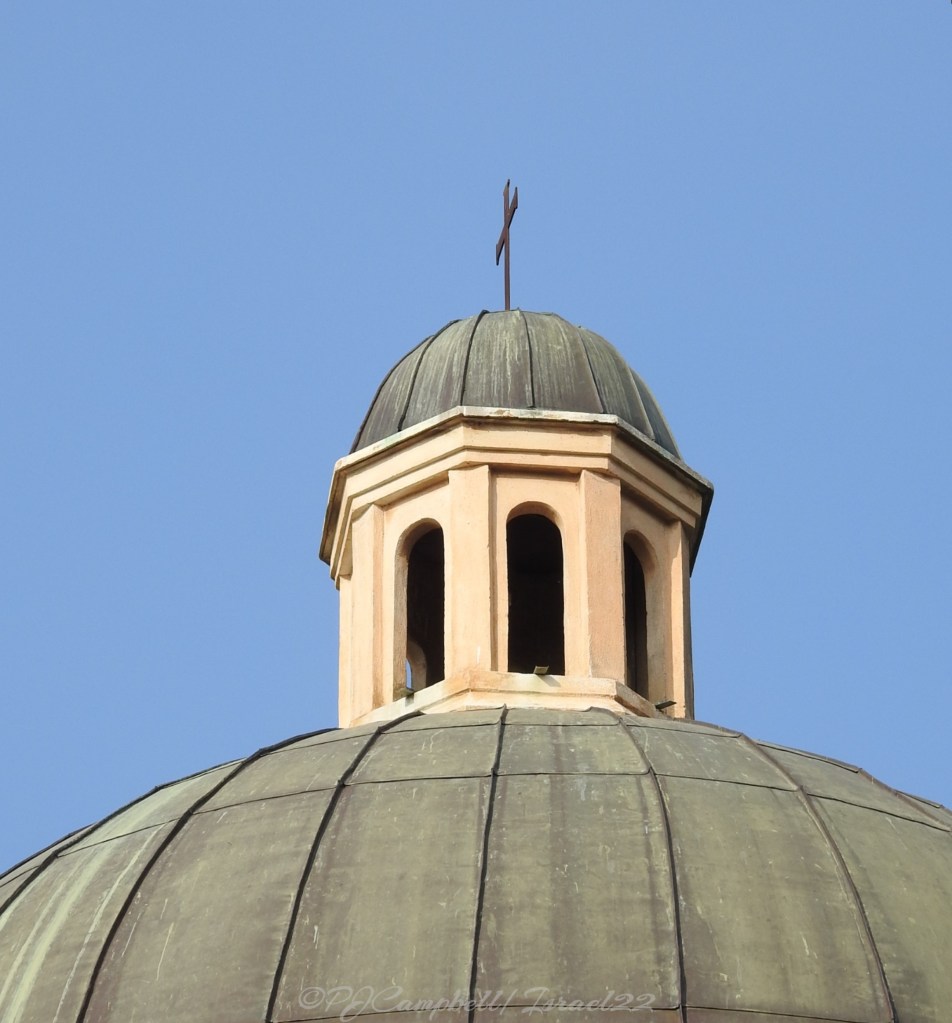
The Franciscan Chapel on the Mount of Beatitudes

The “new” chapel was designed by an Italian named Antonio Barluzzi commissioned by the Italian Mission Society…. with funding from Benito Mussolini…. yes, that Mussolini.2

It is a lovely chapel built with 8 sides in a Neo-Byzantine style. It has marble veneer casing the lower interior walls and includes gold mosaic in the dome over the altar.
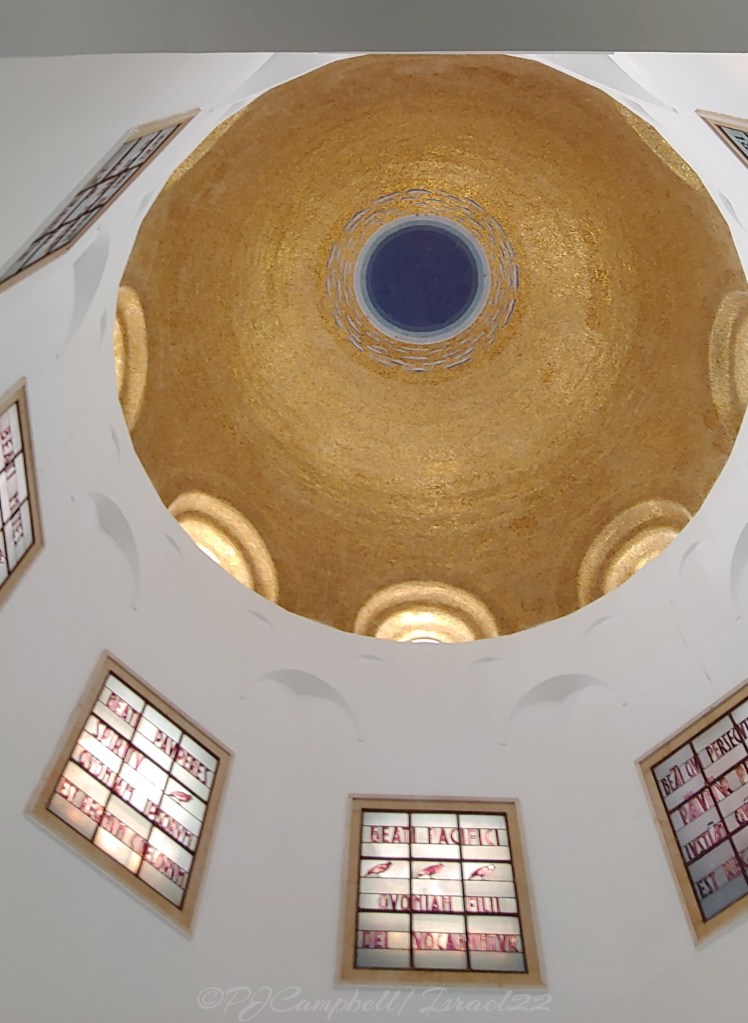
The golden dome inside the chapel.

The floor inside is circular around a central altar and includes mosaics for 7 virtues. Each stained-glass window is dedicated to and shows a single Beatitude written in Latin.2

For this is the Mount of the Beatitudes. While there is a 20th century chapel and garden with views all the way down to the Sea of Galilee, there is very little to identify this hillside as the one where Jesus sat and spoke to his disciples and a multitude of followers some two thousand years ago…nothing at all from the first century to commemorate what is today called “the Sermon on the Mount”.  

The floor mosaics around the altar show 7 virtues
and this one which says, “We adore you, Christ”.

The Sermon on the Mount is detailed in the Gospels, Matthew 5, 6, & 7 and Luke 6. It is the longest single discourse by Jesus memorialized in the Christian Bible. It is probably the most famous and most quoted of all the sermons recorded in the Bible or anywhere else for that matter. These three chapters in Matthew and corresponding chapters in Luke also include the “Lord’s Prayer” which absolutely has to be known by every Christian in the world today. (Okay, maybe the 23rd Psalm would be in the running for most famous and memorized passage, but I think it holds a distant second at best to the Lord’s Prayer.)8

Gateway overlooking the hillside of Mount Eremos

It may also be one of the most mis-quoted and maybe misunderstood passages in scripture. While reading and researching the Beatitudes (in both Matthew and in Luke where some call it the Sermon on the Plain4), I was amazed at how many different interpretations and applications I found. After two thousand years, theologians are still trying to understand what Jesus was saying that day on the hillside where He sat and taught those who followed Him.

At first read, it seems so simple…as is the way with most deeply complicated things. The Beatitudes include 9 blessings that focus on justice, faith, fortitude, hope, temperance, humility, compassion, meekness, charity, peace, and love… of course, love. Did Jesus not always preach love?

Mural inside the chapel showing Jesus teaching His followers.

I have read several translations but the pure poetry of the “blessed” verses in the King James Version (KJV) is what I grew up with and what I tend to remember.

3“Blessed are the poor in spirit,

for theirs is the kingdom of heaven.

4Blessed are those who mourn,

for they will be comforted.

5Blessed are the meek,

for they will inherit the earth.

6Blessed are those who hunger

and thirst for righteousness,

for they will be filled.

7Blessed are the merciful,

for they will be shown mercy.

8Blessed are the pure in heart,

for they will see God.

9Blessed are the peacemakers,

for they will be called sons of God.

10Blessed are those who are persecuted

because of righteousness,

for theirs is the kingdom of heaven.

11Blessed are you when people insult you,

 persecute you, and falsely say all kinds of evil

against you because of Me.

12Rejoice and be glad,

 because great is your reward in heaven;

for in the same way

they persecuted the prophets before you.

Matthew 5

The koine Greek word “makarios” used for Blessed can also mean “happy” or “fulfilled”.7 Some see the Beatitudes as a guide for living for Christians under the New Covenant.  Would that I could follow these tenets and be perfectly happy and fulfilled – perfectly righteous – all on my own! But, alas, I cannot. No one can. That was the point for the Jews in the first century and it is still relevant for all Christians today. You cannot do it on your own – the standard is too high — you need help – you need a Savior.

I walked there, in the garden on the hillside where Jesus (our Savior) might actually have come and sat down to teach this lesson. Scattered throughout the garden amongst the flowers were large plaques showing the Beatitudes in different languages of the world. 

There are other engraved stones about that have a single Beatitude inviting contemplation of just one “blessing” at a time.
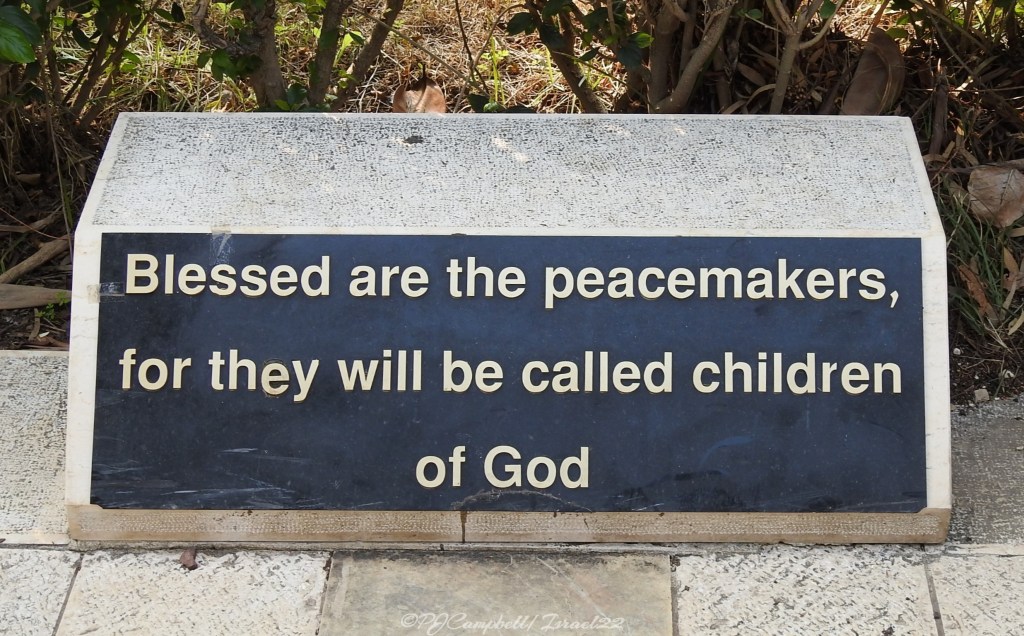
It is a place for meditation, a place to consider those “blessed” words. A place to pray and to talk to God and to listen for that still small voice as God responds.

“And He walks with me, and He talks with me,

And He tells me I am His own,

And the joy we share as we tarry there,

None other, has ever, known!” 5&6

Dr. Bremer from Dallas Theological Seminary (DTS) teaches at the Mount of the Beatitudes.

Scriptural Sources:

  1. Matthew 5:3-12
  2. Luke 6:20-23

Sources and References:

  1. Mount of Beatitudes – Wikipedia
  2. Church of the Beatitudes – Wikipedia
  3. New Testament places associated with Jesus – Wikipedia
  4. Ministry of Jesus – Wikipedia
  5. In The Garden – Lyrics, Hymn Meaning and Story (godtube.com)
  6. In the Garden, C Austin Miles, 1912 (Public Domain)
  7. Strong’s Concordance 3107, Interlinear Bible, Greek – “makarios”, Helps Word Studies 3107
  8. Sermon on the Mount – Wikipedia
  9. The Holy Land for Christian Travelers, John A. Beck, 2017, Baker Books, Baker Publishing Group, Grand Rapids, MI, www.bakerbooks.com , USA, Mount of the Beatitudes, p218 (This book can be purchased on Amazon.com)

ICYMI (In case you missed it) – Previous blogs in the Israel 2022 series:

Israel 2022: Pinch Yourself – April 4, 2022

Israel 2022: Caesarea Maritima – April 11, 2022

Israel 2022: Contested on Mount Carmel – April 20, 2022

Israel 2022: In This Valley – April 30, 2022

Israel 2022: Sea of Galilee – May 9, 2022

Israel 2022: A Very Old Boat – May 31, 2022

Israel 2022: A Blessing & A Curse – Capernaum – June 20, 2022

Israel 2022: One Little Boy Named David – July 5, 2022

Israel 2022: The Gates of Hell – July 23, 2022

A Blessing & A Curse – Capernaum

Series: Israel 2022 – Continuing our adventures in Israel in Feb/Mar 2022

Jesus chose a sleepy fishing village on the Sea of Galilee as the central location for his ministry. Not much there really…. then or now.  The town itself was established by the Hasmoneans in the 2nd century before Christ was born (BC or Before the Common Era, BCE, if you prefer) and lasted until sometime in the 11th century after His death (AD or CE) when it was abandoned after a second major earthquake.1 (The first major earthquake was on January 18, 749 AD and destroyed much of the surrounding cities and towns. That very precise date comes from Wikipedia. The second major earthquake which resulted in Capernaum being abandoned was about 1049 AD – they weren’t so sure on the date here.4)

Well, I suppose in terms of the history of this country (USA), more than 1300 years would be quite something for a town, but in terms of Israel and the ancient near east, it wasn’t such a long span of time at all.  Even though it lasted many years, I think (IMHO – In My Humble Opinion) Capernaum’s heyday and time of great fame had to have been those few short years when Jesus was teaching there, healing the sick, and casting out demons in the name of God, the Father.  It was only about three years but, make no mistake, He did quite a bit of healing in that short time with crowds following Him day and maybe even night all over the place…sometimes just to get a glimpse of Him or sometimes just to touch the hem of his robes.

Ancient olive press – a reminder of the passage at Luke 17:2 – “It were better for him that a millstone were hanged about his neck, and he cast into the sea, than that he should offend one of these little ones.”

At one point, Jesus fed 5000 men (not counting the women and children) and at another 4000. (Matthew 14:17-21 and Matthew 15:4-39) Whether you believe (like I do) that He did this with just a few fish and loaves of bread is one thing…. the fact that so many could be fed at all is pretty miraculous. Ask any caterer how much preparation goes into feeding a couple hundred tired hungry people, let alone 5000 plus, on short notice!  Twelve apostles passed out food and gathered the leftovers in baskets…. consider how many wait-staff a caterer would need to serve 4-5000 people!

View of the Franciscan Monastery from the ruins.

But, notwithstanding any of that, Capernaum, “the village of comfort”, was estimated to have had about 1500 people living there at the time of Christ. It is amazing to think of the population being increased by 5000+ people for even a short period of time. That’s quite a boost in population that would strain on the local economy for any small town. But it is recorded in the scriptures that they came and kept coming. They came to see this new teacher, to hear His words, and to be healed…. both physically and spiritually….and many became His disciples.  

We also came to this place…. to see the ruins of this village that is mentioned so prominently in the four Gospels of the New Testament.  Not only did Jesus adopt this town as His own (Matthew 9:1), but it was also the place where He called Peter, Andrew, James, John, (Matthew 4:18-20) and, later, Matthew to come and follow Him. He promised the four fishermen that He would make them “fishers of men” (Matthew 4:19 and Mark 1:17) and He did.  Five of the twelve apostles coming from one small village is also quite amazing to me.

The large wall in the background was built by the Franciscans in the 1800’s to protect the site from treasure hunters seeking gold and from developers looking for building materials.

Capernaum wasn’t what I had expected.  I’m not really sure what I expected at this point. Israel so far had been so much more than I had thought it would be. And I was finding that, the more I saw, and the more I learned about this land and its relationship with God, the more I wanted to know. This feeling has stuck with me, and I find myself doing more and more research as I go through my photos and work on these blogs.  As my mama would say, Israel has sorta gotten stuck in my craw and I gotta keep working at it until I get it all figured out.

The ruins of Capernaum (Kfar Nahum to the Romans) were excavated as part of Tel Ham (Arabic Talhum)1. From the 11th century until the 19th century, it had been lost.  There was tradition and stories about where it was but no archaeological evidence.

Briefly, in a nutshell:

1838    Synagogue Ruins found by Edward Robinson

1866    Site was finally identified as being Capernaum by Charles William Wilson

1894    Site was purchased by a Franciscan Friar, Giuseppe Baldi, Naples

1905    Study of the synagogue & an ancient octagonal church nearby begun by Heinrich Kohl & Carl Watzinger

1968    The apostle Peter’s house was discovered by Virgilio Corbo and Stanislao Loffreda1

Peter’s house – that’s what I really wanted to see. I had no idea there was a synagogue there that was important. Maybe I could have assumed that there would be a synagogue in a Jewish town, but it had not really crossed my mind to think about it. (Of course, now, having been to Israel, I would certainly realize that every town of any size would have a synagogue.)

As you enter the compound, you first pass a Franciscan monastery on site and then move into the ancient ruins. The first thing you see is the modern church/training center that looks like a gigantic flying saucer come to roost on top of the ruins. It was built in 1990 1. Not that I want to offend anyone, I really have to ask “why?”  Why build right on top of the ruins? I didn’t particularly like contrast of the ultra-modern building hovering over the ancient ruins and I really didn’t like that it covered the very thing I wanted to see! I understand that there is a glass floor and that you can sit and contemplate the ruins underneath looking through the floor (if the building is open to visitors). That really doesn’t change my opinion.

The Franciscan Church/Training Center located just over the ruins of “Peter’s House” in Capernaum. Doesn’t it look a bit like a spaceship?

The ruin that has been identified as Peter’s house from the 1st century is there – under the building. Here’s what tradition and some of the archaeology cites say about the site.  Peter lived there at the time of Jesus who may or may not have stayed with Peter when He [Jesus] was in Capernaum. We know from scripture that Jesus healed Peter’s mother-in-law at home (Matthew 8:14), and it has been assumed that she was at Peter’s house at the time. Sometime, in the latter part of the 1st century AD, the house became what is referred to as a “domus ecclesia”, i.e., house-church 1. It was no longer used for living quarters but was used for worship 2. It was known traditionally as Peter’s home where Jesus stayed, and early Christians went there to worship. In the 4th century, an octagonal basilica was built over the main room of the “house” and, later, in the 5th century, that smaller basilica was dismantled and replaced by a larger octagonal basilica 1&2. It is believed that the two octagonal churches were built over Peter’s house to preserve and memorialize the site. The octagonal church was known to medieval travelers & pilgrims who visited the area 2.

Inscription on a statue of Peter by the Franciscan monastery.

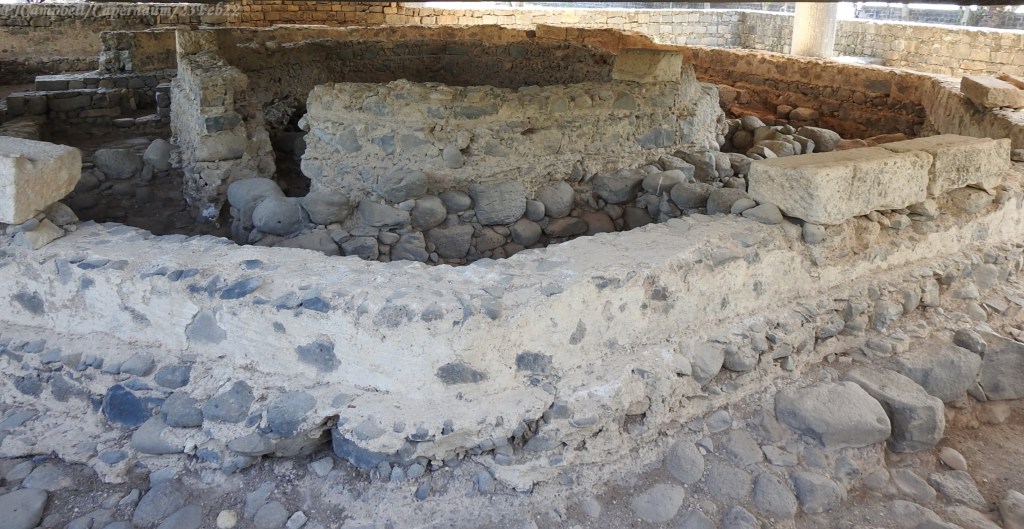
When Peter lived in the house (if he did – I’m still a bit skeptical), it was made of rough basalt stone which is plentiful in the area with a roof made of wooden poles covered with thatch. It is referred to by the Franciscans as “sacra insula” or “holy insula” described as a block of rooms around a central courtyard. 1 When the “house” became a “church”, it was upgraded to have plaster on the walls of the larger main room and a more permanent roof and floor was added. The plastered walls in the main room were decorated with mosaics.  And there is graffiti – some crosses – a even a prayer or two, “Lord Jesus Christ help thy servant” and “Christ have mercy2.

But, of course, I couldn’t see any of that.  The archaeologists who excavated the site reported it, but I couldn’t see anything that even looked like a house or a church or anything…. just what looked like roughly made rock walls up under that big memorial disk. The trouble with ruins is that you only have bits and pieces, so you really have to use your imagination.

As close as I could get to the ruins identified as Peter’s House (the roundish ruins in the center). Note the octagonal walls of the two basilicas built over it.

In my photos, I can see that the walls form an octagon, and I can see a smaller octagon inside and a circular wall (room?) inside that although I could not see all the sides of the octagon from where I stood.  There is a better photo in Wikipedia that shows the site without obstruction which must have been taken prior to the construction of the memorial disk-shaped building on top. 6

So, is that Peter’s house? I don’t know. There does seem to be quite a bit of circumstantial evidence that the house that was covered/marked by those two octagonal basilicas was an important place for the early Christians. And Peter did live somewhere in Capernaum, so I suppose the possibility is good that Peter lived in that house and Jesus visited Peter’s house while at Capernaum.

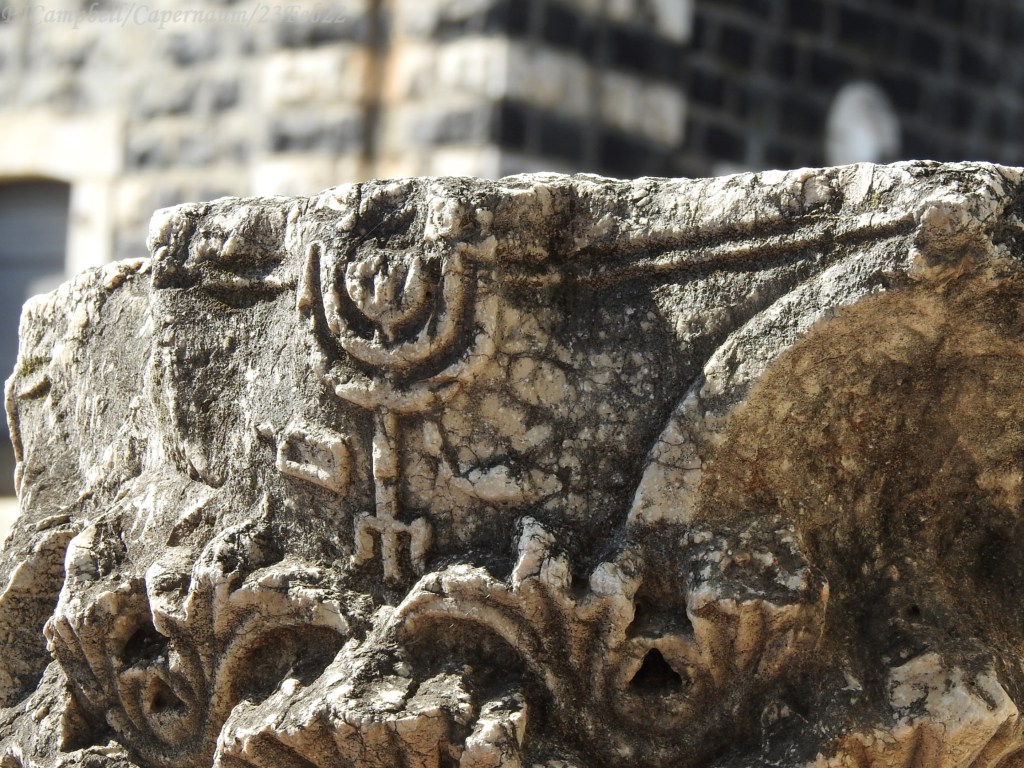
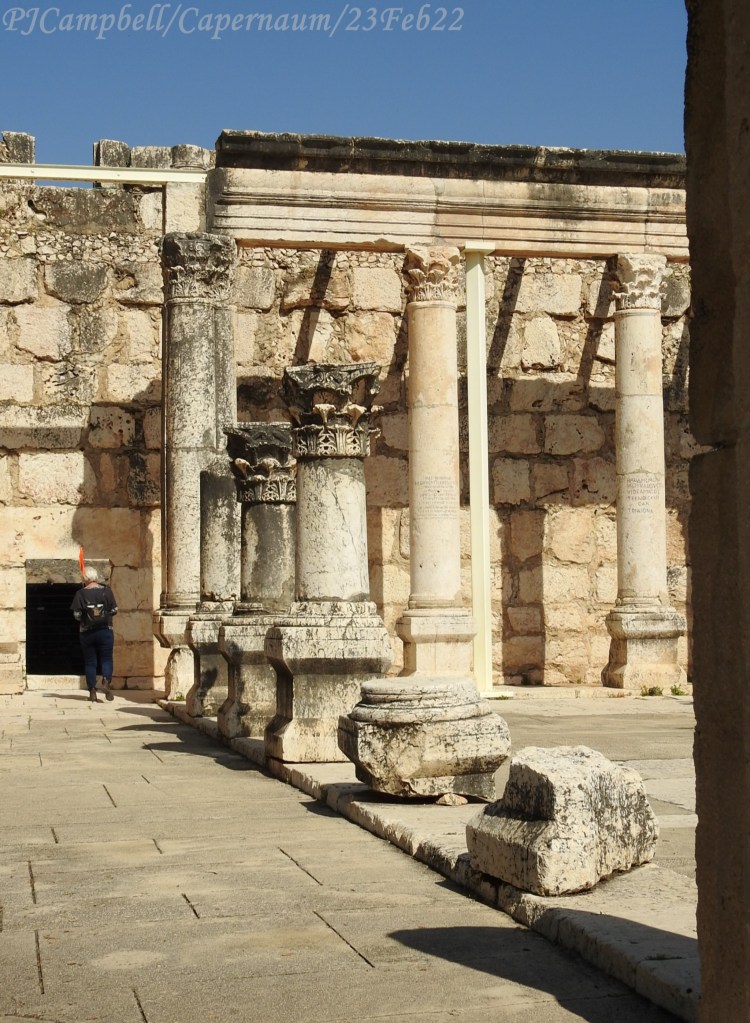
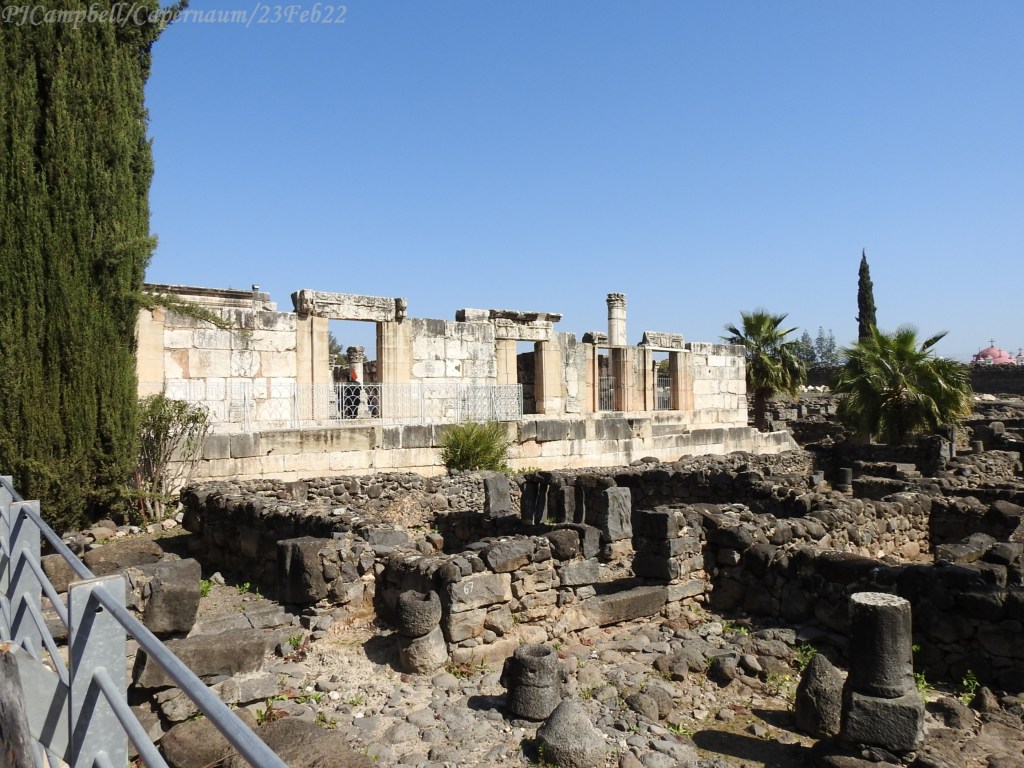
Now, about The synagogue. The ruins are beautiful, and you can clearly see that it was an important building in town and a place of worship for the Jewish people. While the rest of the town was seemingly built of the black basalt, the synagogue was built of limestone brought in from a quarry possibly at Taybeh1. Odd, maybe, but not unusual for a prominent and special building in a village or town.

Inside the synagogue ruins.

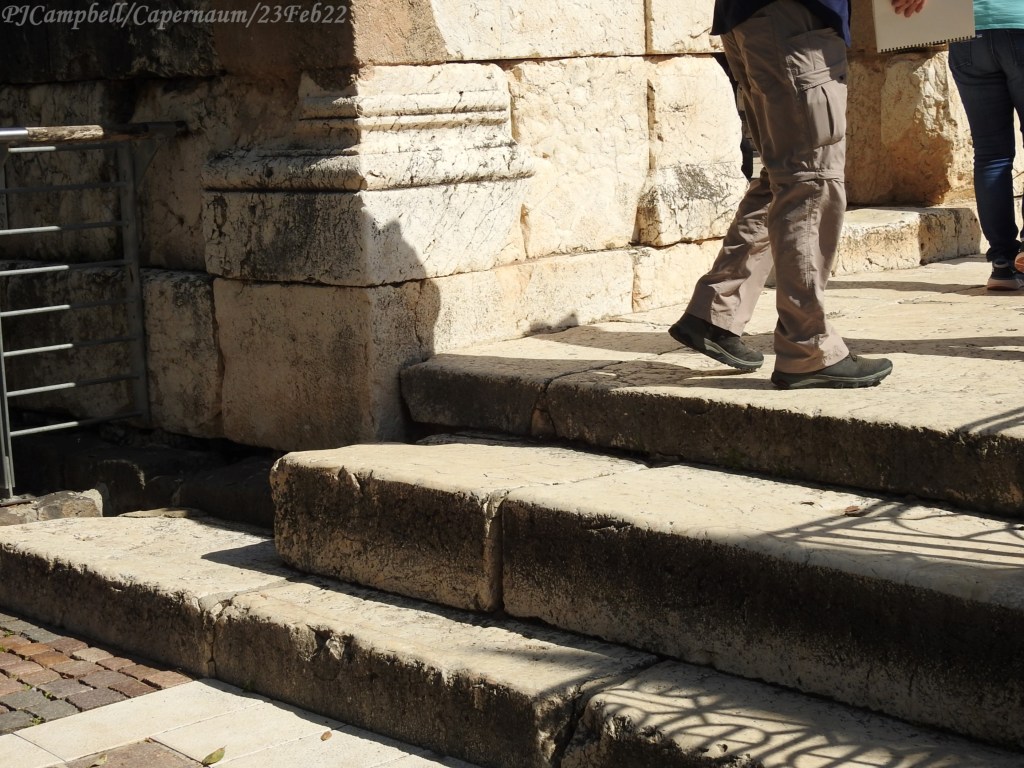
The synagogue was built on a platform that raised it up higher than the rest of the town as was the Jewish tradition. One would have to enter using several steps on the southwest & southeast corners of the building. The synagogue included a prayer hall with a nave and two columned aisles. There are two rows of stone benches that would have been for the elders. There was also a school room to the eastern side.2

The steps to the synagogue on the southwest corner. The steps are thought to be the oldest part of the synagogue.

Was this the synagogue that Luke 7.5 tells us was built by the centurion who admired the Jews living there in Capernaum…the same centurion who asked Jesus to heal his servant? Turns out, it is not. This synagogue was built in the 4th century AD so was definitely not a place where Jesus would have taught. But, then again, turns out, this synagogue was built on top of another more ancient synagogue (as is the habit to build the new over the old) that was made of black basalt and has been dated back to the 1st century. That original ancient synagogue of black basalt is more likely to be the one that Jesus knew2.

The synagogue viewed from the side/just to the north of Peter’s house. Note the homes are made of basalt stone that is dry-stacked or without mortar which was typical of the 1st century AD. Also, note the contrast with the walls of the synagogue which is made of limestone and from about the 4th century AD.

The excavation continues at Capernaum and, no doubt, more things will be learned as the site is explored. Part of the site is owned by the Eastern Orthodox Church just over the wall built to enclose the Franciscan part. The part of the city owned by the Eastern Orthodox Church has not been excavated. Who knows what may be found there if it is ever excavated? Maybe more proof will be discovered that the house under/within the octagonal walls really was the house of Peter. Maybe more will be discovered in the synagogue that points back to Jesus. We know from scripture that Jesus was there along with Peter, James, John, and Matthew…and the rest of his disciples. And we know that many people followed Him there looking for the promised Messiah.

However, notwithstanding all the miracles and the amazing sermons, the overall populace (priests? Pharisees? officials?) of Capernaum did not believe. In the end, Jesus cursed Capernaum for its unbelief. Matthew 11:23 states that Jesus said that Capernaum would be thrown down to Hades. A village that was blessed by the presence of God in the beginning only to be cursed by Him in the end.

Sculpture in the Garden at Capernaum. It was referred to as the “Homeless Jesus”.

Scriptural Sources – As shown throughout the text.

Sources for Historical Information:

  1. Capernaum – Wikipedia
  2. Top Ten Biblical Archaeological Discoveries, © 2011 Biblical Archaeology Society 4710 41st Street, NW Washington, DC 20016 www.biblicalarchaeology.or ,  pages 68-84. (This is a free e-book available at the link shown above.)
  3. Hasmonean dynasty – Wikipedia
  4. 749 Galilee earthquake – Wikipedia
  5. New Testament places associated with Jesus – Wikipedia
  6. https://commons.wikimedia.org/w/index.php?curid=743768 (Credit for photo from Google)
  7. www.bakerbooks.com , USA, Capernaum, pages 185-189
  8. Saint Peter – Wikipedia