
“Would you like to go inside?”
“Well….ye-ah! Absolutely, I would.”
The gentleman had asked the question as he walked over to me from the picnic pavilion where he had been manning the money table at a church yard sale that was going on that beautiful autumn day. I had been walking around taking pictures of the old stone church trying my best to get a shot that didn’t include the cars and trucks that filled the parking lot. Guess he had noticed and thought to see if I’d be interested in a “tour”.
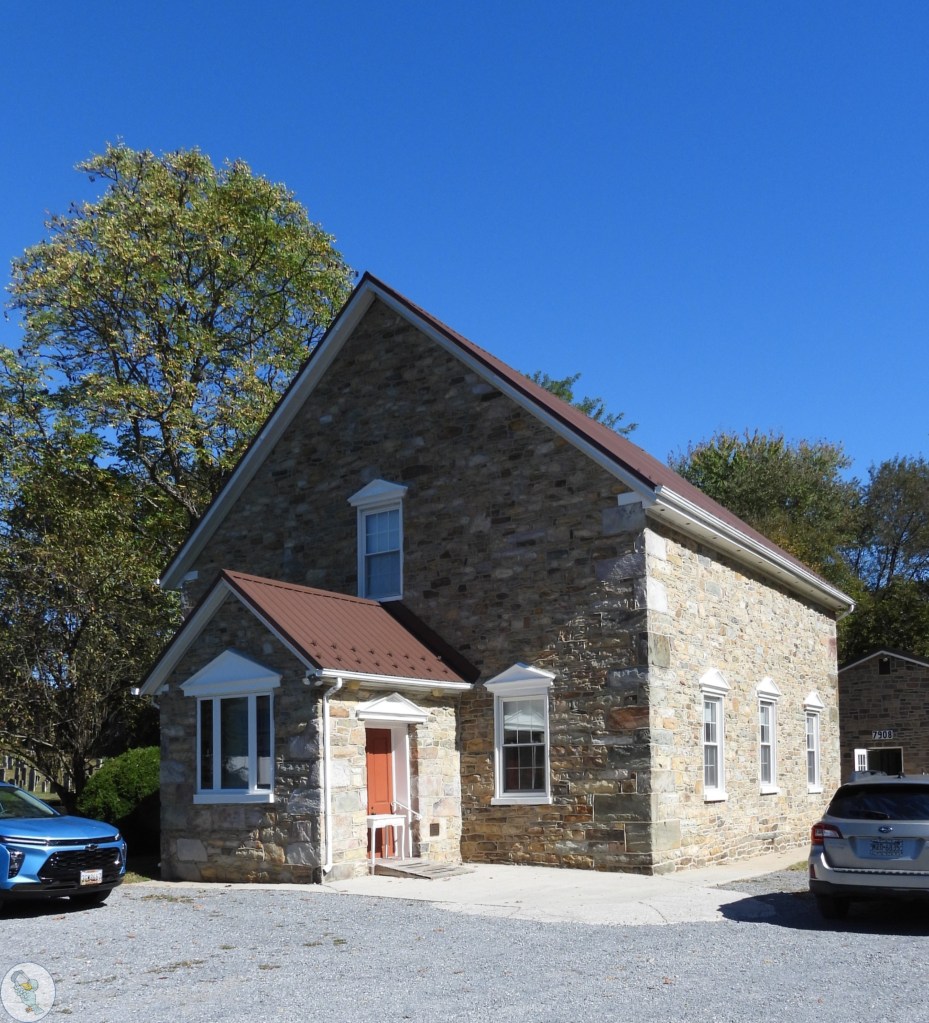
Of course, I wanted to go inside of the church, and I promptly told him so. Rarely do I get an opportunity to go inside the old churches that we spot when we’re out roaming around. Usually, I’m lucky if I get a good window low enough to let me peek inside and maybe take a few grainy photos of whatever happens to be in view of the window.
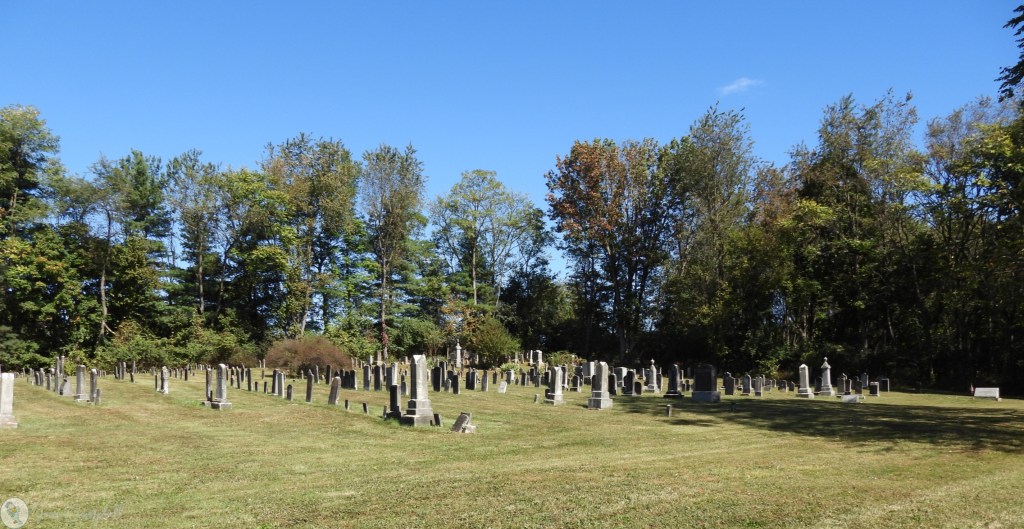
Includes graves from both Revolutionary & Civil Wars
We would never have found this church by chance for it was a bit outside our planned adventure for that day. We’d driven up to Pryor’s Orchard on our annual quest for apples straight from the orchard with our friend, Inez, who’d started us on this annual fall roadtrip some ten years ago. So, in all those ten years of roaming around the area, we’d never even gotten close to this little stone church. Seriously, how would anyone have guessed that we would find Apples Church of Christ on Apples Church Road?
Like many things, we found it because we were looking for something else. Isn’t that always the way it is? We had been at the orchard inspecting the apples, sweet potatoes, squash, honey, beets, and other goodies for sale when I had eaves-dropped on another conversation and heard the proprietor telling a customer about the freshly homemade fried apple pies that you could buy over at the church. That’s all I needed to hear!

This was all a part of a big annual apple festival being held in Thurmont later that weekend. Thank goodness we were a few days early and didn’t run into the hundreds of people who would visit the town for the festival. On the other hand, we weren’t so early that we’d miss out on all the yard sales that would be going on before, during, and after the festival. AND part of that would be a church that was raising funds with a yard sale of their own that included freshly baked goods, i.e., fried apple pies. So, yes, you know that is exactly where we headed – as fast as our GPS could get us there.

Alas, we were not fast enough and got there just a little too late – the last pies had just been sold. (Yes, I am betting those ladies over at the orchard had gotten there ahead of us and bought up all the pies!). But there were consolation prizes – homemade cookies, lots of donated goods to buy, and a beautiful old stone church to explore. And you all know how much I love old churches!
Apples Church – how awesome that we find Apples Church on a day we are out buying apples! Okay. Interestingly enough, when I checked the history of the old church, it appears that it might have been named after the original landowner – one Peter Apfel – who donated an acre of land to the community for a schoolhouse on March 19, 17602 that eventually became the church. While Thurmont, Maryland includes quite a few apple orchards today, there might have been very few in the 1700s when early settlers came from southern Germany to this part of Maryland. An anglicized version of the landowner’s name is, of course, Apple. So, the church (and the road) was probably named after him and not named after the fruit at all.
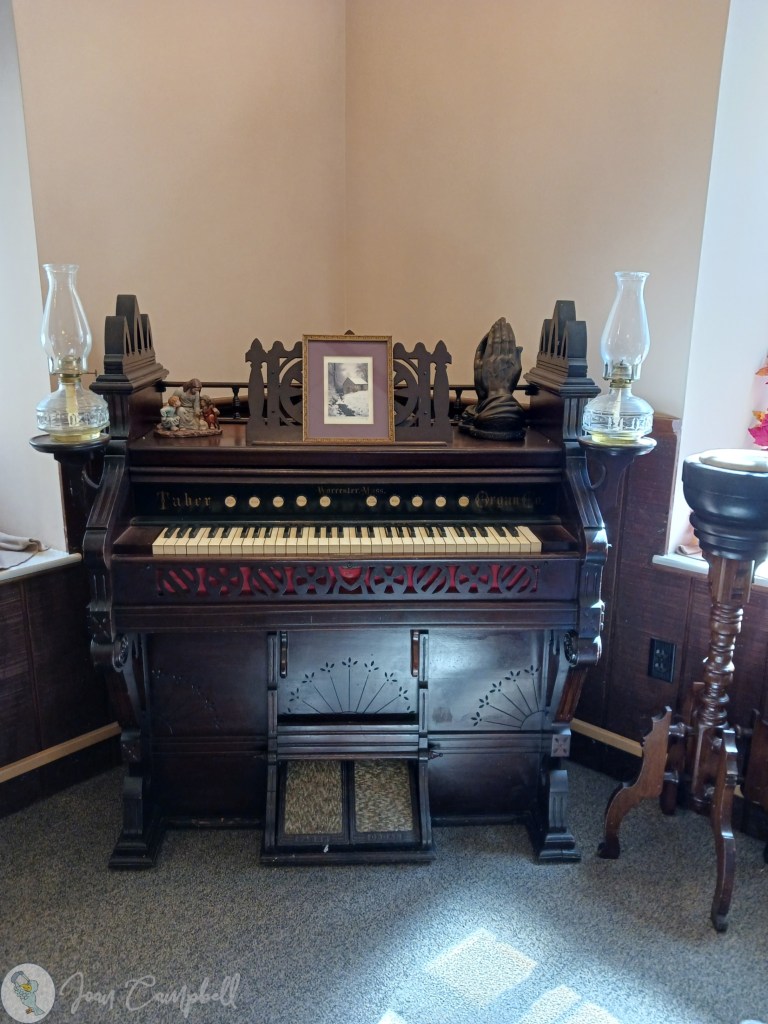
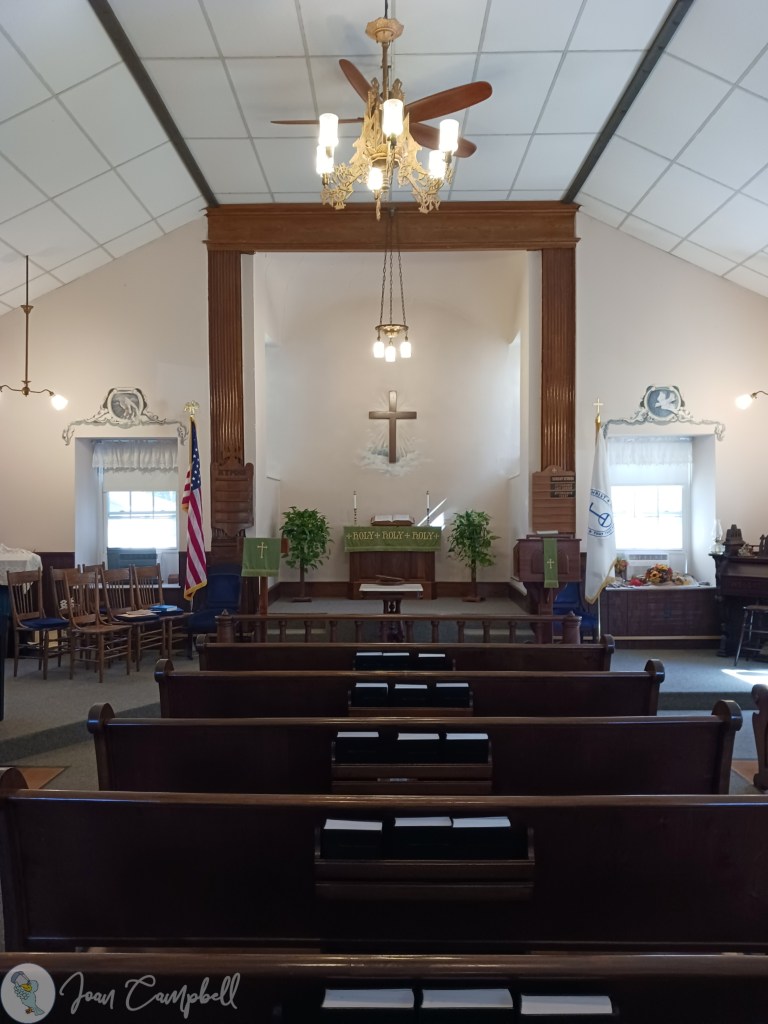
As we entered the church, I was struck by its simplicity which enhances the feeling of serenity and beauty that fills the sanctuary. It seems that all churches are filled with that quiet peacefulness, but I find that the older the church, the more I sense the holiness of the place. It is as if all the prayers prayed, hymns sung, and sermons preached have imbued the very stones of the building with the essence of the souls who worshipped here over the centuries. When I enter old churches, I am always reminded of God warning Moses to remove his shoes as he was standing on holy ground. (Exodus 3:5). Invariably, I find myself lowering my voice to a whisper, pausing to reflect and just slowing down a bit to allow time to fully appreciate the beauty and sacredness of the church.

Our “guide”, Mike, gave us an overview of the history of the church from its beginning as a log building in 1765 to its upgrade to a stone church in 1826 at a whopping cost of $13061 with most of the work being completed by members of the congregation. The original stone church was a taller structure with galleries, tiered windows, a high wine-glass shaped pulpit1, and wooden pews serving both the Lutherans and the Reformed congregants in the area. When it was remodeled in 1912, the galleries were removed, and the overall structure was lowered to its present height1. Finally, in 1980, the interior was updated to be more energy efficient and comfortable for the parishioners1.

The overall church structure is unusual to me in that there is no steeple or bell tower – just a modest one room sanctuary with a smaller entryway. It reminds me very much of Shaker meeting houses on the outside although the interior is very much the more usual Christian church. A separate “education” building was built in 1965 at the back of the church, but it is more modern so was not connected to the original stone building to preserve the historical aspects of the main church. I read from the history that both the log church and the stone church included a gun storage corner at the back of the sanctuary1&2…. civilization had not yet arrived in this part of Maryland (and some would say, it still hasn’t).
Apples Church seems to have started small and pretty much stayed that way over time. Although, the building of the stone church was initiated to accommodate a growing congregation, the history shows that many of the pastors were “circuit riders” and served more than one church in the region at the time perhaps coming to Apples Church once a month or on alternate Sundays. The Lutheran part of the congregation moved over to a new church in Mechanicstown in 1857. Then the Reformed congregation moved over to Trinity Church in 1880 leaving Apples with very few remaining congregants1.
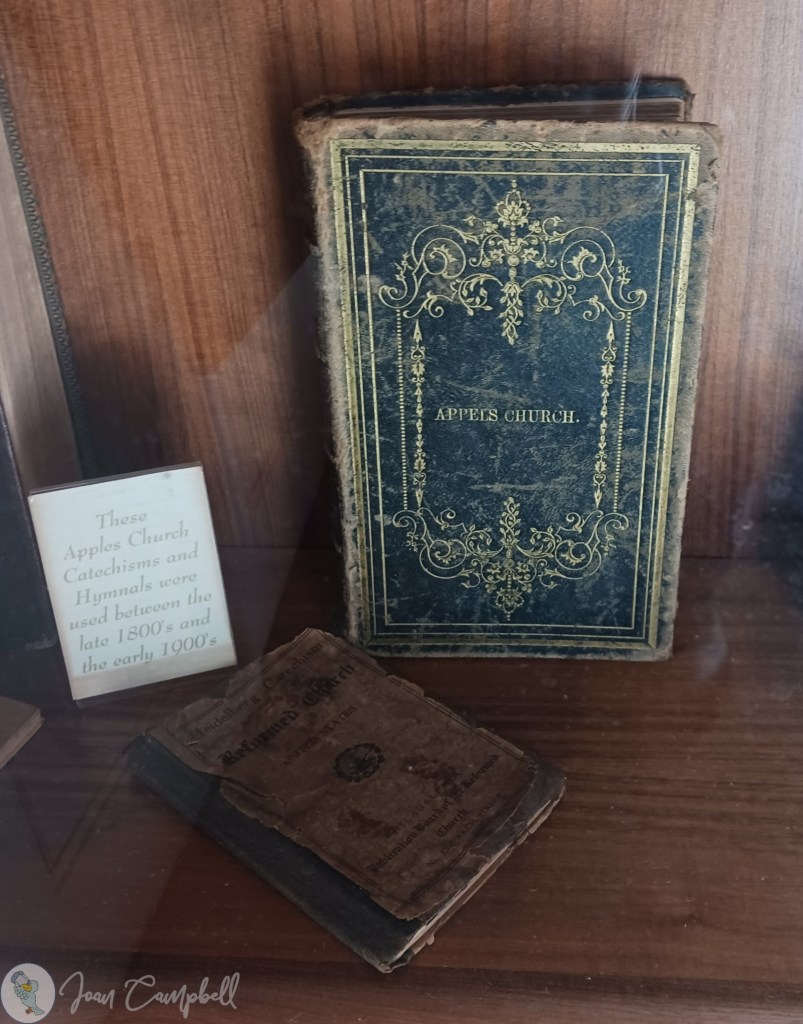
The little stone church was pretty much abandoned for about five years until 1885 when thirty-five former members signed a petition pledging $80 a year towards the salary for a minister to re-establish the church2. If you do the math, 35 times $80, it comes to $2800 per year. I’m not sure if that was the extent of the salary promised to a minister…maybe the United Church of Christ (UCC) added a share…. but it worked out and Apples Church has held services (for the most part) ever since that time. During the period from 1885 to 1980, Trinity Church provided pastors on alternate Sundays to Apples Church. The last full-time pastor was Beth Firme who served the congregation from August 23, 2021 to May 26, 20242. Since that time, the church has been served by Lay Personnel and Pulpit Support from other churches.
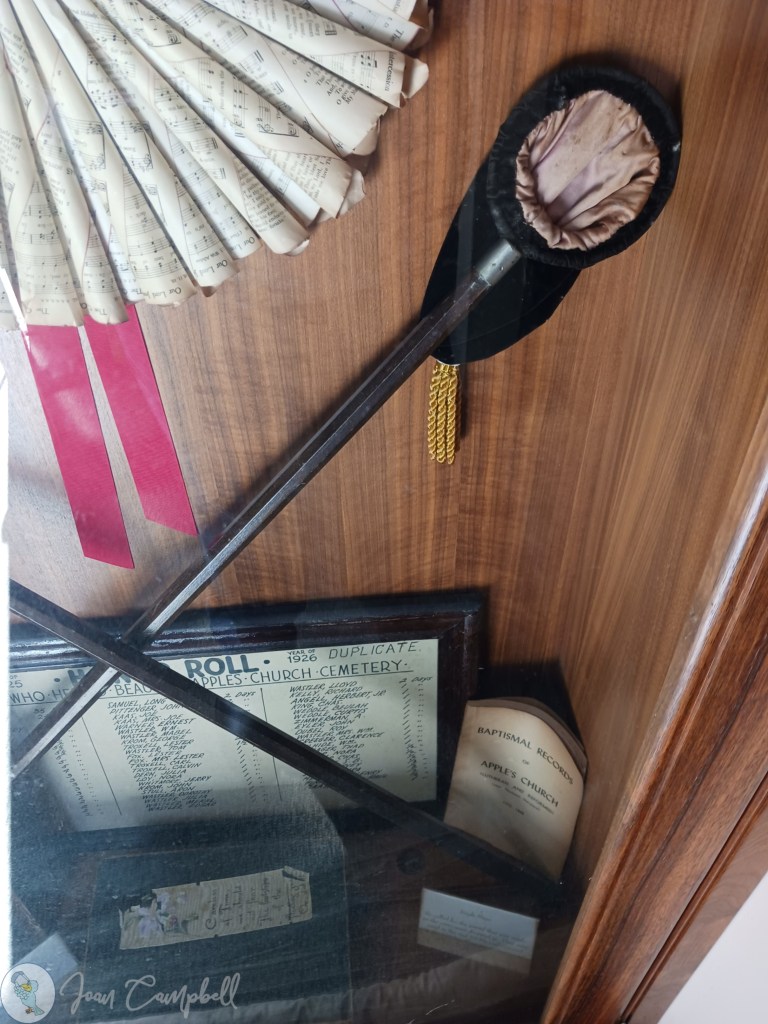
Mike, who graciously showed us around, was every bit the proud and faithful servant of the church. He seemed sad that the congregation was small and its members mostly older – a faithful few who continued to come for Sunday morning services no matter what – but he was optimistic that the congregation could still grow and he prayed that a new pastor would come and bring new life to the church.
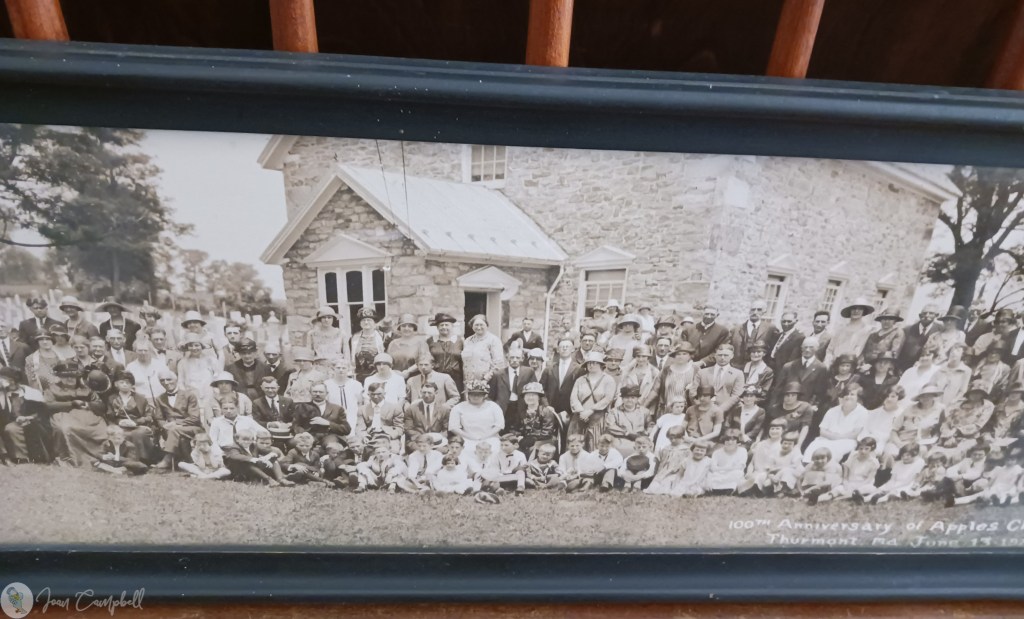
“We pride ourselves as a congregation-powered group.”1
As is our custom when we visit old churches, before we left, we paused to say a prayer for the church and its small congregation, that God would send a new pastor, and the congregation would be blessed for many years to come.
As for me, well…..I never did get a “clean” photo of the church since the yard sale was a pretty big deal and the parking lot stayed full the whole time we were there…but blessings come in many forms and spending a little time in the old stone church and hearing about it from someone who loves it was blessing enough…..not to mention the three small bags of homemade cookies that I bought at the yard sale.
Sources for Historical Information:





 Birding Boomers